AQA · GCSE · Combined Science
Course version: 8464 · Version from Sept 2018
Explain the importance of the carbon and water cycles to living organisms.
Full specification wording
How materials are cycled: explain the importance of the carbon and water cycles to living organisms.
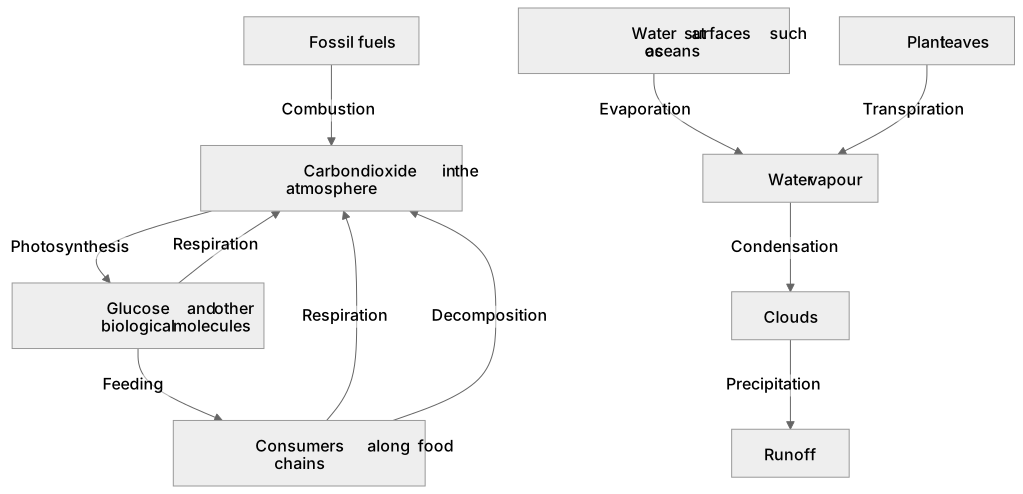
The carbon cycle moves carbon between the atmosphere, living organisms, oceans and fossil fuels.
Checked against the AQA 8464 specification (opens in a new tab) on .
- Point 2 of 6
- 4 key terms
Study notes
From the checked teaching notes for this specification point.
The idea
The carbon cycle moves carbon between the atmosphere, living organisms, oceans and fossil fuels. Photosynthesis removes carbon dioxide from the air and builds it into glucose and other biological molecules; respiration in plants, animals and microorganisms releases carbon dioxide; feeding passes carbon along food chains; decomposition and combustion also return carbon dioxide to the atmosphere. Carbon is essential because it forms the backbone of carbohydrates, proteins, lipids and DNA. The water cycle moves water by evaporation, transpiration, condensation, precipitation and runoff. Water is vital as a solvent for reactions, for transport in blood and xylem, for temperature control and as a reactant in photosynthesis. Both cycles keep supplies available to organisms, so disruption, such as deforestation or drought, can limit growth and survival.
What earns the marks
- State that carbon is a component of carbohydrates, proteins, lipids and DNA, so it is needed to build living cells.
- Describe how photosynthesis removes carbon dioxide from the atmosphere and how respiration returns it.
- Explain that feeding transfers carbon from producers to consumers, and that decomposition and combustion release carbon dioxide.
- State that water is a solvent for metabolic reactions and is used in transport in organisms, for example in blood plasma and xylem.
- Describe the water cycle processes of evaporation, transpiration, condensation, precipitation and runoff.
- Explain that water is a reactant in photosynthesis and helps organisms control temperature.
- Link disruption of either cycle, such as drought or burning fossil fuels, to effects on living organisms.
Common mistakes and how to put them right
Saying plants take in carbon dioxide only for respiration.
Put it right: Plants absorb carbon dioxide for photosynthesis and release it during respiration.
Confusing evaporation with transpiration.
Put it right: Evaporation is loss of water from surfaces such as oceans; transpiration is loss of water vapour from plant leaves.
Claiming the water cycle creates new water.
Put it right: The same water is recycled through evaporation, condensation and precipitation.
Exam tips
- Name the process responsible for each transfer, such as photosynthesis, respiration, evaporation or condensation.
- For 'importance' questions, state what the material is used for in organisms, not just where it moves.
- Use a named organism or habitat to make each explanation concrete.
Try the lesson
The start of the How materials are cycled: explain the importance of the carbon and water cycles to living organisms. lesson, made from checked teaching notes for this specification point.
Have a go first
Why is the continuous cycling of carbon in an ecosystem essential for the survival of living organisms?
Listen
The carbon cycle moves carbon between the atmosphere, living organisms, oceans and fossil fuels. Photosynthesis removes carbon dioxide from the air and builds it into glucose and other biological molecules; respiration in plants, animals and microorganisms releases carbon dioxide; feeding passes carbon along food chains; decomposition and combustion also return carbon dioxide to the atmosphere. Carbon is essential because it forms the backbone of carbohydrates, proteins, lipids and DNA. The water cycle moves water by evaporation, transpiration, condensation, precipitation and runoff. Water is vital as a solvent for reactions, for transport in blood and xylem, for temperature control and as a reactant in photosynthesis. Both cycles keep supplies available to organisms, so disruption, such as deforestation or drought, can limit growth and survival. A strong answer earns marks for these points. State that carbon is a component of carbohydrates, proteins, lipids and DNA, so it is needed to build living cells. Describe how photosynthesis removes carbon dioxide from the atmosphere and how respiration returns it. Explain that feeding transfers carbon from producers to consumers, and that decomposition and combustion release carbon dioxide. State that water is a solvent for metabolic reactions and is used in transport in organisms, for example in blood plasma and xylem. A common slip: Saying plants take in carbon dioxide only for respiration. Instead, plants absorb carbon dioxide for photosynthesis and release it during respiration. Exam tip: Name the process responsible for each transfer, such as photosynthesis, respiration, evaporation or condensation.
See it
Key words
Say what each word means before you turn the card.
Carbon as the basis of biological molecules
Try answering aloud or in your head before turning the card.
Water as a solvent and transport medium
Try answering aloud or in your head before turning the card.
Cycles maintaining supplies for life
Try answering aloud or in your head before turning the card.
Human impact on the carbon and water cycles
Try answering aloud or in your head before turning the card.
See every definition
- Carbon as the basis of biological molecules
- Carbon forms the backbone of carbohydrates, proteins, lipids and DNA, so it is needed to build living cells.
- Water as a solvent and transport medium
- Water is a solvent for metabolic reactions and is used in transport in organisms, for example in blood plasma and xylem.
- Cycles maintaining supplies for life
- Both cycles keep supplies available to organisms, so disruption such as deforestation or drought can limit growth and survival.
- Human impact on the carbon and water cycles
- Disruption of either cycle, such as drought or burning fossil fuels, has effects on living organisms.
Label the diagram
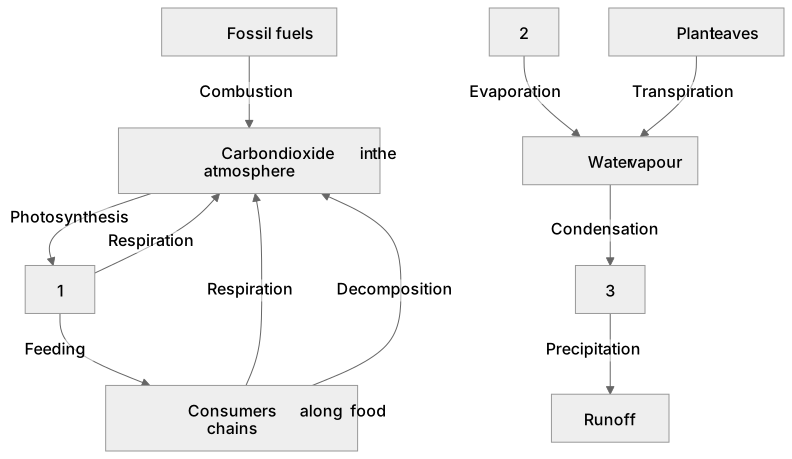
Some boxes have lost their names. Pick the right name for each number.
1Box 1
2Box 2
3Box 3
There is more to this lesson
The full lesson goes on to check your understanding and help you earn the marks. Create a free account to carry on, with your progress saved.
A week of Premium from your first lesson · Then the free plan continues · No card, no charge
Test your understanding of How materials are cycled: explain the importance of the carbon and water cycles to living organisms.
Active recall beats re-reading. Take an instant quiz now to test what you’ve learned and lock it into long-term memory.
A week of Premium from your first lesson · Then the free plan continues · No card, no charge