AQA · GCSE · Combined Science
Course version: 8464 · Version from Sept 2018
Recall that many different materials cycle through the abiotic and biotic…
Full specification wording
How materials are cycled: recall that many different materials cycle through the abiotic and biotic components of an ecosystem
An ecosystem has abiotic (non-living) components like air, water, soil, and sunlight, and biotic (living) components like plants, animals, and bacteria.
Checked against the AQA 8464 specification (opens in a new tab) on .
- Point 1 of 6
- 4 key terms
Study notes
From the checked teaching notes for this specification point.
The idea
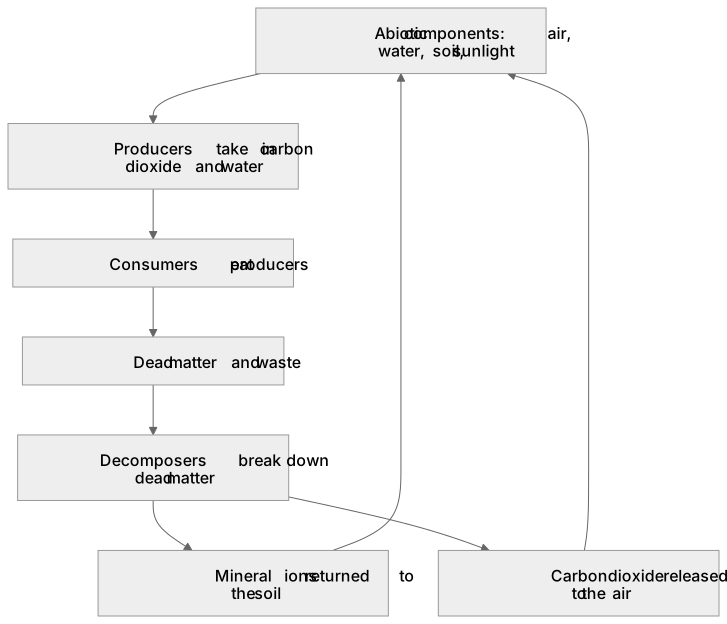
An ecosystem has abiotic (non-living) components like air, water, soil, and sunlight, and biotic (living) components like plants, animals, and bacteria. Materials are not used once and discarded: elements like carbon, molecules like water, and various mineral ions are continually transferred between these components. Producers take in carbon dioxide and water; consumers eat producers; decomposers break down dead matter, returning mineral ions to the soil. These transfers form closed loops called cycles. Because the same particles are reused, ecosystems can sustain life for long periods without new material arriving. A garden compost heap illustrates this: plant waste becomes nutrient-rich compost as microorganisms respire and release carbon dioxide, and the minerals can be taken up by new plants.
What earns the marks
- State that ecosystems contain abiotic (non-living) and biotic (living) components, giving a named example of each.
- Name at least two materials that cycle, such as carbon, water, nitrogen or mineral ions.
- Describe a transfer of a named material from an abiotic component to a biotic component, for example carbon dioxide from air into a plant during photosynthesis.
- Describe a transfer from a biotic component back to an abiotic component, for example carbon dioxide released to the air during respiration or decomposition.
- Explain that decomposers return mineral ions to the soil when they break down dead organisms and waste.
- Recognise that the same elements, molecules, and ions are reused repeatedly, so the materials form cycles rather than one-way chains.
Common mistakes and how to put them right
Treating energy and matter as the same.
Put it right: State that materials cycle but energy does not.
Calling water or mineral ions 'atoms'.
Put it right: Refer to water as a molecule, mineral ions as ions, and carbon or nitrogen as elements or atoms.
Describing only living organisms and omitting the abiotic components.
Put it right: Name both an abiotic store, such as the atmosphere or soil, and a biotic store, such as a plant or animal.
Exam tips
- Use the words abiotic and biotic correctly in your answer, and label each example clearly.
- Give a named material and follow it through at least two transfers to show it cycles.
- Link each transfer to a process you know, such as photosynthesis, feeding, respiration, excretion or decomposition.
Try the lesson
The start of the How materials are cycled: recall that many different materials cycle through the abiotic and biotic components of an ecosystem lesson, made from checked teaching notes for this specification point.
Have a go first
Which statement describes how materials move through an ecosystem?
Listen
An ecosystem has abiotic (non-living) components like air, water, soil, and sunlight, and biotic (living) components like plants, animals, and bacteria. Materials are not used once and discarded: elements like carbon, molecules like water, and various mineral ions are continually transferred between these components. Producers take in carbon dioxide and water; consumers eat producers; decomposers break down dead matter, returning mineral ions to the soil. These transfers form closed loops called cycles. Because the same particles are reused, ecosystems can sustain life for long periods without new material arriving. A garden compost heap illustrates this: plant waste becomes nutrient-rich compost as microorganisms respire and release carbon dioxide, and the minerals can be taken up by new plants. A strong answer earns marks for these points. State that ecosystems contain abiotic (non-living) and biotic (living) components, giving a named example of each. Name at least two materials that cycle, such as carbon, water, nitrogen or mineral ions. Describe a transfer of a named material from an abiotic component to a biotic component, for example carbon dioxide from air into a plant during photosynthesis. Describe a transfer from a biotic component back to an abiotic component, for example carbon dioxide released to the air during respiration or decomposition. A common slip: Treating energy and matter as the same: energy flows through an ecosystem and is eventually lost as heat, whereas materials are recycled. Instead, state that materials cycle but energy does not. Exam tip: Use the words abiotic and biotic correctly in your answer, and label each example clearly.
See it
Key words
Say what each word means before you turn the card.
abiotic components
Try answering aloud or in your head before turning the card.
biotic components
Try answering aloud or in your head before turning the card.
decomposers
Try answering aloud or in your head before turning the card.
cycles
Try answering aloud or in your head before turning the card.
See every definition
- abiotic components
- The non-living parts of an ecosystem, such as air, water, soil and sunlight.
- biotic components
- The living parts of an ecosystem, such as plants, animals and bacteria.
- decomposers
- Organisms that break down dead matter and return mineral ions to the soil.
- cycles
- Closed loops formed by the continual transfer of materials between the abiotic and biotic components of an ecosystem.
Label the diagram
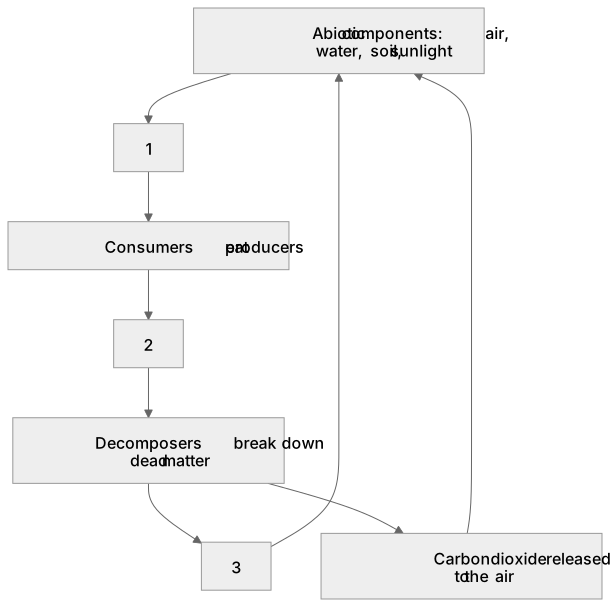
Some boxes have lost their names. Pick the right name for each number.
1Box 1
2Box 2
3Box 3
There is more to this lesson
The full lesson goes on to check your understanding and help you earn the marks. Create a free account to carry on, with your progress saved.
A week of Premium from your first lesson · Then the free plan continues · No card, no charge
Test your understanding of How materials are cycled: recall that many different materials cycle through the abiotic and biotic components of an ecosystem
Active recall beats re-reading. Take an instant quiz now to test what you’ve learned and lock it into long-term memory.
A week of Premium from your first lesson · Then the free plan continues · No card, no charge