AQA · GCSE · Combined Science
Course version: 8464 · Version from Sept 2018
Deduce that a compound is ionic from a diagram of its structure in one of…
Full specification wording
Ionic compounds: deduce that a compound is ionic from a diagram of its structure in one of the specified forms
An ionic compound diagram shows a giant lattice: a regular, repeating grid of ions held in fixed positions.
Checked against the AQA 8464 specification (opens in a new tab) on .
- Point 3 of 6
- 4 key terms
Study notes
From the checked teaching notes for this specification point.
The idea
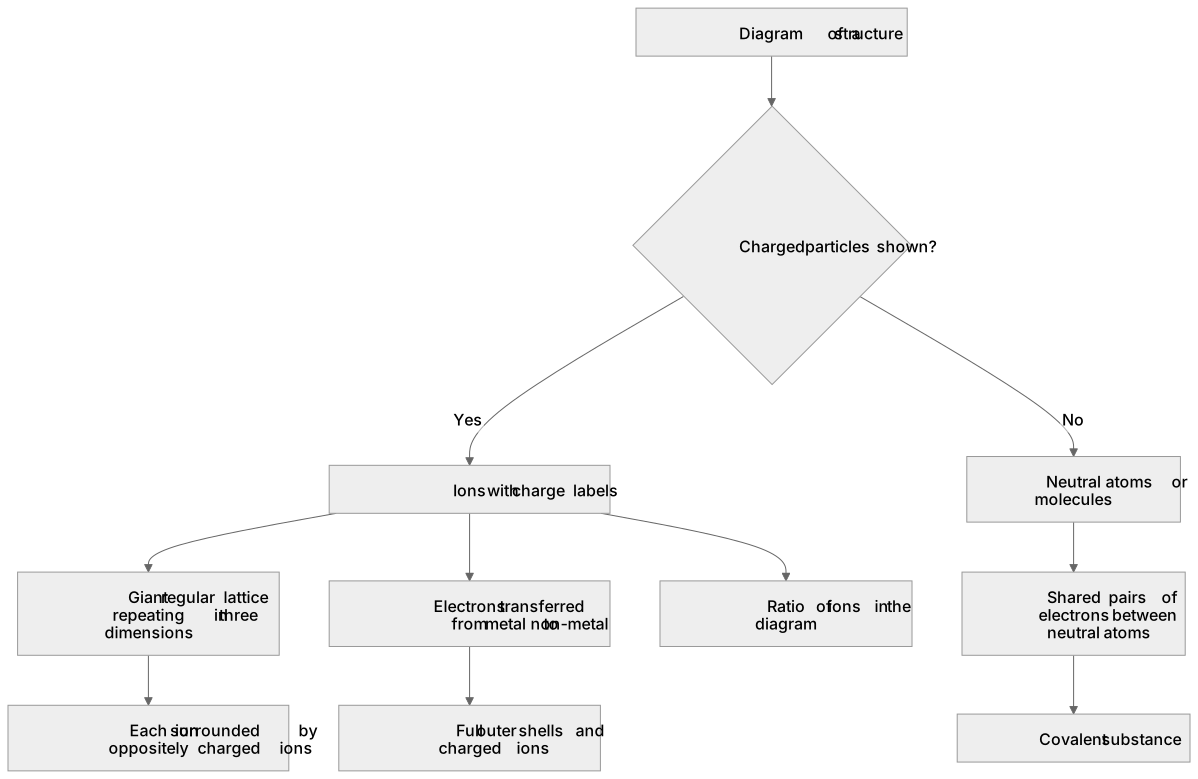
An ionic compound diagram shows a giant lattice: a regular, repeating grid of ions held in fixed positions. To deduce that a compound is ionic, look for charged particles rather than neutral atoms or molecules. In dot and cross diagrams, each ion carries a charge label such as Na⁺ or O²⁻, and electrons are shown transferred from metal to non-metal, giving full outer shells. In ball and stick or space-filling models, the pattern repeats in three dimensions with each ion surrounded by oppositely charged neighbours, for example six around each ion in sodium chloride. The key clue is a giant regular arrangement of ions, not separate molecules. If the diagram shows shared pairs of electrons between neutral atoms, it represents a covalent substance instead.
What earns the marks
- Identify that the diagram shows ions, indicated by charge labels such as Na⁺, Mg²⁺, Cl⁻ or O²⁻, rather than neutral atoms.
- Recognise a giant regular lattice that repeats in three dimensions, with each ion surrounded by oppositely charged ions.
- Link the transfer of electrons from a metal to a non-metal to the formation of full outer shells and charged ions.
- Distinguish ionic diagrams from covalent diagrams, where atoms share electron pairs and no ions are present.
- Use the ratio of ions in the diagram to support the deduction, for example one Mg²⁺ for every two Cl⁻ in magnesium chloride.
Common mistakes and how to put them right
Treating a dot and cross diagram of ions as showing shared electrons.
Put it right: In an ionic diagram the electrons are transferred, so each ion has a full outer shell and a charge label.
Assuming any regular pattern means ionic.
Put it right: Check for charged particles, because some covalent substances also form regular giant structures.
Reading a ball and stick model as separate molecules.
Put it right: The sticks show attractions between ions in a continuous lattice, not covalent bonds between molecules.
Exam tips
- Scan the diagram first for charge labels or square brackets around ion symbols, as these are the quickest evidence of ionic bonding.
- State the deduction and then justify it with one feature of the diagram, such as the repeating lattice or the transferred electrons.
- If the diagram shows neutral atoms sharing pairs, say so explicitly and explain that this indicates covalent bonding instead.
Try the lesson
The start of the Ionic compounds: deduce that a compound is ionic from a diagram of its structure in one of the specified forms lesson, made from checked teaching notes for this specification point.
Have a go first
The diagram represents part of a solid structure.
[Na⁺] [Cl⁻] [Na⁺] [Cl⁻] [Na⁺] [Cl⁻] [Na⁺] [Cl⁻] [Na⁺]
What can the student deduce about the compound?
Listen
An ionic compound diagram shows a giant lattice: a regular, repeating grid of ions held in fixed positions. To deduce that a compound is ionic, look for charged particles rather than neutral atoms or molecules. In dot and cross diagrams, each ion carries a charge label such as Na⁺ or O²⁻, and electrons are shown transferred from metal to non-metal, giving full outer shells. In ball and stick or space-filling models, the pattern repeats in three dimensions with each ion surrounded by oppositely charged neighbours, for example six around each ion in sodium chloride. The key clue is a giant regular arrangement of ions, not separate molecules. If the diagram shows shared pairs of electrons between neutral atoms, it represents a covalent substance instead. A strong answer earns marks for these points. Identify that the diagram shows ions, indicated by charge labels such as Na⁺, Mg²⁺, Cl⁻ or O²⁻, rather than neutral atoms. Recognise a giant regular lattice that repeats in three dimensions, with each ion surrounded by oppositely charged ions. Link the transfer of electrons from a metal to a non-metal to the formation of full outer shells and charged ions. Distinguish ionic diagrams from covalent diagrams, where atoms share electron pairs and no ions are present. A common slip: Treating a dot and cross diagram of ions as showing shared electrons. Instead, in an ionic diagram the electrons are transferred, so each ion has a full outer shell and a charge label. Exam tip: Scan the diagram first for charge labels or square brackets around ion symbols, as these are the quickest evidence of ionic bonding.
See it
Key words
Say what each word means before you turn the card.
Ionic bonding
Try answering aloud or in your head before turning the card.
Giant ionic lattices
Try answering aloud or in your head before turning the card.
Electron transfer
Try answering aloud or in your head before turning the card.
Representing structures
Try answering aloud or in your head before turning the card.
See every definition
- Ionic bonding
- Bonding shown when electrons are transferred from a metal to a non-metal, giving charged ions with full outer shells.
- Giant ionic lattices
- A regular, repeating grid of ions held in fixed positions, repeating in three dimensions with each ion surrounded by oppositely charged neighbours.
- Electron transfer
- Electrons shown transferred from metal to non-metal, giving full outer shells and charged ions rather than shared pairs.
- Representing structures
- Diagrams such as dot and cross, ball and stick or space-filling models, where charged particles rather than neutral atoms or molecules show an ionic compound.
There is more to this lesson
The full lesson goes on to check your understanding and help you earn the marks. Create a free account to carry on, with your progress saved.
A week of Premium from your first lesson · Then the free plan continues · No card, no charge
Test your understanding of Ionic compounds: deduce that a compound is ionic from a diagram of its structure in one of the specified forms
Active recall beats re-reading. Take an instant quiz now to test what you’ve learned and lock it into long-term memory.
A week of Premium from your first lesson · Then the free plan continues · No card, no charge