AQA · GCSE · Combined Science
Course version: 8464 · Version from Sept 2018
Work out the empirical formula of an ionic compound from a given model or…
Full specification wording
Ionic compounds: work out the empirical formula of an ionic compound from a given model or diagram that shows the ions in the structure.
An empirical formula gives the simplest whole-number ratio of ions in a compound.
Checked against the AQA 8464 specification (opens in a new tab) on .
- Point 5 of 6
- 4 key terms
Study notes
From the checked teaching notes for this specification point.
The idea
An empirical formula gives the simplest whole-number ratio of ions in a compound. In an ionic lattice diagram, each ion is drawn with its charge, for example Na⁺, Mg²⁺, O²⁻ or Cl⁻. To work out the formula, count the ions of each type shown, or use the ratio in which they appear, then reduce that ratio to its simplest whole-number form. For example, a diagram showing two Na⁺ ions for every one O²⁻ ion gives Na₂O, because the 2:1 ratio is already simplest. If a diagram showed four Na⁺ ions and two O²⁻ ions, the ratio 4:2 simplifies to 2:1, so the formula is still Na₂O. The charges must balance overall: the total positive charge equals the total negative charge. Always write the cation first, then the anion, and use subscript numbers only where more than one ion is needed.
What earns the marks
- Count the number of each type of ion shown in the model or diagram accurately.
- Write the ion ratio in the order cation then anion, for example Na⁺ : Cl⁻.
- Simplify the ratio to the simplest whole-number terms by dividing all parts by their highest common factor.
- Check that the total positive charge equals the total negative charge in the simplified ratio.
- Write the empirical formula using element symbols and subscript numbers, for example MgCl₂, without showing the charges in the final formula.
Common mistakes and how to put them right
Writing the ratio as it appears without simplifying, for example giving Na₄O₂ instead of Na₂O.
Put it right by dividing all counts by their highest common factor.
Including the ionic charges in the final formula, for example writing Mg²⁺Cl⁻₂.
Put it right by writing the neutral formula MgCl₂ with no charge symbols.
Reversing the order and writing the anion first, for example ClNa.
Put it right by placing the cation first, as in NaCl.
Exam tips
- Underline or list each ion type and tally the counts before writing any ratio.
- After simplifying, multiply the charge on each ion by its subscript to confirm the positive and negative totals are equal.
- If the diagram is large, work methodically across the lattice rather than guessing from a small region.
Try the lesson
The start of the Ionic compounds: work out the empirical formula of an ionic compound from a given model or diagram that shows the ions in the structure. lesson, made from checked teaching notes for this specification point.
Have a go first
A 2D representation of an ionic lattice is shown below, where 'M' represents a magnesium ion and 'X' represents a chloride ion.
X M X X M X M X X M X X X X M X X M
What is the empirical formula of this ionic compound?
Listen
An empirical formula gives the simplest whole-number ratio of ions in a compound. In an ionic lattice diagram, each ion is drawn with its charge, for example Na⁺, Mg²⁺, O²⁻ or Cl⁻. To work out the formula, count the ions of each type shown, or use the ratio in which they appear, then reduce that ratio to its simplest whole-number form. For example, a diagram showing two Na⁺ ions for every one O²⁻ ion gives Na₂O, because the 2:1 ratio is already simplest. If a diagram showed four Na⁺ ions and two O²⁻ ions, the ratio 4:2 simplifies to 2:1, so the formula is still Na₂O. The charges must balance overall: the total positive charge equals the total negative charge. Always write the cation first, then the anion, and use subscript numbers only where more than one ion is needed. A strong answer earns marks for these points. Count the number of each type of ion shown in the model or diagram accurately. Write the ion ratio in the order cation then anion, for example Na⁺ : Cl⁻. Simplify the ratio to the simplest whole-number terms by dividing all parts by their highest common factor. Check that the total positive charge equals the total negative charge in the simplified ratio. A common slip: Writing the ratio as it appears without simplifying, for example giving Na₄O₂ instead of Na₂O. Instead, dividing all counts by their highest common factor. Exam tip: Underline or list each ion type and tally the counts before writing any ratio.
See it
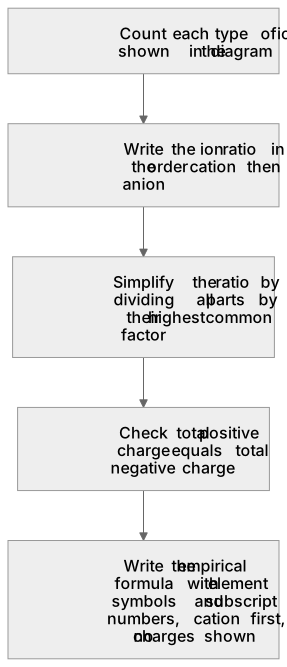
Put it in order
Put these steps in the order they happen.
- 1. Write the ion ratio in the order cation then anion
- 2. Simplify the ratio by dividing all parts by their highest common factor
- 3. Count each type of ion shown in the diagram
- 4. Write the empirical formula with element symbols and subscript numbers, cation first, no charges shown
- 5. Check total positive charge equals total negative charge
Key words
Say what each word means before you turn the card.
Empirical formula
Try answering aloud or in your head before turning the card.
Simplest whole-number ratios
Try answering aloud or in your head before turning the card.
Charge balance in ionic compounds
Try answering aloud or in your head before turning the card.
Interpreting visual models and diagrams
Try answering aloud or in your head before turning the card.
See every definition
- Empirical formula
- Gives the simplest whole-number ratio of ions in a compound.
- Simplest whole-number ratios
- The ion ratio reduced to its simplest whole-number form by dividing all parts by their highest common factor.
- Charge balance in ionic compounds
- The total positive charge equals the total negative charge overall.
- Interpreting visual models and diagrams
- Counting the ions of each type shown, or using the ratio in which they appear, to work out the formula.
Label the diagram
Some boxes have lost their names. Pick the right name for each number.
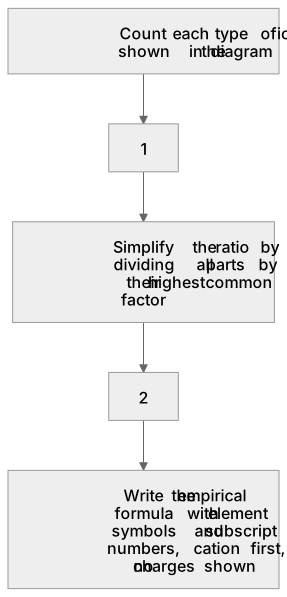
1Box 1
2Box 2
There is more to this lesson
The full lesson goes on to check your understanding and help you earn the marks. Create a free account to carry on, with your progress saved.
A week of Premium from your first lesson · Then the free plan continues · No card, no charge
Test your understanding of Ionic compounds: work out the empirical formula of an ionic compound from a given model or diagram that shows the ions in the structure.
Active recall beats re-reading. Take an instant quiz now to test what you’ve learned and lock it into long-term memory.
A week of Premium from your first lesson · Then the free plan continues · No card, no charge