AQA · GCSE · Combined Science
Course version: 8464 · Version from Sept 2018
Key ideas: chemical reactions take place in only three different ways:
At a fundamental level, chemical changes are categorised by how subatomic particles interact.
Checked against the AQA 8464 specification (opens in a new tab) on .
- Point 16 of 26
- 3 key terms
Study notes
From the checked teaching notes for this specification point.
The idea
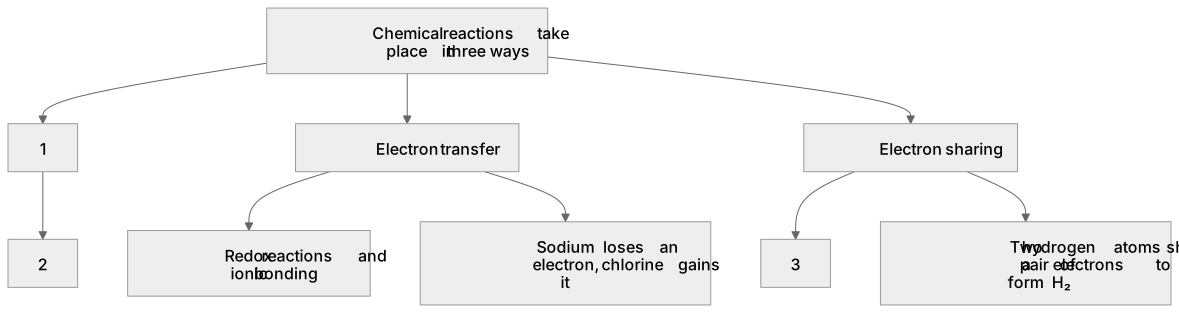
At a fundamental level, chemical changes are categorised by how subatomic particles interact. The first mechanism is proton transfer, occurring in acid-base neutralisation where an acid donates a hydrogen ion (H⁺) to a base. The second is electron transfer, characteristic of redox reactions and ionic bonding. For example, when sodium reacts with chlorine, sodium loses an electron to form a positive ion while chlorine gains it to form a negative ion. The third mechanism is electron sharing, which happens when non-metal atoms bond covalently, such as two hydrogen atoms sharing a pair of electrons to form H₂. Understanding these particle interactions helps explain macroscopic changes.
What earns the marks
- Identify proton transfer as the mechanism in acid-base reactions, where H⁺ ions are donated and accepted.
- Describe electron transfer in redox reactions or ionic bonding, where one species loses electrons and another gains them.
- Explain electron sharing as the mechanism for covalent bonding between non-metal atoms to achieve full outer shells.
- Apply these concepts to specific examples, such as identifying electron transfer in the reaction between a metal and a non-metal.
- Recognise that a hydrogen ion (H⁺) is equivalent to a proton in the context of acid-base chemistry.
Common mistakes and how to put them right
Confusing electron transfer with electron sharing.
Put it right by remembering that transfer creates oppositely charged ions (ionic bonding), whereas sharing keeps atoms joined in molecules (covalent bonding).
Thinking proton transfer involves the nucleus breaking apart.
Put it right by understanding that in chemistry, a 'proton' refers to a hydrogen ion (H⁺) that has lost its single electron, not a proton escaping from a heavier nucleus.
Assuming oxidation and reduction can happen independently.
Put it right by noting that electron transfer must involve both simultaneously; if one reactant loses electrons, another must gain them.
Exam tips
- When asked to explain a reaction in terms of electrons, explicitly state which atom loses electrons and which gains them, or state that they are shared.
- Look for the terms 'acid' or 'alkali' in the question prompt as a strong hint that the reaction involves proton transfer.
Try the lesson
The start of the Key ideas: chemical reactions take place in only three different ways: lesson, made from checked teaching notes for this specification point.
Have a go first
According to the key ideas, chemical reactions take place in only three different ways. Which of the following is one of these three ways?
Listen
At a fundamental level, chemical changes are categorised by how subatomic particles interact. The first mechanism is proton transfer, occurring in acid-base neutralisation where an acid donates a hydrogen ion (H⁺) to a base. The second is electron transfer, characteristic of redox reactions and ionic bonding. For example, when sodium reacts with chlorine, sodium loses an electron to form a positive ion while chlorine gains it to form a negative ion. The third mechanism is electron sharing, which happens when non-metal atoms bond covalently, such as two hydrogen atoms sharing a pair of electrons to form H₂. Understanding these particle interactions helps explain macroscopic changes. A strong answer earns marks for these points. Identify proton transfer as the mechanism in acid-base reactions, where H⁺ ions are donated and accepted. Describe electron transfer in redox reactions or ionic bonding, where one species loses electrons and another gains them. Explain electron sharing as the mechanism for covalent bonding between non-metal atoms to achieve full outer shells. Apply these concepts to specific examples, such as identifying electron transfer in the reaction between a metal and a non-metal. A common slip: Confusing electron transfer with electron sharing. Instead, remembering that transfer creates oppositely charged ions (ionic bonding), whereas sharing keeps atoms joined in molecules (covalent bonding). Exam tip: When asked to explain a reaction in terms of electrons, explicitly state which atom loses electrons and which gains them, or state that they are shared.
See it

Key words
Say what each word means before you turn the card.
Proton transfer
Try answering aloud or in your head before turning the card.
Electron transfer
Try answering aloud or in your head before turning the card.
Electron sharing
Try answering aloud or in your head before turning the card.
See every definition
- Proton transfer
- The mechanism occurring in acid-base neutralisation, where an acid donates a hydrogen ion (H⁺) to a base.
- Electron transfer
- The mechanism characteristic of redox reactions and ionic bonding, where one species loses electrons and another gains them.
- Electron sharing
- The mechanism that happens when non-metal atoms bond covalently, such as two hydrogen atoms sharing a pair of electrons.
Label the diagram
Some boxes have lost their names. Pick the right name for each number.
1Box 1
2Box 2
3Box 3
There is more to this lesson
The full lesson goes on to check your understanding and help you earn the marks. Create a free account to carry on, with your progress saved.
A week of Premium from your first lesson · Then the free plan continues · No card, no charge
Test your understanding of Key ideas: chemical reactions take place in only three different ways:
Active recall beats re-reading. Take an instant quiz now to test what you’ve learned and lock it into long-term memory.
A week of Premium from your first lesson · Then the free plan continues · No card, no charge