AQA · GCSE · Combined Science
Course version: 8464 · Version from Sept 2018
There are barriers to reaction so reactions occur at different rates
Full specification wording
Key ideas: there are barriers to reaction so reactions occur at different rates
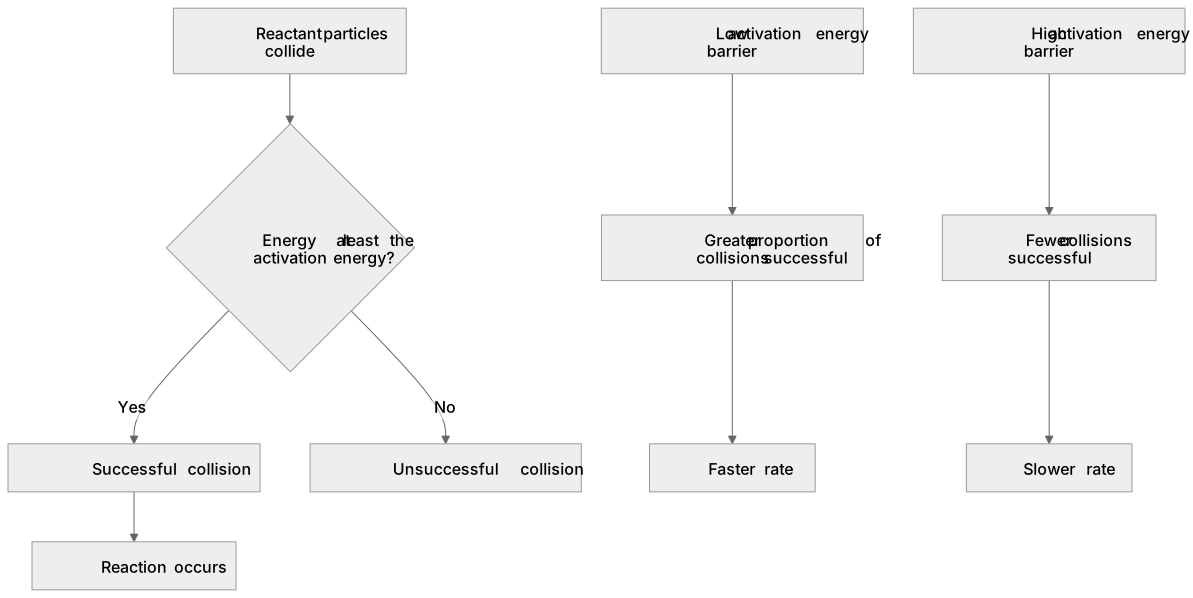
Particles can only react when they collide with enough energy to overcome the activation energy barrier, and this barrier differs from reaction to reaction.
Checked against the AQA 8464 specification (opens in a new tab) on .
- Point 15 of 26
- 3 key terms
Study notes
From the checked teaching notes for this specification point.
The idea
Particles can only react when they collide with enough energy to overcome the activation energy barrier, and this barrier differs from reaction to reaction. A low barrier means many collisions succeed, so the reaction is fast; a high barrier means few collisions succeed, so the reaction is slow. For example, magnesium fizzing in dilute hydrochloric acid has a modest barrier and reacts quickly at room temperature, whereas a mixture of hydrogen and oxygen needs a spark because its barrier is high. Temperature, concentration, pressure, surface area and catalysts change the rate by altering how often particles collide or how many collisions clear the barrier.
What earns the marks
- Reaction requires collision between reactant particles with energy greater than or equal to the activation energy.
- The activation energy is the minimum energy needed to break the bonds in reactant particles so new bonds can form.
- A low activation energy barrier allows a greater proportion of collisions to be successful, giving a faster rate.
- A high activation energy barrier means fewer collisions are successful, so the reaction is slower unless energy is supplied.
- Increasing temperature increases both collision frequency and the proportion of particles with energy above the barrier.
- A catalyst provides an alternative pathway with a lower activation energy, increasing the rate without being used up.
Common mistakes and how to put them right
Thinking any collision causes reaction.
Put it right by stating that particles must collide with at least the activation energy.
Confusing rate with yield.
Put it right by explaining that a catalyst or higher temperature changes how fast products form, not how much product can form.
Believing a catalyst increases the energy of particles.
Put it right by saying it lowers the activation energy of the alternative pathway.
Exam tips
- Link every rate factor back to either collision frequency or the proportion of collisions with enough energy.
- Use the phrase activation energy precisely when explaining why some reactions need heating or a spark.
- When comparing two reactions, state which has the higher barrier and therefore the slower rate at the same conditions.
Try the lesson
The start of the Key ideas: there are barriers to reaction so reactions occur at different rates lesson, made from checked teaching notes for this specification point.
Have a go first
A reaction has a high barrier to reaction. What does this mean for the rate of the reaction?
Listen
Particles can only react when they collide with enough energy to overcome the activation energy barrier, and this barrier differs from reaction to reaction. A low barrier means many collisions succeed, so the reaction is fast; a high barrier means few collisions succeed, so the reaction is slow. For example, magnesium fizzing in dilute hydrochloric acid has a modest barrier and reacts quickly at room temperature, whereas a mixture of hydrogen and oxygen needs a spark because its barrier is high. Temperature, concentration, pressure, surface area and catalysts change the rate by altering how often particles collide or how many collisions clear the barrier. A strong answer earns marks for these points. Reaction requires collision between reactant particles with energy greater than or equal to the activation energy. The activation energy is the minimum energy needed to break the bonds in reactant particles so new bonds can form. A low activation energy barrier allows a greater proportion of collisions to be successful, giving a faster rate. A high activation energy barrier means fewer collisions are successful, so the reaction is slower unless energy is supplied. A common slip: Thinking any collision causes reaction. Instead, stating that particles must collide with at least the activation energy. Exam tip: Link every rate factor back to either collision frequency or the proportion of collisions with enough energy.
See it
Key words
Say what each word means before you turn the card.
Activation energy
Try answering aloud or in your head before turning the card.
Collision theory
Try answering aloud or in your head before turning the card.
Catalysts
Try answering aloud or in your head before turning the card.
See every definition
- Activation energy
- The minimum energy needed to break the bonds in reactant particles so new bonds can form.
- Collision theory
- Particles can only react when they collide with enough energy to overcome the activation energy barrier.
- Catalysts
- A catalyst provides an alternative pathway with a lower activation energy, increasing the rate without being used up.
There is more to this lesson
The full lesson goes on to check your understanding and help you earn the marks. Create a free account to carry on, with your progress saved.
A week of Premium from your first lesson · Then the free plan continues · No card, no charge
Test your understanding of Key ideas: there are barriers to reaction so reactions occur at different rates
Active recall beats re-reading. Take an instant quiz now to test what you’ve learned and lock it into long-term memory.
A week of Premium from your first lesson · Then the free plan continues · No card, no charge