AQA · GCSE · Combined Science
Course version: 8464 · Version from Sept 2018
Life processes depend on molecules whose structure is related to their…
Full specification wording
Key ideas: life processes depend on molecules whose structure is related to their function
This idea says that the molecules inside living things are built in particular shapes, and those shapes let the molecules do their jobs.
Checked against the AQA 8464 specification (opens in a new tab) on .
- Point 1 of 26
- 4 key terms
Study notes
From the checked teaching notes for this specification point.
The idea
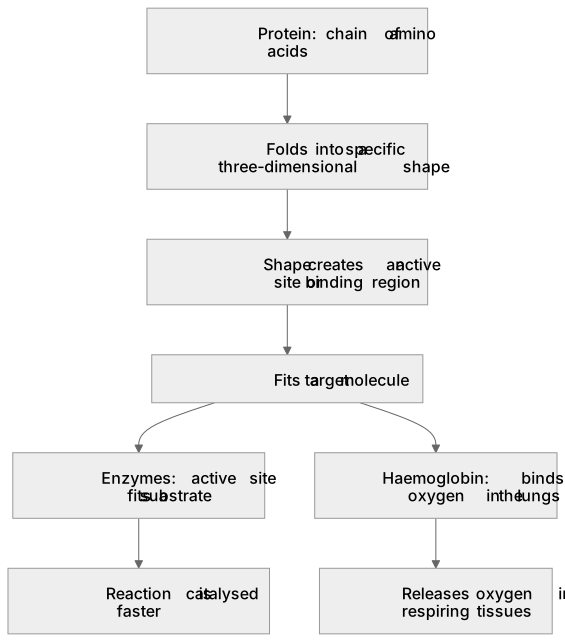
This idea says that the molecules inside living things are built in particular shapes, and those shapes let the molecules do their jobs. A protein is a chain of amino acids folded into a specific three-dimensional shape; the shape creates an active site or binding region that fits a target molecule. Enzymes are proteins whose active site fits a substrate, so the reaction they catalyse happens faster. Haemoglobin is a protein that binds oxygen in the lungs and releases it in respiring tissues. DNA is a polymer of nucleotides whose base sequence stores genetic information, and the two strands pair by complementary bases. Lipids and carbohydrates are also suited to roles such as energy storage and membrane structure. When revising, link each named molecule to its shape and its job.
What earns the marks
- States that biological molecules such as carbohydrates, lipids, proteins and DNA have structures suited to particular roles in organisms.
- Explains that enzymes are proteins with a specific active site, and that a substrate binds to this site so the reaction is catalysed.
- Describes how the shape of a protein, including enzymes, depends on its chain of amino acids and how it folds.
- Explains that DNA stores genetic information in its base sequence and that complementary base pairing allows copying.
- Relates the properties of other molecules, such as the insolubility of lipids or the compact branching of starch, to their functions.
- Uses the idea of a specific fit, for example enzyme and substrate or complementary bases, to explain why a process works.
Common mistakes and how to put them right
Saying that an enzyme is used up in a reaction.
Put it right: The enzyme is a catalyst and is not used up, so it can catalyse the reaction repeatedly.
Describing the active site as changing shape to fit any substrate.
Put it right: The active site has a specific shape that only complementary substrates can bind to.
Confusing the roles of DNA and protein.
Put it right: DNA stores the genetic code, while proteins are the molecules built from that code and carry out many cell functions.
Exam tips
- Use the phrase specific shape or complementary fit when explaining enzyme action, and name the substrate and product in your example.
- When asked about DNA, mention the base sequence and complementary base pairing rather than only calling it a double helix.
- Draw a quick labelled diagram of an enzyme and substrate to support a written explanation if the question allows it.
Try the lesson
The start of the Key ideas: life processes depend on molecules whose structure is related to their function lesson, made from checked teaching notes for this specification point.
Have a go first
Which molecule is a long chain of amino acids folded into a specific shape so that it can act as an enzyme?
Listen
This idea says that the molecules inside living things are built in particular shapes, and those shapes let the molecules do their jobs. A protein is a chain of amino acids folded into a specific three-dimensional shape; the shape creates an active site or binding region that fits a target molecule. Enzymes are proteins whose active site fits a substrate, so the reaction they catalyse happens faster. Haemoglobin is a protein that binds oxygen in the lungs and releases it in respiring tissues. DNA is a polymer of nucleotides whose base sequence stores genetic information, and the two strands pair by complementary bases. Lipids and carbohydrates are also suited to roles such as energy storage and membrane structure. When revising, link each named molecule to its shape and its job. A strong answer earns marks for these points. States that biological molecules such as carbohydrates, lipids, proteins and DNA have structures suited to particular roles in organisms. Explains that enzymes are proteins with a specific active site, and that a substrate binds to this site so the reaction is catalysed. Describes how the shape of a protein, including enzymes, depends on its chain of amino acids and how it folds. Explains that DNA stores genetic information in its base sequence and that complementary base pairing allows copying. A common slip: Saying that an enzyme is used up in a reaction. Instead, the enzyme is a catalyst and is not used up, so it can catalyse the reaction repeatedly. Exam tip: Use the phrase specific shape or complementary fit when explaining enzyme action, and name the substrate and product in your example.
See it
Key words
Say what each word means before you turn the card.
Enzymes
Try answering aloud or in your head before turning the card.
DNA
Try answering aloud or in your head before turning the card.
Active site
Try answering aloud or in your head before turning the card.
Haemoglobin
Try answering aloud or in your head before turning the card.
See every definition
- Enzymes
- Proteins whose active site fits a substrate, so the reaction they catalyse happens faster.
- DNA
- A polymer of nucleotides whose base sequence stores genetic information, with two strands pairing by complementary bases.
- Active site
- A region created by a protein's specific three-dimensional shape that fits a target molecule.
- Haemoglobin
- A protein that binds oxygen in the lungs and releases it in respiring tissues.
Label the diagram
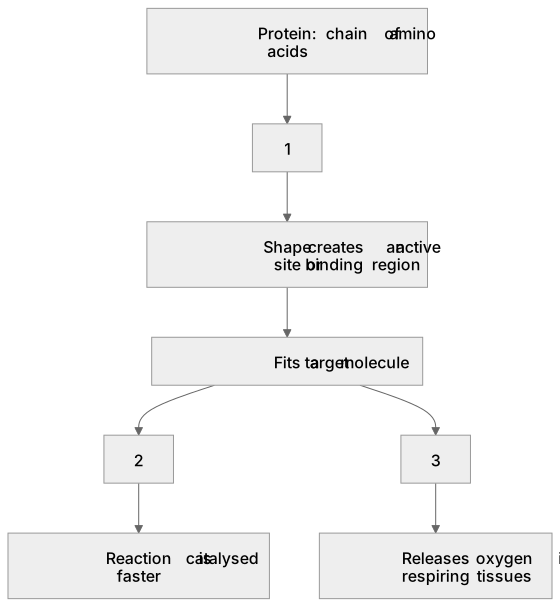
Some boxes have lost their names. Pick the right name for each number.
1Box 1
2Box 2
3Box 3
There is more to this lesson
The full lesson goes on to check your understanding and help you earn the marks. Create a free account to carry on, with your progress saved.
A week of Premium from your first lesson · Then the free plan continues · No card, no charge
Test your understanding of Key ideas: life processes depend on molecules whose structure is related to their function
Active recall beats re-reading. Take an instant quiz now to test what you’ve learned and lock it into long-term memory.
A week of Premium from your first lesson · Then the free plan continues · No card, no charge