AQA · GCSE · Combined Science
Course version: 8464 · Version from Sept 2018
The fundamental units of living organisms are cells, which may be part of…
Full specification wording
Key ideas: the fundamental units of living organisms are cells, which may be part of highly adapted structures including tissues, organs and organ systems, enabling living processes to be performed effectively
Cells are the basic building blocks of every living organism.
Checked against the AQA 8464 specification (opens in a new tab) on .
- Point 2 of 26
- 4 key terms
Study notes
From the checked teaching notes for this specification point.
The idea
Cells are the basic building blocks of every living organism. A single cell can carry out all life processes, but in multicellular organisms cells become specialised for particular jobs. Similar specialised cells group together as a tissue, such as muscle tissue or xylem tissue. Different tissues combine to form an organ, for example the stomach or a leaf. Organs work together as an organ system, such as the digestive system or the transport system in plants. This hierarchy allows large organisms to perform living processes efficiently because each level is adapted to its role.
For example: A root hair cell has a long extension that increases surface area for water uptake, and the many root hair cells form root tissue that absorbs water for the whole plant.
What earns the marks
- Cells are the fundamental units of living organisms; all living processes occur in or are controlled by cells.
- Specialised cells have structural adaptations that suit a particular function, such as a sperm cell having a tail for swimming.
- A tissue is a group of similar cells working together to carry out a shared function, for example muscle tissue or xylem tissue.
- An organ is a group of different tissues working together to perform a specific function, such as the heart or a leaf.
- An organ system is a group of organs working together to carry out a major life process, such as the digestive system.
- The levels of organisation form a hierarchy: cells, tissues, organs, organ systems and the whole organism.
Common mistakes and how to put them right
Saying that a tissue is a group of organs.
Put it right by stating that a tissue is a group of similar cells, while an organ contains several different tissues.
Confusing an organ with an organ system.
Put it right by noting that an organ system is a group of organs, for example the stomach is an organ in the digestive system.
Describing a cell as adapted without linking the adaptation to a function.
Put it right by naming the feature and explaining how it helps the cell carry out its job, such as many mitochondria releasing energy for muscle contraction.
Exam tips
- Use the correct sequence when describing organisation: cell, tissue, organ, organ system, organism.
- When asked about adaptation, name the structural feature and then explain the advantage it gives, for example a large surface area increases the rate of absorption.
- Give named examples from a familiar organism, such as root hair cells, xylem tissue, leaves and the transport system in a plant, to make your answer precise.
Try the lesson
The start of the Key ideas: the fundamental units of living organisms are cells, which may be part of highly adapted structures including tissues, organs and organ systems, enabling living processes to be performed effectively lesson, made from checked teaching notes for this specification point.
Have a go first
Which of these is the fundamental unit of all living organisms?
Listen
Cells are the basic building blocks of every living organism. A single cell can carry out all life processes, but in multicellular organisms cells become specialised for particular jobs. Similar specialised cells group together as a tissue, such as muscle tissue or xylem tissue. Different tissues combine to form an organ, for example the stomach or a leaf. Organs work together as an organ system, such as the digestive system or the transport system in plants. This hierarchy allows large organisms to perform living processes efficiently because each level is adapted to its role. For example, a root hair cell has a long extension that increases surface area for water uptake, and the many root hair cells form root tissue that absorbs water for the whole plant. A strong answer earns marks for these points. Cells are the fundamental units of living organisms; all living processes occur in or are controlled by cells. Specialised cells have structural adaptations that suit a particular function, such as a sperm cell having a tail for swimming. A tissue is a group of similar cells working together to carry out a shared function, for example muscle tissue or xylem tissue. An organ is a group of different tissues working together to perform a specific function, such as the heart or a leaf. A common slip: Saying that a tissue is a group of organs. Instead, stating that a tissue is a group of similar cells, while an organ contains several different tissues. Exam tip: Use the correct sequence when describing organisation: cell, tissue, organ, organ system, organism.
See it
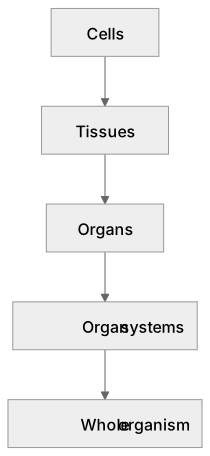
Put it in order
Put these steps in the order they happen.
- 1. Tissues
- 2. Organs
- 3. Cells
- 4. Whole organism
- 5. Organ systems
Key words
Say what each word means before you turn the card.
Cells
Try answering aloud or in your head before turning the card.
Tissue
Try answering aloud or in your head before turning the card.
Organ
Try answering aloud or in your head before turning the card.
Organ system
Try answering aloud or in your head before turning the card.
See every definition
- Cells
- The fundamental units of living organisms, in which all living processes occur or are controlled.
- Tissue
- A group of similar cells working together to carry out a shared function, such as muscle tissue or xylem tissue.
- Organ
- A group of different tissues working together to perform a specific function, such as the heart or a leaf.
- Organ system
- A group of organs working together to carry out a major life process, such as the digestive system.
Label the diagram
Some boxes have lost their names. Pick the right name for each number.
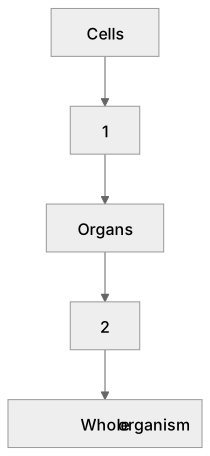
1Box 1
2Box 2
There is more to this lesson
The full lesson goes on to check your understanding and help you earn the marks. Create a free account to carry on, with your progress saved.
A week of Premium from your first lesson · Then the free plan continues · No card, no charge
Test your understanding of Key ideas: the fundamental units of living organisms are cells, which may be part of highly adapted structures including tissues, organs and organ systems, enabling living processes to be performed effectively
Active recall beats re-reading. Take an instant quiz now to test what you’ve learned and lock it into long-term memory.
A week of Premium from your first lesson · Then the free plan continues · No card, no charge