AQA · GCSE · Combined Science
Course version: 8464 · Version from Sept 2018
That differences, for example between pressures or temperatures or…
Full specification wording
Key ideas: that differences, for example between pressures or temperatures or electrical potentials, are the drivers of change
A difference in a quantity between two places or states provides the push that makes things change.
Checked against the AQA 8464 specification (opens in a new tab) on .
- Point 24 of 26
Study notes
From the checked teaching notes for this specification point.
The idea
A difference in a quantity between two places or states provides the push that makes things change. Where pressure differs, a force acts from high pressure towards low pressure: a balloon shrinks when the surrounding air pressure rises, and air rushes out of a punctured tyre. Where temperature differs, energy transfers by conduction, convection or radiation from hot to cold until temperatures equalise, so a hot drink cools in a cool room. Where electrical potential differs, charge flows: a cell maintains a potential difference across a circuit, driving current through components. In each case the size of the difference controls the rate of change, and when the difference is zero there is no net change. This idea links the pressure, heating and electricity topics and explains why a complete circuit, a temperature gradient or a pressure gradient is needed for change to occur.
What earns the marks
- States that change is driven by a difference in a quantity between two regions or states, not by an absolute value.
- Gives pressure as an example: a pressure difference produces a resultant force from higher to lower pressure, causing movement or deformation.
- Gives temperature as an example: a temperature difference causes energy transfer from hotter to cooler regions until thermal equilibrium.
- Gives electrical potential as an example: a potential difference across a circuit drives current; no potential difference means no net current.
- Explains that a larger difference generally produces a faster rate of change, and that zero difference means no net change.
- Applies the idea to an unfamiliar context, such as identifying the difference that drives a stated process.
Common mistakes and how to put them right
Thinking that a high pressure alone causes flow.
Put it right: Flow requires a difference between two pressures, so equal pressures give no net movement.
Believing that a hot object transfers energy because it is hot.
Put it right: Energy transfers only when there is a temperature difference, and transfer stops at equal temperatures.
Assuming current flows from a cell because the cell has charge.
Put it right: The cell maintains a potential difference, and that difference drives the current.
Exam tips
- Name the two places or states being compared and state which quantity differs between them.
- Use the phrase 'from higher to lower' when describing the direction of the resulting change.
- Link the size of the difference to the rate of change, and state that no difference means no net change.
Try the lesson
The start of the Key ideas: that differences, for example between pressures or temperatures or electrical potentials, are the drivers of change lesson, made from checked teaching notes for this specification point.
Have a go first
A metal block is placed in contact with a second metal block that is at a lower temperature. What causes energy to be transferred from the warmer block to the cooler block?
Listen
A difference in a quantity between two places or states provides the push that makes things change. Where pressure differs, a force acts from high pressure towards low pressure: a balloon shrinks when the surrounding air pressure rises, and air rushes out of a punctured tyre. Where temperature differs, energy transfers by conduction, convection or radiation from hot to cold until temperatures equalise, so a hot drink cools in a cool room. Where electrical potential differs, charge flows: a cell maintains a potential difference across a circuit, driving current through components. In each case the size of the difference controls the rate of change, and when the difference is zero there is no net change. This idea links the pressure, heating and electricity topics and explains why a complete circuit, a temperature gradient or a pressure gradient is needed for change to occur. A strong answer earns marks for these points. States that change is driven by a difference in a quantity between two regions or states, not by an absolute value. Gives pressure as an example: a pressure difference produces a resultant force from higher to lower pressure, causing movement or deformation. Gives temperature as an example: a temperature difference causes energy transfer from hotter to cooler regions until thermal equilibrium. Gives electrical potential as an example: a potential difference across a circuit drives current; no potential difference means no net current. A common slip: Thinking that a high pressure alone causes flow. Instead, flow requires a difference between two pressures, so equal pressures give no net movement. Exam tip: Name the two places or states being compared and state which quantity differs between them.
See it
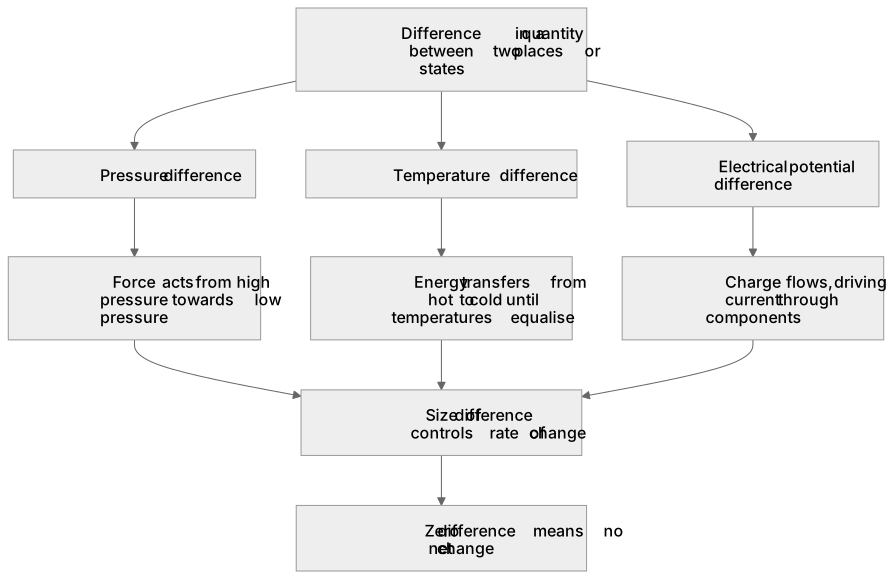
Label the diagram
Some boxes have lost their names. Pick the right name for each number.
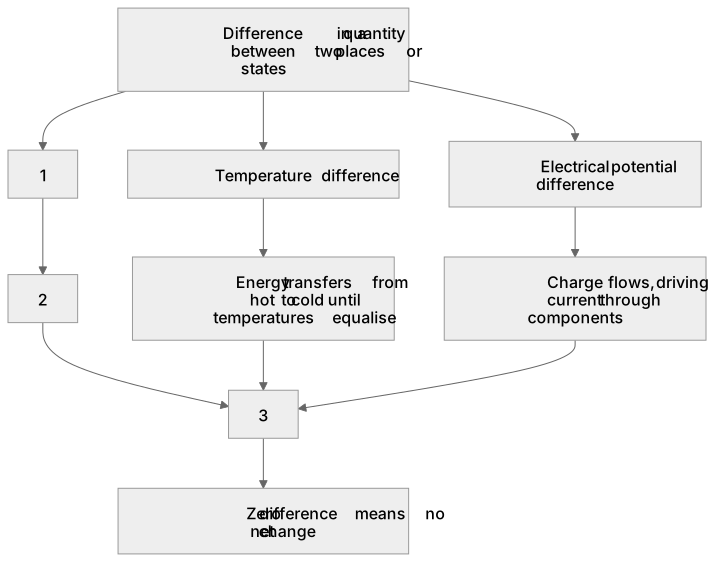
1Box 1
2Box 2
3Box 3
There is more to this lesson
The full lesson goes on to check your understanding and help you earn the marks. Create a free account to carry on, with your progress saved.
A week of Premium from your first lesson · Then the free plan continues · No card, no charge
Test your understanding of Key ideas: that differences, for example between pressures or temperatures or electrical potentials, are the drivers of change
Active recall beats re-reading. Take an instant quiz now to test what you’ve learned and lock it into long-term memory.
A week of Premium from your first lesson · Then the free plan continues · No card, no charge