AQA · GCSE · Combined Science
Course version: 8464 · Version from Sept 2018
The phenomena of ‘action at a distance’ and the related concept of the…
Full specification wording
Key ideas: the phenomena of ‘action at a distance’ and the related concept of the field as the key to analysing electrical, magnetic and gravitational effects
Action at a distance describes forces that act between objects without them touching, such as the pull of gravity on a falling ball, the attraction between opposite electric charges, and the force…
Checked against the AQA 8464 specification (opens in a new tab) on .
- Point 23 of 26
- 3 key terms
Study notes
From the checked teaching notes for this specification point.
The idea
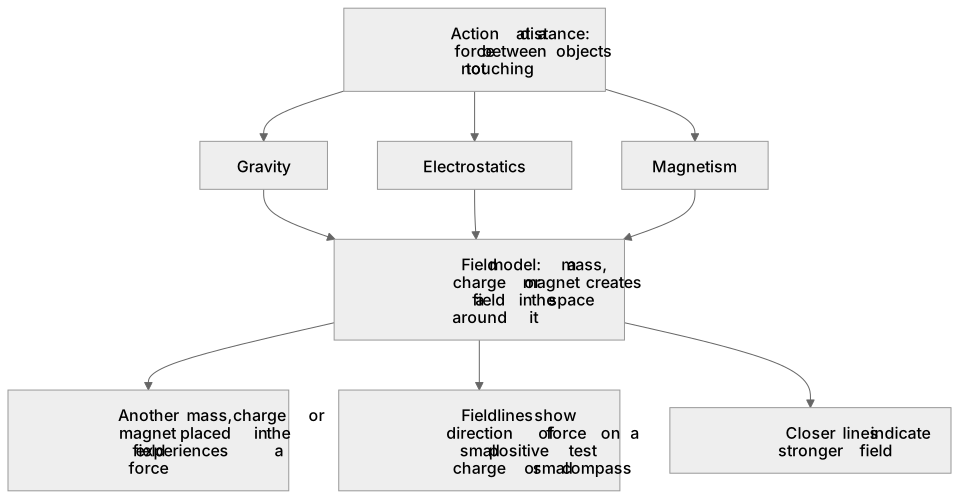
Action at a distance describes forces that act between objects without them touching, such as the pull of gravity on a falling ball, the attraction between opposite electric charges, and the force between magnetic poles. The field model explains this: a mass, a charge or a magnet creates a field in the space around it, and another mass, charge or magnet placed in that field experiences a force. Field lines show the direction a small positive test charge or a small compass would move, and their spacing shows relative strength. Gravitational and electric fields can be radial or uniform; magnetic fields run from north to south outside a magnet. Using fields lets you analyse effects by asking what creates the field, what enters it, and which way the force acts.
What earns the marks
- Defines action at a distance as a force acting between objects that are not touching, with gravity, electrostatics and magnetism as examples.
- Describes a field as a region in which a mass, a charge or a magnetic pole experiences a force.
- States that field lines show the direction of the force on a small positive test charge or on a small compass needle, and that closer lines indicate a stronger field.
- Applies the field model to analyse a named effect, for example a charged balloon attracting a neutral wall or a compass needle aligning with Earth's magnetic field.
- Distinguishes gravitational, electric and magnetic fields by what creates them and by whether the force can be attractive, repulsive or both.
- Uses the field idea to explain induced magnetism or electrostatic induction without requiring contact between the objects.
Common mistakes and how to put them right
Believing a field is a substance that flows between objects.
Put it right by describing a field as a region of influence that can be represented by field lines.
Thinking field lines show the path an object travels.
Put it right by stating that field lines show the direction of the force at a point, not a trajectory.
Assuming all non-contact forces are the same.
Put it right by separating gravitational, electric and magnetic fields according to their source and the possible directions of force.
Exam tips
- Name the field, state what creates it and state what experiences a force in it before describing the effect.
- Use the spacing of field lines to compare field strength, and the arrow direction to state the direction of the force.
- When explaining a non-contact effect, mention the field rather than saying the objects 'just attract' or 'just repel'.
Try the lesson
The start of the Key ideas: the phenomena of ‘action at a distance’ and the related concept of the field as the key to analysing electrical, magnetic and gravitational effects lesson, made from checked teaching notes for this specification point.
Have a go first
Which statement describes the meaning of action at a distance?
Listen
Action at a distance describes forces that act between objects without them touching, such as the pull of gravity on a falling ball, the attraction between opposite electric charges, and the force between magnetic poles. The field model explains this: a mass, a charge or a magnet creates a field in the space around it, and another mass, charge or magnet placed in that field experiences a force. Field lines show the direction a small positive test charge or a small compass would move, and their spacing shows relative strength. Gravitational and electric fields can be radial or uniform; magnetic fields run from north to south outside a magnet. Using fields lets you analyse effects by asking what creates the field, what enters it, and which way the force acts. A strong answer earns marks for these points. Defines action at a distance as a force acting between objects that are not touching, with gravity, electrostatics and magnetism as examples. Describes a field as a region in which a mass, a charge or a magnetic pole experiences a force. States that field lines show the direction of the force on a small positive test charge or on a small compass needle, and that closer lines indicate a stronger field. Applies the field model to analyse a named effect, for example a charged balloon attracting a neutral wall or a compass needle aligning with Earth's magnetic field. A common slip: Believing a field is a substance that flows between objects. Instead, describing a field as a region of influence that can be represented by field lines. Exam tip: Name the field, state what creates it and state what experiences a force in it before describing the effect.
See it
Key words
Say what each word means before you turn the card.
Action at a distance
Try answering aloud or in your head before turning the card.
Field
Try answering aloud or in your head before turning the card.
Field lines
Try answering aloud or in your head before turning the card.
See every definition
- Action at a distance
- A force acting between objects that are not touching, such as gravity, electrostatics and magnetism.
- Field
- A region in which a mass, a charge or a magnetic pole experiences a force.
- Field lines
- Lines that show the direction of the force on a small positive test charge or a small compass needle, with closer lines indicating a stronger field.
Label the diagram
Some boxes have lost their names. Pick the right name for each number.
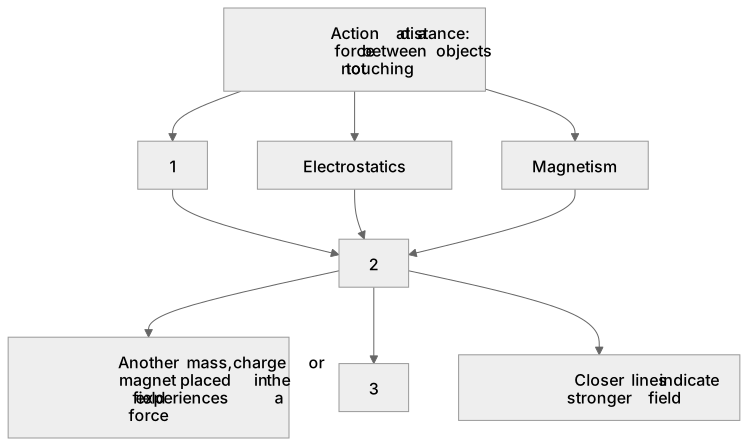
1Box 1
2Box 2
3Box 3
There is more to this lesson
The full lesson goes on to check your understanding and help you earn the marks. Create a free account to carry on, with your progress saved.
A week of Premium from your first lesson · Then the free plan continues · No card, no charge
Test your understanding of Key ideas: the phenomena of ‘action at a distance’ and the related concept of the field as the key to analysing electrical, magnetic and gravitational effects
Active recall beats re-reading. Take an instant quiz now to test what you’ve learned and lock it into long-term memory.
A week of Premium from your first lesson · Then the free plan continues · No card, no charge