AQA · GCSE · Combined Science
Course version: 8464 · Version from Sept 2018
Humans reduce the amount of land available for other animals and plants by…
Full specification wording
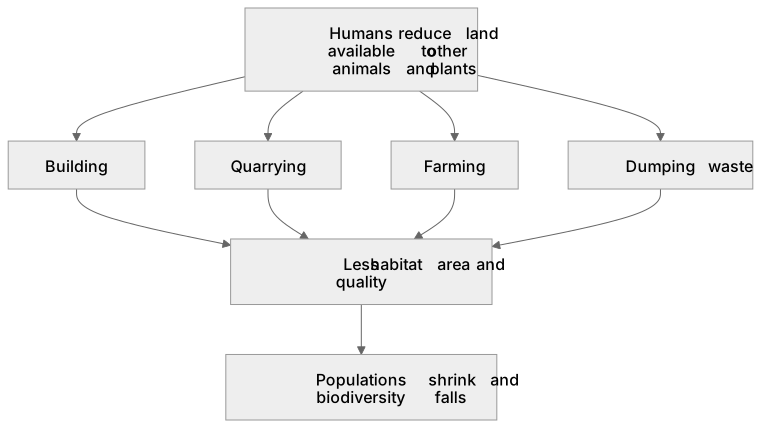
Land use: Humans reduce the amount of land available for other animals and plants by building, quarrying, farming and dumping waste.
Land is a finite resource shared by humans and wildlife.
Checked against the AQA 8464 specification (opens in a new tab) on .
- Point 1 of 3
- 3 key terms
Study notes
From the checked teaching notes for this specification point.
The idea
Land is a finite resource shared by humans and wildlife. When people build houses, roads and factories, that ground is sealed or occupied, so plants cannot grow and animals lose feeding, shelter and breeding sites. Quarrying removes surface rock for materials such as limestone, destroying habitats and leaving bare, slow-to-recolonise ground. Farming uses large areas for crops, pasture and livestock, often replacing diverse ecosystems with few species; hedgerows and ponds may be removed to enlarge fields. Dumping waste covers land with landfill, spoil or rubbish, poisoning soil and water and smothering vegetation. Each activity lowers the area and quality of habitat, so populations shrink and biodiversity falls.
For example: A new housing estate on a meadow removes the flowers, insects, birds and mammals that lived there, and the remaining wildlife must crowd into smaller patches.
What earns the marks
- Building covers land with houses, roads and industry, removing the vegetation that other organisms depend on.
- Quarrying extracts rock and minerals, destroying habitats at the surface and leaving disturbed land that recolonises slowly.
- Farming occupies extensive areas for crops and livestock, often reducing species diversity compared with the original ecosystem.
- Dumping waste creates landfill and polluted ground, which smothers plants and harms animals and soil organisms.
- All four activities reduce the total area and quality of habitat available to other animals and plants, so populations and biodiversity decline.
Common mistakes and how to put them right
Thinking land use only affects the place where building happens.
Put it right: Roads, quarries, farms and landfill also fragment and pollute surrounding habitats.
Confusing quarrying with mining for fossil fuels.
Put it right: Quarrying is surface extraction of rock such as limestone, and it removes habitat directly.
Assuming farming always increases wildlife because it grows plants.
Put it right: Monoculture crops and cleared fields usually support fewer species than the habitat they replace.
Exam tips
- Name each activity from the statement and link it to a specific habitat loss, such as sealing soil or removing hedgerows.
- Use the phrase finite land resource to explain why human use competes with wildlife.
- Give one concrete example, such as a new road or landfill site, and state the effect on named organisms.
Try the lesson
The start of the Land use: Humans reduce the amount of land available for other animals and plants by building, quarrying, farming and dumping waste. lesson, made from checked teaching notes for this specification point.
Have a go first
Which human activity reduces the amount of land available for other animals and plants by covering the ground with houses, roads and other structures?
Listen
Land is a finite resource shared by humans and wildlife. When people build houses, roads and factories, that ground is sealed or occupied, so plants cannot grow and animals lose feeding, shelter and breeding sites. Quarrying removes surface rock for materials such as limestone, destroying habitats and leaving bare, slow-to-recolonise ground. Farming uses large areas for crops, pasture and livestock, often replacing diverse ecosystems with few species; hedgerows and ponds may be removed to enlarge fields. Dumping waste covers land with landfill, spoil or rubbish, poisoning soil and water and smothering vegetation. Each activity lowers the area and quality of habitat, so populations shrink and biodiversity falls. For example, a new housing estate on a meadow removes the flowers, insects, birds and mammals that lived there, and the remaining wildlife must crowd into smaller patches. A strong answer earns marks for these points. Building covers land with houses, roads and industry, removing the vegetation that other organisms depend on. Quarrying extracts rock and minerals, destroying habitats at the surface and leaving disturbed land that recolonises slowly. Farming occupies extensive areas for crops and livestock, often reducing species diversity compared with the original ecosystem. Dumping waste creates landfill and polluted ground, which smothers plants and harms animals and soil organisms. A common slip: Thinking land use only affects the place where building happens. Instead, roads, quarries, farms and landfill also fragment and pollute surrounding habitats. Exam tip: Name each activity from the statement and link it to a specific habitat loss, such as sealing soil or removing hedgerows.
See it
Key words
Say what each word means before you turn the card.
Competition for finite land
Try answering aloud or in your head before turning the card.
Habitat destruction and fragmentation
Try answering aloud or in your head before turning the card.
Biodiversity decline
Try answering aloud or in your head before turning the card.
See every definition
- Competition for finite land
- Land is a finite resource shared by humans and wildlife, so human activities reduce the amount of land available for other animals and plants.
- Habitat destruction and fragmentation
- Building, quarrying, farming and dumping waste remove or damage habitat, and surrounding habitats are also fragmented and polluted.
- Biodiversity decline
- Each activity lowers the area and quality of habitat, so populations shrink and biodiversity falls.
Label the diagram
Some boxes have lost their names. Pick the right name for each number.
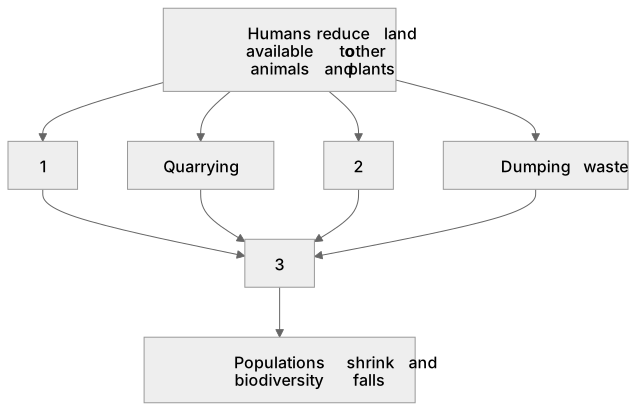
1Box 1
2Box 2
3Box 3
There is more to this lesson
The full lesson goes on to check your understanding and help you earn the marks. Create a free account to carry on, with your progress saved.
A week of Premium from your first lesson · Then the free plan continues · No card, no charge
Test your understanding of Land use: Humans reduce the amount of land available for other animals and plants by building, quarrying, farming and dumping waste.
Active recall beats re-reading. Take an instant quiz now to test what you’ve learned and lock it into long-term memory.
A week of Premium from your first lesson · Then the free plan continues · No card, no charge