AQA · GCSE · Combined Science
Course version: 8464 · Version from Sept 2018
The decay or burning of the peat releases carbon dioxide into the…
Full specification wording
Land use: The decay or burning of the peat releases carbon dioxide into the atmosphere.
Peat is partially decomposed plant material that accumulates in waterlogged, acidic bogs where oxygen is scarce, so decomposition is very slow.
Checked against the AQA 8464 specification (opens in a new tab) on .
- Point 3 of 3
- 4 key terms
Study notes
From the checked teaching notes for this specification point.
The idea
Peat is partially decomposed plant material that accumulates in waterlogged, acidic bogs where oxygen is scarce, so decomposition is very slow. Carbon taken from the atmosphere by living plants becomes locked in the peat, making it a long-term carbon store. When peat is drained, dug up or burned, this stored carbon is no longer protected. Microorganisms decompose the exposed peat aerobically, respiring and releasing carbon dioxide. Burning peat in power stations or on managed land also releases carbon dioxide directly as the carbon in the peat combines with oxygen. In both routes the carbon store is converted into atmospheric carbon dioxide, a greenhouse gas, so land use that damages peat increases the concentration of carbon dioxide in the atmosphere.
What earns the marks
- Peat is a store of carbon because it is formed from plant material that has only partially decomposed in waterlogged, low-oxygen conditions.
- Decay of peat is carried out by microorganisms that respire aerobically when the peat is drained or exposed to air, releasing carbon dioxide.
- Burning peat is a combustion reaction in which carbon in the peat reacts with oxygen, producing carbon dioxide.
- Land use such as drainage, extraction or burning of peat bogs therefore reduces a carbon store and adds carbon dioxide to the atmosphere.
Common mistakes and how to put them right
Thinking that decay of peat releases methane only.
Put it right: , aerobic decay of exposed peat releases carbon dioxide, and methane is associated with anaerobic conditions in waterlogged peat.
Writing that burning peat releases carbon dioxide because plants respire.
Put it right: , burning is combustion of the carbon in peat, not respiration by plants.
Assuming peat is a fossil fuel formed over millions of years like coal.
Put it right: , peat is recently accumulated partially decomposed plant material, although it is still a long-term carbon store.
Exam tips
- Name the process for each route: decay by microorganisms for drained peat, and combustion for burned peat.
- State the carbon store being depleted and the atmosphere as the destination of the carbon dioxide.
- Link the release to the greenhouse effect by naming carbon dioxide as a greenhouse gas rather than simply saying pollution.
Try the lesson
The start of the Land use: The decay or burning of the peat releases carbon dioxide into the atmosphere. lesson, made from checked teaching notes for this specification point.
Have a go first
Peat is a store of carbon. Which gas is released into the atmosphere when peat decays or burns?
Listen
Peat is partially decomposed plant material that accumulates in waterlogged, acidic bogs where oxygen is scarce, so decomposition is very slow. Carbon taken from the atmosphere by living plants becomes locked in the peat, making it a long-term carbon store. When peat is drained, dug up or burned, this stored carbon is no longer protected. Microorganisms decompose the exposed peat aerobically, respiring and releasing carbon dioxide. Burning peat in power stations or on managed land also releases carbon dioxide directly as the carbon in the peat combines with oxygen. In both routes the carbon store is converted into atmospheric carbon dioxide, a greenhouse gas, so land use that damages peat increases the concentration of carbon dioxide in the atmosphere. A strong answer earns marks for these points. Peat is a store of carbon because it is formed from plant material that has only partially decomposed in waterlogged, low-oxygen conditions. Decay of peat is carried out by microorganisms that respire aerobically when the peat is drained or exposed to air, releasing carbon dioxide. Burning peat is a combustion reaction in which carbon in the peat reacts with oxygen, producing carbon dioxide. Land use such as drainage, extraction or burning of peat bogs therefore reduces a carbon store and adds carbon dioxide to the atmosphere. A common slip: Thinking that decay of peat releases methane only. Instead, , aerobic decay of exposed peat releases carbon dioxide, and methane is associated with anaerobic conditions in waterlogged peat. Exam tip: Name the process for each route: decay by microorganisms for drained peat, and combustion for burned peat.
See it
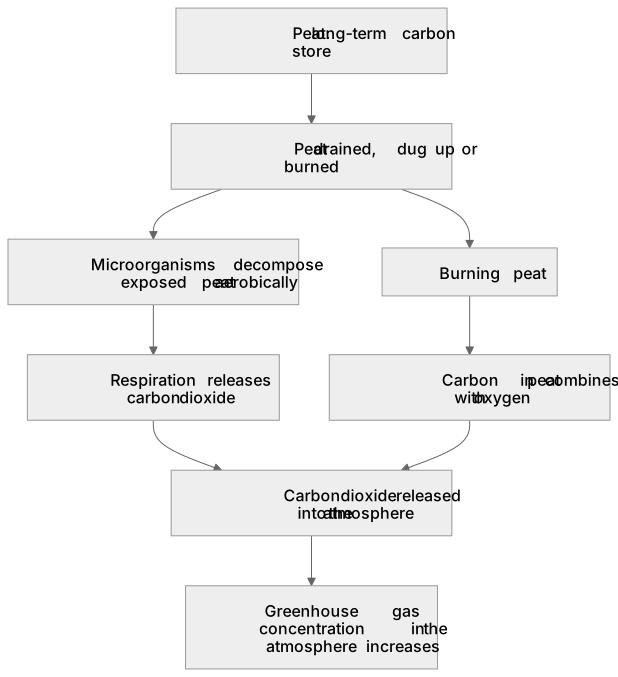
Key words
Say what each word means before you turn the card.
Carbon store
Try answering aloud or in your head before turning the card.
Decay
Try answering aloud or in your head before turning the card.
Combustion
Try answering aloud or in your head before turning the card.
Greenhouse gas
Try answering aloud or in your head before turning the card.
See every definition
- Carbon store
- Peat is a long-term store of carbon because carbon taken from the atmosphere by living plants becomes locked in it.
- Decay
- Microorganisms decompose the exposed peat aerobically, respiring and releasing carbon dioxide.
- Combustion
- Burning peat releases carbon dioxide directly as the carbon in the peat combines with oxygen.
- Greenhouse gas
- Carbon dioxide released into the atmosphere is a greenhouse gas, so damaging peat increases its concentration in the atmosphere.
Label the diagram
Some boxes have lost their names. Pick the right name for each number.
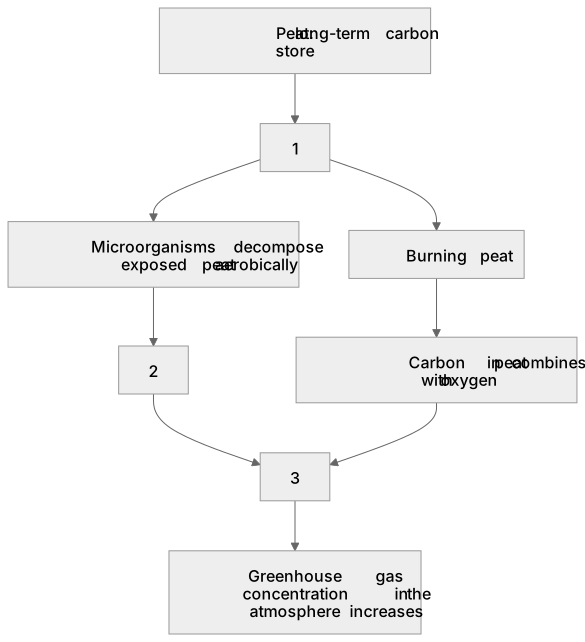
1Box 1
2Box 2
3Box 3
There is more to this lesson
The full lesson goes on to check your understanding and help you earn the marks. Create a free account to carry on, with your progress saved.
A week of Premium from your first lesson · Then the free plan continues · No card, no charge
Test your understanding of Land use: The decay or burning of the peat releases carbon dioxide into the atmosphere.
Active recall beats re-reading. Take an instant quiz now to test what you’ve learned and lock it into long-term memory.
A week of Premium from your first lesson · Then the free plan continues · No card, no charge