AQA · GCSE · Combined Science
Course version: 8464 · Version from Sept 2018
Consumers that kill and eat other animals are predators, and those eaten…
Full specification wording
Levels of organisation: Consumers that kill and eat other animals are predators, and those eaten are prey. In a stable community the numbers of predators and prey rise and fall in cycles.
A predator is a consumer that hunts and kills other animals for food; the animal it eats is its prey.
Checked against the AQA 8464 specification (opens in a new tab) on .
- Point 9 of 11
- 4 key terms
Study notes
From the checked teaching notes for this specification point.
The idea
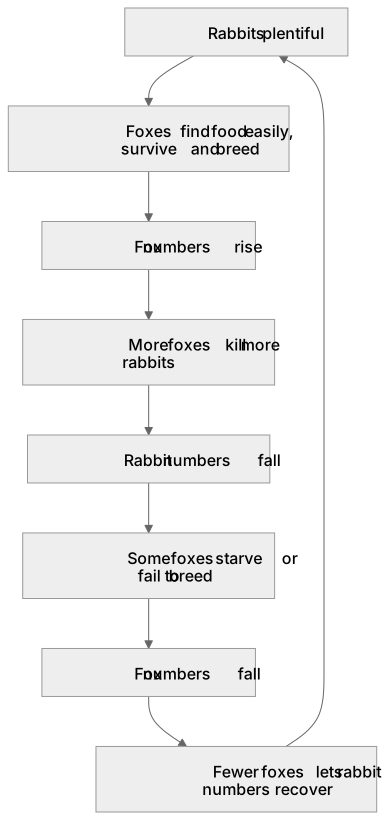
A predator is a consumer that hunts and kills other animals for food; the animal it eats is its prey. This feeding relationship links organisms into food webs, so a change in one population affects another. In a stable community, predator and prey numbers rise and fall in repeating cycles rather than staying constant. Consider a fox and rabbit example: when rabbits are plentiful, foxes find food easily, survive well and breed, so fox numbers rise. More foxes then kill more rabbits, so rabbit numbers fall. With less prey, some foxes starve or fail to breed, so fox numbers fall. Fewer foxes lets rabbit numbers recover, and the cycle repeats. The predator cycle lags behind the prey cycle because the predator's breeding and survival respond to prey availability.
What earns the marks
- Defines a predator as a consumer that kills and eats other animals, and prey as the animal that is eaten.
- Links predator and prey populations through food chains and webs, so a change in one population affects the other.
- Describes the prey population rising when predation pressure is low, then falling as predator numbers increase.
- Explains that predator numbers rise after prey numbers rise, because more food supports survival and reproduction.
- States that the predator cycle lags behind the prey cycle, giving repeating rise-and-fall cycles in a stable community.
- Uses a named example, such as foxes and rabbits, to show how the two populations interact over time.
Common mistakes and how to put them right
Saying predators and prey numbers rise and fall at exactly the same time.
Put it right: The predator peak comes after the prey peak because predators respond to prey availability.
Treating the relationship as one-way, with predators only affecting prey.
Put it right: Each population affects the other, so the interaction is reciprocal.
Assuming a stable community means constant numbers.
Put it right: Stability means the populations fluctuate in repeating cycles around a long-term balance.
Exam tips
- Define both terms precisely before describing the cycle, so the examiner sees the key vocabulary used correctly.
- Describe the cycle in order: prey increase, predator increase, prey decrease, predator decrease, then repeat.
- Refer to the graph or data if one is given, quoting the direction of change rather than only naming the animals.
Try the lesson
The start of the Levels of organisation: Consumers that kill and eat other animals are predators, and those eaten are prey. In a stable community the numbers of predators and prey rise and fall in cycles. lesson, made from checked teaching notes for this specification point.
Have a go first
In a stable community, a fox hunts and eats rabbits. Which term describes the rabbits?
Listen
A predator is a consumer that hunts and kills other animals for food; the animal it eats is its prey. This feeding relationship links organisms into food webs, so a change in one population affects another. In a stable community, predator and prey numbers rise and fall in repeating cycles rather than staying constant. Consider a fox and rabbit example: when rabbits are plentiful, foxes find food easily, survive well and breed, so fox numbers rise. More foxes then kill more rabbits, so rabbit numbers fall. With less prey, some foxes starve or fail to breed, so fox numbers fall. Fewer foxes lets rabbit numbers recover, and the cycle repeats. The predator cycle lags behind the prey cycle because the predator's breeding and survival respond to prey availability. A strong answer earns marks for these points. Defines a predator as a consumer that kills and eats other animals, and prey as the animal that is eaten. Links predator and prey populations through food chains and webs, so a change in one population affects the other. Describes the prey population rising when predation pressure is low, then falling as predator numbers increase. Explains that predator numbers rise after prey numbers rise, because more food supports survival and reproduction. A common slip: Saying predators and prey numbers rise and fall at exactly the same time. Instead, the predator peak comes after the prey peak because predators respond to prey availability. Exam tip: Define both terms precisely before describing the cycle, so the examiner sees the key vocabulary used correctly.
See it
Key words
Say what each word means before you turn the card.
Predator
Try answering aloud or in your head before turning the card.
Prey
Try answering aloud or in your head before turning the card.
Stable community
Try answering aloud or in your head before turning the card.
Predator cycle
Try answering aloud or in your head before turning the card.
See every definition
- Predator
- A consumer that kills and eats other animals.
- Prey
- An animal that is eaten by a predator.
- Stable community
- A community in which the numbers of predators and prey rise and fall in cycles rather than staying constant.
- Predator cycle
- The repeating rise and fall of predator numbers, which lags behind the prey cycle because breeding and survival respond to prey availability.
Label the diagram
Some boxes have lost their names. Pick the right name for each number.
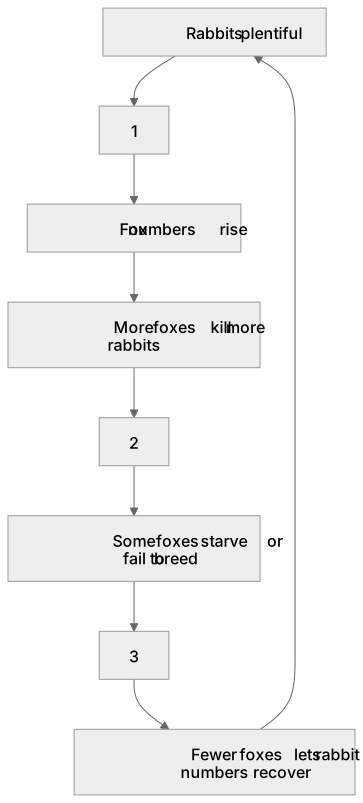
1Box 1
2Box 2
3Box 3
There is more to this lesson
The full lesson goes on to check your understanding and help you earn the marks. Create a free account to carry on, with your progress saved.
A week of Premium from your first lesson · Then the free plan continues · No card, no charge
Test your understanding of Levels of organisation: Consumers that kill and eat other animals are predators, and those eaten are prey. In a stable community the numbers of predators and prey rise and fall in cycles.
Active recall beats re-reading. Take an instant quiz now to test what you’ve learned and lock it into long-term memory.
A week of Premium from your first lesson · Then the free plan continues · No card, no charge