AQA · GCSE · Combined Science
Course version: 8464 · Version from Sept 2018
In a chemical reaction involving two reactants, it is common to use an…
Full specification wording
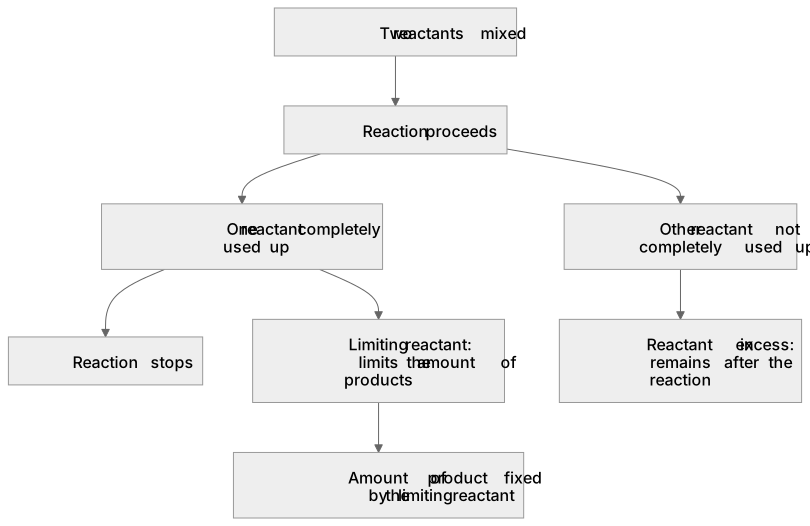
Limiting reactants (HT only): In a chemical reaction involving two reactants, it is common to use an excess of one of the reactants to ensure that all of the other reactant is used. The reactant that is completely used up is called the limiting reactant because it limits the amount of products.
When two reactants are mixed, the reaction stops as soon as one of them is used up.
Checked against the AQA 8464 specification (opens in a new tab) on .
- Point 1 of 2
Study notes
From the checked teaching notes for this specification point.
The idea
When two reactants are mixed, the reaction stops as soon as one of them is used up. That reactant is the limiting reactant; the other is in excess. Using an excess of one reactant is a practical way to make sure the more valuable or harder-to-obtain reactant is fully consumed, so no product is lost. For example, in 2Mg + O₂ → 2MgO, if 0.10 mol Mg reacts with 0.20 mol O₂, Mg is limiting because it runs out first, even though less oxygen was needed. The amount of product is fixed by the limiting reactant, not by the excess. To identify the limiting reactant, compare the mole ratio from the balanced equation with the amounts actually present; the reactant that would produce the smaller amount of product is limiting. Note that limiting reactant concepts are assessed at Higher Tier only.
What earns the marks
- The limiting reactant is the reactant that is completely used up when the reaction stops.
- The reactant in excess is not completely used up and remains after the reaction.
- The amount of product formed is determined by the limiting reactant, not by the excess reactant.
- Using an excess of one reactant can ensure that the other reactant is fully used, which is useful when that other reactant is expensive or difficult to obtain.
- To identify the limiting reactant, compare the actual mole amounts with the mole ratio in the balanced equation.
Common mistakes and how to put them right
Assuming the reactant with the smaller mass is always limiting.
Put it right: Compare amounts in moles using the balanced equation, because molar masses differ.
Thinking the excess reactant is the one that runs out first.
Put it right: The excess reactant remains after reaction; the limiting reactant is used up.
Ignoring the coefficients in the balanced equation when comparing mole amounts.
Put it right: Use the ratio from the equation, for example 2 mol Mg to 1 mol O₂.
Exam tips
- Write the balanced equation first and label the mole ratio before doing any comparison.
- Convert masses to moles using moles = mass ÷ relative formula mass, then compare with the equation ratio.
- Remember that limiting reactant calculations and explanations are assessed at Higher Tier only.
Try the lesson
The start of the Limiting reactants (HT only): In a chemical reaction involving two reactants, it is common to use an excess of one of the reactants to ensure that all of the other reactant is used. The reactant that is completely used up is called the limiting reactant because it limits the amount of products. lesson, made from checked teaching notes for this specification point.
Have a go first
Hydrogen reacts with chlorine to form hydrogen chloride: H₂ + Cl₂ → 2HCl. A mixture contains 3.0 mol of hydrogen and 2.0 mol of chlorine. What is the maximum amount of hydrogen chloride that can be formed?
Listen
When two reactants are mixed, the reaction stops as soon as one of them is used up. That reactant is the limiting reactant; the other is in excess. Using an excess of one reactant is a practical way to make sure the more valuable or harder-to-obtain reactant is fully consumed, so no product is lost. For example, in 2Mg + O₂ → 2MgO, if 0.10 mol Mg reacts with 0.20 mol O₂, Mg is limiting because it runs out first, even though less oxygen was needed. The amount of product is fixed by the limiting reactant, not by the excess. To identify the limiting reactant, compare the mole ratio from the balanced equation with the amounts actually present; the reactant that would produce the smaller amount of product is limiting. Note that limiting reactant concepts are assessed at Higher Tier only. A strong answer earns marks for these points. The limiting reactant is the reactant that is completely used up when the reaction stops. The reactant in excess is not completely used up and remains after the reaction. The amount of product formed is determined by the limiting reactant, not by the excess reactant. Using an excess of one reactant can ensure that the other reactant is fully used, which is useful when that other reactant is expensive or difficult to obtain. A common slip: Assuming the reactant with the smaller mass is always limiting. Instead, compare amounts in moles using the balanced equation, because molar masses differ. Exam tip: Write the balanced equation first and label the mole ratio before doing any comparison.
See it
Watch it explained
What is the one idea the video explains? Say it in a sentence.
Read the described scene instead
When two reactants are mixed, the reaction continues until one of them is used up. That reactant is the limiting reactant, because it limits how much product can form. The other reactant is in excess and remains after the reaction stops. The amount of product is set by the limiting reactant, not by the excess. Using an excess of one reactant can make sure the other reactant is fully used. This is useful when that other reactant is valuable or difficult to obtain. In the magnesium example, oxygen is in excess. The excess does not increase the product beyond what the limiting reactant allows. Let's apply this to 2Mg + O2 → 2MgO. Suppose 0.10 mol of magnesium reacts with 0.20 mol of oxygen. The balanced equation needs 2 mol of magnesium for every 1 mol of oxygen. So 0.10 mol of magnesium needs only 0.05 mol of oxygen. Oxygen is in excess. Magnesium runs out first, so magnesium is the limiting reactant. The product amount is fixed by the 0.10 mol of magnesium. To identify the limiting reactant, start with the balanced equation and write its mole ratio. Convert any masses to moles using moles equals mass divided by relative formula mass. Compare the actual mole amounts with the equation ratio. The reactant that would produce the smaller amount of product is the limiting reactant. One common mistake is assuming the reactant with the smaller mass is always limiting. Compare moles instead, because molar masses differ. Another mistake is thinking the excess reactant runs out first. The excess reactant remains; the limiting reactant is used up. Also, do not ignore the coefficients in the balanced equation when comparing mole amounts. Remember: the limiting reactant is completely used up and controls the amount of product. The excess reactant remains after the reaction. Use the balanced equation's mole ratio and the actual mole amounts to decide which reactant is limiting. These limiting reactant ideas are assessed at Higher Tier only.
Label the diagram
Some boxes have lost their names. Pick the right name for each number.
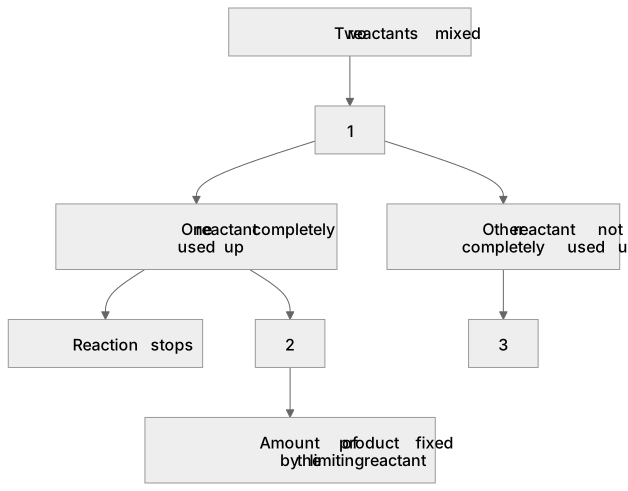
1Box 1
2Box 2
3Box 3
There is more to this lesson
The full lesson goes on to check your understanding and help you earn the marks. Create a free account to carry on, with your progress saved.
A week of Premium from your first lesson · Then the free plan continues · No card, no charge
Test your understanding of Limiting reactants (HT only): In a chemical reaction involving two reactants, it is common to use an excess of one of the reactants to ensure that all of the other reactant is used. The reactant that is completely used up is called the limiting reactant because it limits the amount of products.
Active recall beats re-reading. Take an instant quiz now to test what you’ve learned and lock it into long-term memory.
A week of Premium from your first lesson · Then the free plan continues · No card, no charge