AQA · GCSE · Combined Science
Course version: 8464 · Version from Sept 2018
Students should be able to explain the effect of a limiting quantity of a…
Full specification wording
Limiting reactants (HT only): Students should be able to explain the effect of a limiting quantity of a reactant on the amount of products it is possible to obtain in terms of amounts in moles or masses in grams.
The limiting reactant controls the maximum product because the reaction stops when it is used up.
Checked against the AQA 8464 specification (opens in a new tab) on .
- Point 2 of 2
- 4 key terms
Study notes
From the checked teaching notes for this specification point.
The idea
The limiting reactant controls the maximum product because the reaction stops when it is used up. To explain the effect, compare the actual mole amounts with the balanced equation ratio. For example, in N₂ + 3H₂ → 2NH₃, if 1 mol N₂ reacts with 2 mol H₂, hydrogen is limiting because 1 mol N₂ needs 3 mol H₂. The hydrogen can form (2 ÷ 3) × 2 = 1.33 mol NH₃, while nitrogen could form 2 mol NH₃, so the actual maximum is 1.33 mol. In masses, convert the limiting moles to grams using mass = moles × relative formula mass. Extra excess reactant cannot increase the product once the limiting reactant is gone. This topic is assessed at Higher Tier only.
What earns the marks
- The limiting reactant is used up first and therefore determines the maximum amount of product.
- The balanced equation gives the mole ratio needed to compare the amounts of reactants actually present.
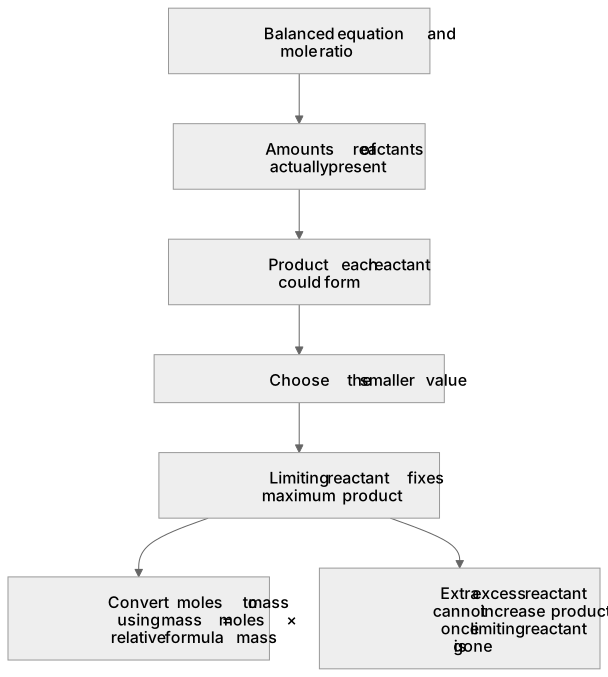
- Calculate the product that each reactant could form, then choose the smaller value as the maximum possible amount.
- Convert between moles and mass using mass = moles × relative formula mass when the question asks for masses in grams.
Common mistakes and how to put them right
Using the larger reactant amount to calculate product.
Put it right: Use the limiting reactant, which gives the smaller possible product amount.
Forgetting to multiply by the coefficient ratio from the balanced equation.
Put it right: Apply the mole ratio, for example 3 mol H₂ forms 2 mol NH₃.
Mixing up moles and grams in the final answer.
Put it right: Convert carefully using relative formula mass and state the unit.
Exam tips
- Show the balanced equation and the mole ratio before calculating product amounts.
- Calculate the product from each reactant separately, then compare to identify the limiting reactant and maximum yield.
- Be aware that explaining the effect of a limiting quantity of a reactant is a Higher Tier only requirement.
Try the lesson
The start of the Limiting reactants (HT only): Students should be able to explain the effect of a limiting quantity of a reactant on the amount of products it is possible to obtain in terms of amounts in moles or masses in grams. lesson, made from checked teaching notes for this specification point.
Have a go first
8.0 g of methane (CH₄) is burned completely in excess oxygen: CH₄ + 2O₂ → CO₂ + 2H₂O. What mass of carbon dioxide is produced? (Mᵣ: CH₄ = 16, CO₂ = 44)
Listen
The limiting reactant controls the maximum product because the reaction stops when it is used up. To explain the effect, compare the actual mole amounts with the balanced equation ratio. For example, in N₂ + 3H₂ → 2NH₃, if 1 mol N₂ reacts with 2 mol H₂, hydrogen is limiting because 1 mol N₂ needs 3 mol H₂. The hydrogen can form (2 ÷ 3) × 2 = 1.33 mol NH₃, while nitrogen could form 2 mol NH₃, so the actual maximum is 1.33 mol. In masses, convert the limiting moles to grams using mass = moles × relative formula mass. Extra excess reactant cannot increase the product once the limiting reactant is gone. This topic is assessed at Higher Tier only. A strong answer earns marks for these points. The limiting reactant is used up first and therefore determines the maximum amount of product. The balanced equation gives the mole ratio needed to compare the amounts of reactants actually present. Calculate the product that each reactant could form, then choose the smaller value as the maximum possible amount. Convert between moles and mass using mass = moles × relative formula mass when the question asks for masses in grams. A common slip: Using the larger reactant amount to calculate product. Instead, use the limiting reactant, which gives the smaller possible product amount. Exam tip: Show the balanced equation and the mole ratio before calculating product amounts.
See it
Watch it explained
What is the one idea the video explains? Say it in a sentence.
Read the described scene instead
This lesson is for Higher Tier only. The limiting reactant is the reactant used up first, and it controls the maximum amount of product. When it is gone, the reaction stops, even if other reactants remain. To explain the effect, compare the actual mole amounts with the ratio in the balanced equation. The balanced equation gives the mole ratio needed to compare the reactants actually present. Calculate the product each reactant could form, then choose the smaller value. In N two plus three H two forming two N H three, one mole of nitrogen needs three moles of hydrogen. If you have one mole of nitrogen and only two moles of hydrogen, hydrogen is limiting. Hydrogen could form two divided by three, times two, equals one point three three moles of ammonia. Nitrogen could form two moles, so the actual maximum is one point three three moles. If the question asks for masses in grams, convert the limiting moles to grams using mass equals moles times relative formula mass. Keep the units clear. Extra excess reactant cannot increase the product once the limiting reactant is gone. Avoid using the larger reactant amount to calculate product. Use the limiting reactant, which gives the smaller possible product amount. Do not forget the coefficient ratio from the balanced equation: three moles of hydrogen forms two moles of ammonia. Finally, do not mix up moles and grams; convert carefully and state the unit. Remember: the limiting reactant is used up first and sets the maximum product. Compare the product each reactant could form using the balanced equation ratio, then choose the smaller value. For masses, convert the limiting moles using mass equals moles times relative formula mass. This is a Higher Tier only requirement.
Key words
Say what each word means before you turn the card.
Limiting reactant
Try answering aloud or in your head before turning the card.
Mole ratio
Try answering aloud or in your head before turning the card.
Maximum product
Try answering aloud or in your head before turning the card.
Mass in grams
Try answering aloud or in your head before turning the card.
See every definition
- Limiting reactant
- The reactant that is used up first and therefore determines the maximum amount of product it is possible to obtain.
- Mole ratio
- The ratio given by the balanced equation that is needed to compare the amounts of reactants actually present.
- Maximum product
- The smaller of the product amounts that each reactant could form, chosen as the maximum possible amount.
- Mass in grams
- A quantity found by converting moles using mass = moles × relative formula mass when the question asks for masses in grams.
Label the diagram
Some boxes have lost their names. Pick the right name for each number.
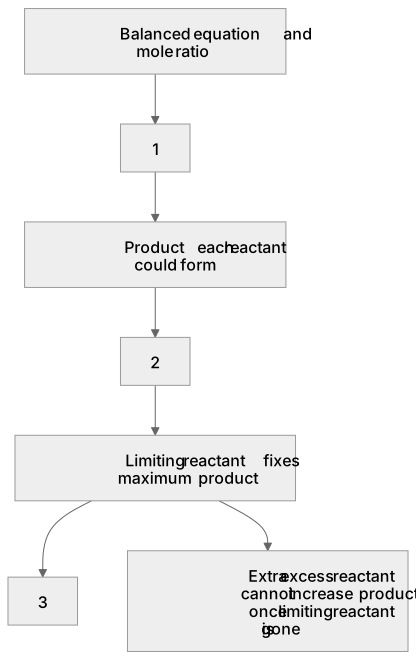
1Box 1
2Box 2
3Box 3
There is more to this lesson
The full lesson goes on to check your understanding and help you earn the marks. Create a free account to carry on, with your progress saved.
A week of Premium from your first lesson · Then the free plan continues · No card, no charge
Test your understanding of Limiting reactants (HT only): Students should be able to explain the effect of a limiting quantity of a reactant on the amount of products it is possible to obtain in terms of amounts in moles or masses in grams.
Active recall beats re-reading. Take an instant quiz now to test what you’ve learned and lock it into long-term memory.
A week of Premium from your first lesson · Then the free plan continues · No card, no charge