AQA · GCSE · Combined Science
Course version: 8464 · Version from Sept 2018
A magnetic compass contains a small bar magnet. The Earth has a magnetic…
Full specification wording
Magnetic fields: A magnetic compass contains a small bar magnet. The Earth has a magnetic field. The compass needle points in the direction of the Earth’s magnetic field.
A magnetic compass is a small bar magnet mounted so it can pivot freely.
Checked against the AQA 8464 specification (opens in a new tab) on .
- Point 5 of 8
- 4 key terms
Study notes
From the checked teaching notes for this specification point.
The idea
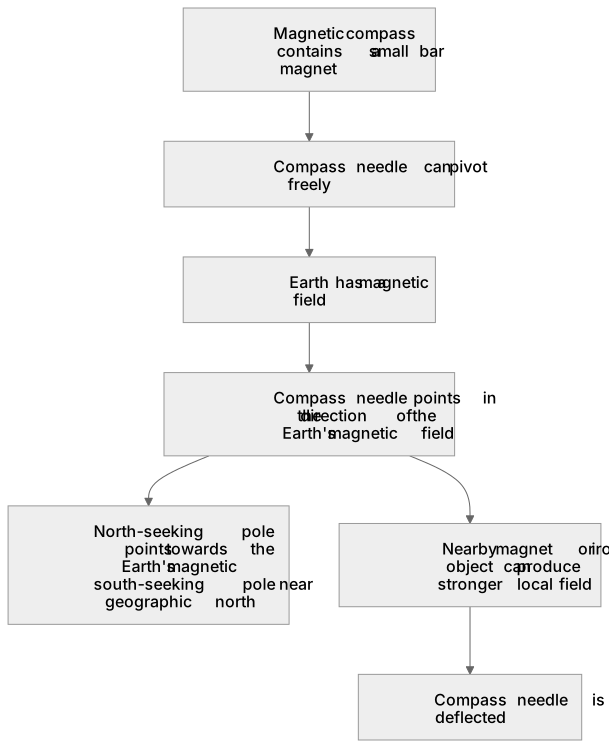
A magnetic compass is a small bar magnet mounted so it can pivot freely. Because a freely suspended magnet aligns with the local magnetic field, the compass needle rotates until it lies along the Earth's magnetic field at that place. The end of the needle that points roughly north is the north-seeking pole; it is attracted towards the Earth's magnetic south-seeking pole, which lies near the geographic north. This is why a compass helps with navigation. The needle does not point exactly to the geographic North Pole because of magnetic declination, and nearby magnets or iron objects can deflect it.
For example: Holding a compass near a bar magnet makes the needle swing to align with the stronger local field rather than the Earth's field.
What earns the marks
- State that a compass contains a small bar magnet that is free to rotate.
- Explain that the Earth itself has a magnetic field, so a freely pivoted magnet aligns with it.
- Describe the compass needle as pointing along the direction of the Earth's magnetic field at its location.
- Identify the north-seeking pole of the compass needle as the end that points towards the Earth's magnetic south-seeking pole near geographic north.
- Explain that a nearby magnet or iron object can produce a stronger local field and deflect the compass needle.
- Recognise that the compass indicates magnetic north, which differs slightly from geographic north due to magnetic declination.
Common mistakes and how to put them right
Saying the compass needle points to the geographic North Pole exactly.
Put it right by explaining it aligns with the Earth's magnetic field, which is close to but not exactly at geographic north.
Believing the Earth has a giant bar magnet with its north pole at the geographic north.
Put it right by stating that the Earth's magnetic south-seeking pole is near geographic north, which is why the compass north-seeking pole is attracted there.
Thinking the compass needle is attracted to the Earth by gravity or static electricity.
Put it right by stating it is a magnetic interaction between the needle's magnetic poles and the Earth's magnetic field.
Exam tips
- Link the compass to the idea of a freely suspended bar magnet aligning with a magnetic field.
- When explaining compass direction, mention both the needle's north-seeking pole and the Earth's magnetic south-seeking pole near geographic north.
- If a question mentions a magnet near a compass, explain the deflection in terms of the stronger local field overriding the Earth's field.
Try the lesson
The start of the Magnetic fields: A magnetic compass contains a small bar magnet. The Earth has a magnetic field. The compass needle points in the direction of the Earth’s magnetic field. lesson, made from checked teaching notes for this specification point.
Have a go first
A student holds a magnetic compass away from any other magnets. What does the compass needle do?
Listen
A magnetic compass is a small bar magnet mounted so it can pivot freely. Because a freely suspended magnet aligns with the local magnetic field, the compass needle rotates until it lies along the Earth's magnetic field at that place. The end of the needle that points roughly north is the north-seeking pole; it is attracted towards the Earth's magnetic south-seeking pole, which lies near the geographic north. This is why a compass helps with navigation. The needle does not point exactly to the geographic North Pole because of magnetic declination, and nearby magnets or iron objects can deflect it. For example, holding a compass near a bar magnet makes the needle swing to align with the stronger local field rather than the Earth's field. A strong answer earns marks for these points. State that a compass contains a small bar magnet that is free to rotate. Explain that the Earth itself has a magnetic field, so a freely pivoted magnet aligns with it. Describe the compass needle as pointing along the direction of the Earth's magnetic field at its location. Identify the north-seeking pole of the compass needle as the end that points towards the Earth's magnetic south-seeking pole near geographic north. A common slip: Saying the compass needle points to the geographic North Pole exactly. Instead, explaining it aligns with the Earth's magnetic field, which is close to but not exactly at geographic north. Exam tip: Link the compass to the idea of a freely suspended bar magnet aligning with a magnetic field.
See it
Key words
Say what each word means before you turn the card.
Magnetic compass
Try answering aloud or in your head before turning the card.
Earth's magnetic field
Try answering aloud or in your head before turning the card.
Alignment of a freely suspended magnet
Try answering aloud or in your head before turning the card.
Magnetic declination
Try answering aloud or in your head before turning the card.
See every definition
- Magnetic compass
- Contains a small bar magnet mounted so it can pivot freely, and its needle rotates until it lies along the local magnetic field.
- Earth's magnetic field
- The field of the Earth itself, so that a freely pivoted magnet aligns with it and the compass needle points in its direction.
- Alignment of a freely suspended magnet
- A freely suspended magnet aligns with the local magnetic field, so the compass needle rotates until it lies along the Earth's magnetic field at that place.
- Magnetic declination
- The compass indicates magnetic north, which differs slightly from geographic north because of this.
Label the diagram
Some boxes have lost their names. Pick the right name for each number.
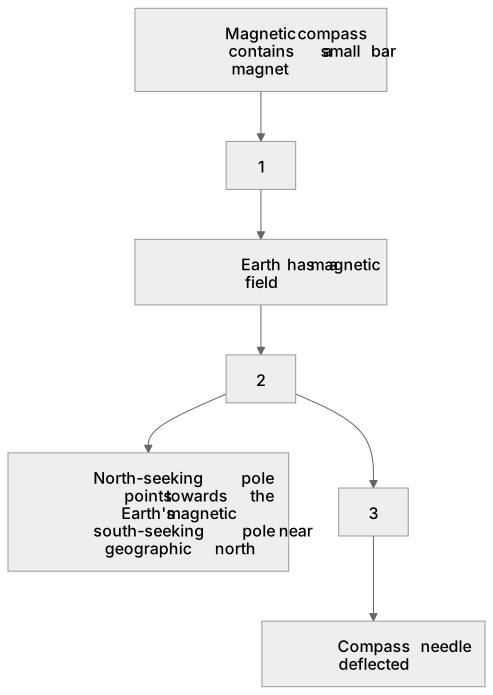
1Box 1
2Box 2
3Box 3
There is more to this lesson
The full lesson goes on to check your understanding and help you earn the marks. Create a free account to carry on, with your progress saved.
A week of Premium from your first lesson · Then the free plan continues · No card, no charge
Test your understanding of Magnetic fields: A magnetic compass contains a small bar magnet. The Earth has a magnetic field. The compass needle points in the direction of the Earth’s magnetic field.
Active recall beats re-reading. Take an instant quiz now to test what you’ve learned and lock it into long-term memory.
A week of Premium from your first lesson · Then the free plan continues · No card, no charge