AQA · GCSE · Combined Science
Course version: 8464 · Version from Sept 2018
Students should be able to describe both positive and negative human…
Full specification wording
Maintaining biodiversity: Students should be able to describe both positive and negative human interactions in an ecosystem and explain their impact on biodiversity.
Human interactions with an ecosystem can raise or lower biodiversity.
Checked against the AQA 8464 specification (opens in a new tab) on .
- Point 1 of 8
- 3 key terms
Study notes
From the checked teaching notes for this specification point.
The idea
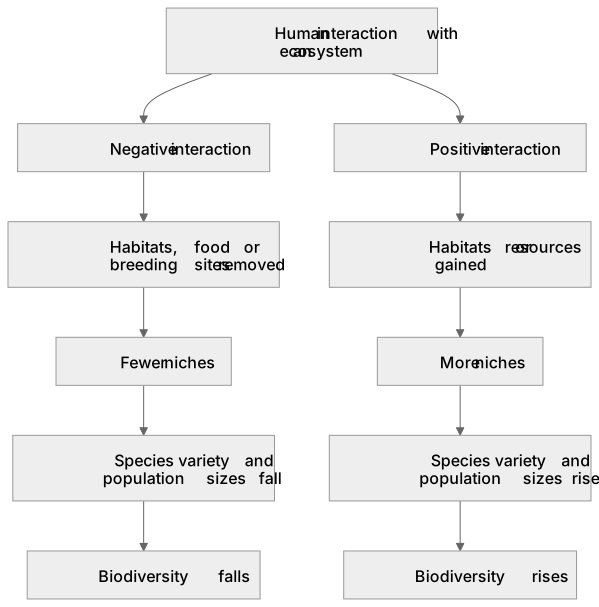
Human interactions with an ecosystem can raise or lower biodiversity. Negative interactions include deforestation, draining peat bogs, overfishing, pollution and building on greenfield land; each removes habitats, food or breeding sites, so species numbers and variety fall. Positive interactions include replanting woodland, restoring wetlands, creating hedgerows and wildlife corridors, reducing pollution and setting aside nature reserves. To describe, name the interaction and say what changes in the ecosystem. To explain, link that change to species survival: fewer habitats means fewer niches, so populations shrink and some species disappear locally.
For example: Clearing hedgerows removes nesting sites and insect food, lowering bird diversity.
What earns the marks
- Names a negative interaction such as deforestation, peat extraction, overfishing, pollution or urban expansion and states the habitat or resource lost.
- Names a positive interaction such as reforestation, wetland restoration, hedgerow planting, wildlife corridors or pollution reduction and states the habitat or resource gained.
- Explains the impact on biodiversity by linking habitat change to the number of available niches, so species variety and population sizes rise or fall.
- Uses a specific example, such as hedgerow removal reducing nesting sites and insect food so bird diversity falls.
- Distinguishes local effects, such as one pond being polluted, from wider effects, such as a river catchment losing several species.
- Applies the terms biodiversity, ecosystem, habitat, species and population correctly when describing the interaction.
Common mistakes and how to put them right
Treating any planting as automatically positive.
Put it right: State which species benefit and why, because planting a single non-native species can reduce variety.
Confusing habitat loss with extinction.
Put it right: Habitat loss lowers biodiversity and may cause local extinction, but global extinction needs wider evidence.
Describing an interaction without its impact.
Put it right: Add the consequence for species number or population size, not just the activity.
Exam tips
- Use a two-part answer: first describe the interaction, then explain the biodiversity impact using because or so.
- Choose one negative and one positive interaction and develop each with a named organism or habitat.
- Link answers to niches and habitats; these ideas carry the explanation beyond simple description.
Try the lesson
The start of the Maintaining biodiversity: Students should be able to describe both positive and negative human interactions in an ecosystem and explain their impact on biodiversity. lesson, made from checked teaching notes for this specification point.
Have a go first
Which human activity is a positive interaction that helps to maintain biodiversity in an ecosystem?
Listen
Human interactions with an ecosystem can raise or lower biodiversity. Negative interactions include deforestation, draining peat bogs, overfishing, pollution and building on greenfield land; each removes habitats, food or breeding sites, so species numbers and variety fall. Positive interactions include replanting woodland, restoring wetlands, creating hedgerows and wildlife corridors, reducing pollution and setting aside nature reserves. To describe, name the interaction and say what changes in the ecosystem. To explain, link that change to species survival: fewer habitats means fewer niches, so populations shrink and some species disappear locally. For example, clearing hedgerows removes nesting sites and insect food, lowering bird diversity. A strong answer earns marks for these points. Names a negative interaction such as deforestation, peat extraction, overfishing, pollution or urban expansion and states the habitat or resource lost. Names a positive interaction such as reforestation, wetland restoration, hedgerow planting, wildlife corridors or pollution reduction and states the habitat or resource gained. Explains the impact on biodiversity by linking habitat change to the number of available niches, so species variety and population sizes rise or fall. Uses a specific example, such as hedgerow removal reducing nesting sites and insect food so bird diversity falls. Exam tip: Use a two-part answer: first describe the interaction, then explain the biodiversity impact using because or so.
See it
Key words
Say what each word means before you turn the card.
Biodiversity
Try answering aloud or in your head before turning the card.
Human impact on ecosystems
Try answering aloud or in your head before turning the card.
Habitat loss and restoration
Try answering aloud or in your head before turning the card.
See every definition
- Biodiversity
- The variety and number of species in an ecosystem, which human interactions can raise or lower.
- Human impact on ecosystems
- Positive and negative human interactions with an ecosystem, such as deforestation or replanting woodland, and their effect on biodiversity.
- Habitat loss and restoration
- Removal of habitats, food or breeding sites, or gaining them again through replanting woodland, restoring wetlands or creating hedgerows and wildlife corridors.
Label the diagram
Some boxes have lost their names. Pick the right name for each number.
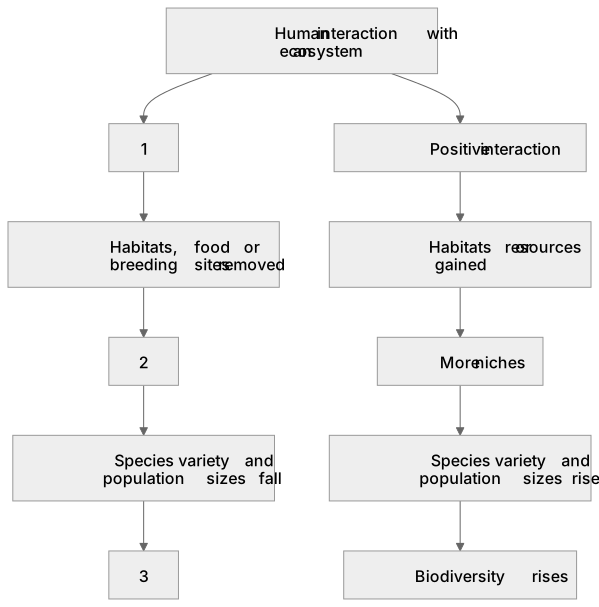
1Box 1
2Box 2
3Box 3
There is more to this lesson
The full lesson goes on to check your understanding and help you earn the marks. Create a free account to carry on, with your progress saved.
A week of Premium from your first lesson · Then the free plan continues · No card, no charge
Test your understanding of Maintaining biodiversity: Students should be able to describe both positive and negative human interactions in an ecosystem and explain their impact on biodiversity.
Active recall beats re-reading. Take an instant quiz now to test what you’ve learned and lock it into long-term memory.
A week of Premium from your first lesson · Then the free plan continues · No card, no charge