AQA · GCSE · Combined Science
Course version: 8464 · Version from Sept 2018
Metabolism: conversion of glucose to starch, glycogen and cellulose
Glucose is a soluble sugar made in photosynthesis and used in respiration.
Checked against the AQA 8464 specification (opens in a new tab) on .
- Point 5 of 10
- 4 key terms
Study notes
From the checked teaching notes for this specification point.
The idea
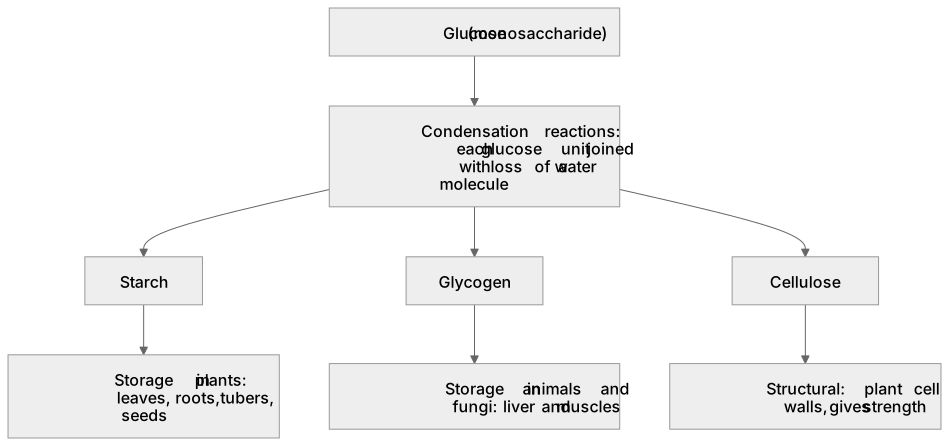
Glucose is a soluble sugar made in photosynthesis and used in respiration. Excess glucose is converted into storage or structural polymers by condensation reactions, each glucose unit joining with the loss of a water molecule. Plants convert glucose to starch for storage in leaves, roots and seeds, and to cellulose for cell walls. Animals, including humans, convert glucose to glycogen for storage in the liver and muscles. Starch and glycogen are compact, insoluble and easily hydrolysed back to glucose when needed; cellulose is strong and structural. A useful method is to compare the three products by monomer, solubility, function and location, for example starch in a potato tuber, glycogen in liver cells and cellulose in a plant cell wall.
What earns the marks
- Glucose is a monosaccharide; starch, glycogen and cellulose are polysaccharides formed by joining many glucose units together.
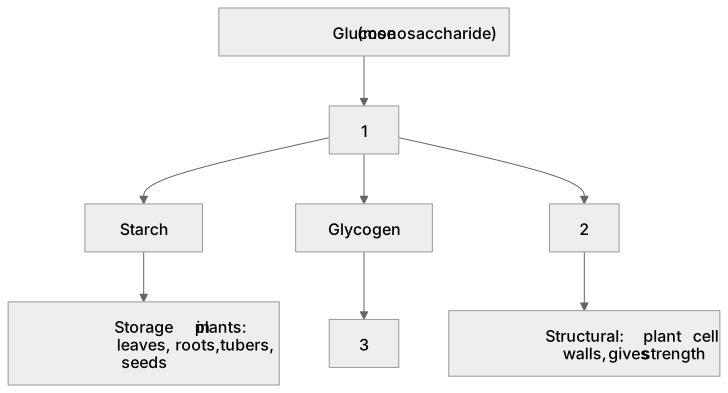
- The conversions are condensation reactions: each glucose unit added releases one molecule of water.
- Starch is the storage polysaccharide in plants, found in leaves, roots, tubers and seeds.
- Glycogen is the storage polysaccharide in animals and fungi, stored in the liver and muscles.
- Cellulose is a structural polysaccharide that forms plant cell walls and gives strength.
- Starch and glycogen are insoluble and compact, so they do not affect cell water potential and are readily hydrolysed to glucose for respiration.
- Cellulose molecules form straight chains held by hydrogen bonds, giving strength; it is not used as an energy store in humans.
- All three are polymers of glucose but differ in the arrangement of glucose units and in the bonds between them, so their properties differ.
Common mistakes and how to put them right
Saying glucose is converted to glycogen in plants.
Put it right: , plants store starch, while animals and fungi store glycogen.
Describing the conversion as hydrolysis.
Put it right: , joining glucose units is condensation, which releases water; hydrolysis uses water to break the polymer down.
Stating that cellulose is a storage molecule.
Put it right: , cellulose is structural, forming plant cell walls, and is not broken down for energy in humans.
Exam tips
- Link each product to its function and location, for example starch in a potato tuber, glycogen in liver cells, cellulose in a plant cell wall.
- Use the word condensation and state that water is released when glucose units join.
- Compare the three polysaccharides in a table of monomer, solubility, function and where found to cover several marking points concisely.
Try the lesson
The start of the Metabolism: conversion of glucose to starch, glycogen and cellulose lesson, made from checked teaching notes for this specification point.
Have a go first
In which molecule are glucose units stored in a plant cell?
Listen
Glucose is a soluble sugar made in photosynthesis and used in respiration. Excess glucose is converted into storage or structural polymers by condensation reactions, each glucose unit joining with the loss of a water molecule. Plants convert glucose to starch for storage in leaves, roots and seeds, and to cellulose for cell walls. Animals, including humans, convert glucose to glycogen for storage in the liver and muscles. Starch and glycogen are compact, insoluble and easily hydrolysed back to glucose when needed; cellulose is strong and structural. A useful method is to compare the three products by monomer, solubility, function and location, for example starch in a potato tuber, glycogen in liver cells and cellulose in a plant cell wall. A strong answer earns marks for these points. Glucose is a monosaccharide; starch, glycogen and cellulose are polysaccharides formed by joining many glucose units together. The conversions are condensation reactions: each glucose unit added releases one molecule of water. Starch is the storage polysaccharide in plants, found in leaves, roots, tubers and seeds. Glycogen is the storage polysaccharide in animals and fungi, stored in the liver and muscles. A common slip: Saying glucose is converted to glycogen in plants. Instead, , plants store starch, while animals and fungi store glycogen. Exam tip: Link each product to its function and location, for example starch in a potato tuber, glycogen in liver cells, cellulose in a plant cell wall.
See it
Key words
Say what each word means before you turn the card.
Condensation
Try answering aloud or in your head before turning the card.
Starch
Try answering aloud or in your head before turning the card.
Glycogen
Try answering aloud or in your head before turning the card.
Cellulose
Try answering aloud or in your head before turning the card.
See every definition
- Condensation
- A reaction in which glucose units are joined together, with the loss of a water molecule each time a unit is added.
- Starch
- The storage polysaccharide in plants, found in leaves, roots, tubers and seeds, which is compact, insoluble and easily hydrolysed back to glucose.
- Glycogen
- The storage polysaccharide in animals and fungi, stored in the liver and muscles, which is compact, insoluble and readily hydrolysed to glucose for respiration.
- Cellulose
- A structural polysaccharide that forms plant cell walls and gives strength, with straight chains held by hydrogen bonds, and is not used as an energy store in humans.
Label the diagram
Some boxes have lost their names. Pick the right name for each number.
1Box 1
2Box 2
3Box 3
There is more to this lesson
The full lesson goes on to check your understanding and help you earn the marks. Create a free account to carry on, with your progress saved.
A week of Premium from your first lesson · Then the free plan continues · No card, no charge
Test your understanding of Metabolism: conversion of glucose to starch, glycogen and cellulose
Active recall beats re-reading. Take an instant quiz now to test what you’ve learned and lock it into long-term memory.
A week of Premium from your first lesson · Then the free plan continues · No card, no charge