AQA · GCSE · Combined Science
Course version: 8464 · Version from Sept 2018
The use of glucose and nitrate ions to form amino acids which in turn are…
Full specification wording
Metabolism: the use of glucose and nitrate ions to form amino acids which in turn are used to synthesise proteins
Plants make glucose by photosynthesis.
Checked against the AQA 8464 specification (opens in a new tab) on .
- Point 7 of 10
- 4 key terms
Study notes
From the checked teaching notes for this specification point.
The idea
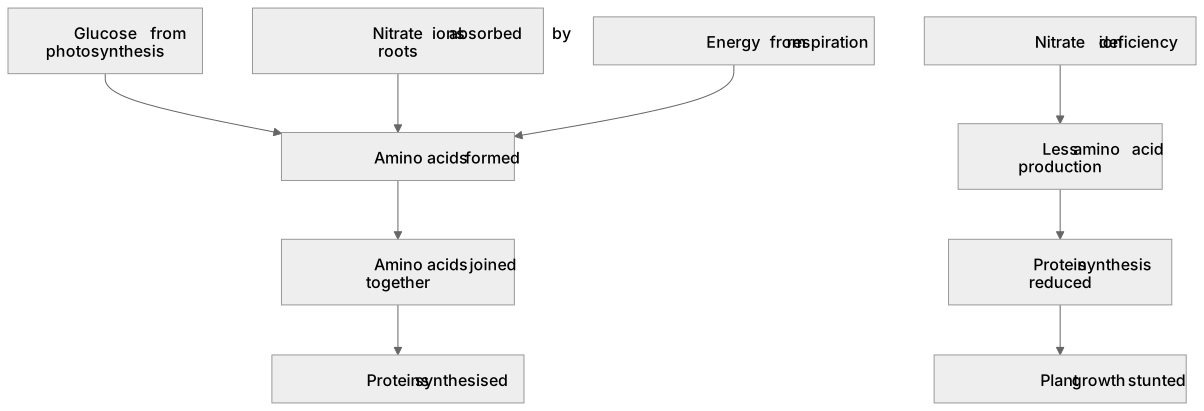
Plants make glucose by photosynthesis. Glucose provides carbon skeletons and energy. Nitrate ions absorbed by roots supply nitrogen. These combine to form amino acids, the monomers of proteins. For example, glucose from photosynthesis and nitrate ions from soil are used in leaf cells to make amino acids, which are then joined by peptide bonds into proteins. Proteins act as enzymes, hormones, structural components and transport molecules. This is an example of metabolism: the sum of all reactions in a cell or the body. The process requires energy from respiration. If nitrate ions are deficient, plants cannot make enough amino acids, so protein synthesis slows and growth is stunted, with yellowing older leaves. This links mineral nutrition to protein synthesis and plant health.
What earns the marks
- Glucose is produced by photosynthesis and provides carbon, hydrogen and oxygen for amino acid synthesis.
- Nitrate ions are absorbed from the soil by root hair cells and provide nitrogen for amino acid synthesis.
- Amino acids are the monomers that are joined together to synthesise proteins.
- Protein synthesis is an example of metabolism and requires energy from respiration.
- A deficiency of nitrate ions limits amino acid production, so protein synthesis and plant growth are reduced.
Common mistakes and how to put them right
Thinking plants absorb nitrogen gas from the air.
Put it right: Plants absorb nitrate ions from the soil through root hair cells.
Confusing amino acids with proteins.
Put it right: Amino acids are the monomers; proteins are polymers made from many amino acids.
Believing glucose alone is enough to make proteins.
Put it right: Glucose provides carbon skeletons, but nitrogen from nitrate ions is also needed to form amino acids.
Exam tips
- Link the role of glucose to photosynthesis and the role of nitrate ions to root absorption when explaining amino acid formation.
- Use the terms monomer and polymer correctly: amino acids are monomers, proteins are polymers.
- When describing deficiency symptoms, state the effect on protein synthesis and then on growth, rather than just saying the plant is unhealthy.
Try the lesson
The start of the Metabolism: the use of glucose and nitrate ions to form amino acids which in turn are used to synthesise proteins lesson, made from checked teaching notes for this specification point.
Have a go first
In a plant, glucose made in photosynthesis is combined with nitrate ions absorbed from the soil. What is produced by this combination?
Listen
Plants make glucose by photosynthesis. Glucose provides carbon skeletons and energy. Nitrate ions absorbed by roots supply nitrogen. These combine to form amino acids, the monomers of proteins. For example, glucose from photosynthesis and nitrate ions from soil are used in leaf cells to make amino acids, which are then joined by peptide bonds into proteins. Proteins act as enzymes, hormones, structural components and transport molecules. This is an example of metabolism: the sum of all reactions in a cell or the body. The process requires energy from respiration. If nitrate ions are deficient, plants cannot make enough amino acids, so protein synthesis slows and growth is stunted, with yellowing older leaves. This links mineral nutrition to protein synthesis and plant health. A strong answer earns marks for these points. Glucose is produced by photosynthesis and provides carbon, hydrogen and oxygen for amino acid synthesis. Nitrate ions are absorbed from the soil by root hair cells and provide nitrogen for amino acid synthesis. Amino acids are the monomers that are joined together to synthesise proteins. Protein synthesis is an example of metabolism and requires energy from respiration. A common slip: Thinking plants absorb nitrogen gas from the air. Instead, plants absorb nitrate ions from the soil through root hair cells. Exam tip: Link the role of glucose to photosynthesis and the role of nitrate ions to root absorption when explaining amino acid formation.
See it
Key words
Say what each word means before you turn the card.
amino acids
Try answering aloud or in your head before turning the card.
nitrate ions
Try answering aloud or in your head before turning the card.
metabolism
Try answering aloud or in your head before turning the card.
glucose
Try answering aloud or in your head before turning the card.
See every definition
- amino acids
- Formed from glucose and nitrate ions, these are the monomers that are joined together to synthesise proteins.
- nitrate ions
- Absorbed from the soil by root hair cells, they supply nitrogen for amino acid synthesis.
- metabolism
- The sum of all reactions in a cell or the body, of which protein synthesis is an example.
- glucose
- Produced by photosynthesis, it provides carbon skeletons for amino acid synthesis.
Label the diagram
Some boxes have lost their names. Pick the right name for each number.
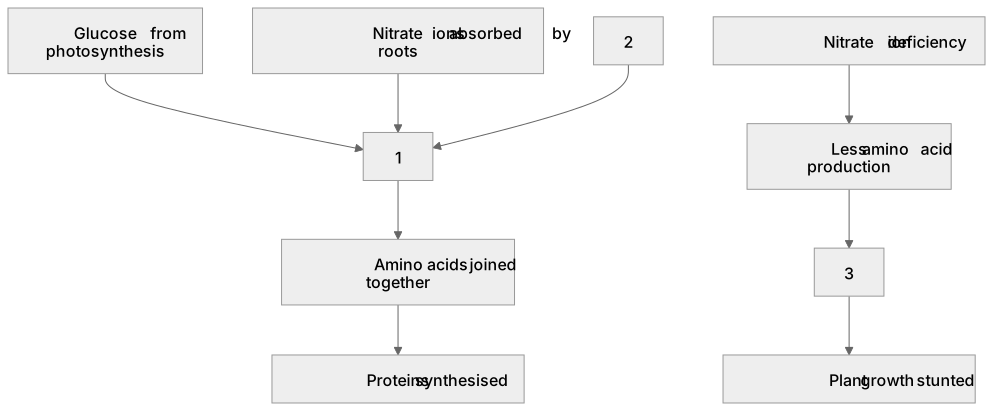
1Box 1
2Box 2
3Box 3
There is more to this lesson
The full lesson goes on to check your understanding and help you earn the marks. Create a free account to carry on, with your progress saved.
A week of Premium from your first lesson · Then the free plan continues · No card, no charge
Test your understanding of Metabolism: the use of glucose and nitrate ions to form amino acids which in turn are used to synthesise proteins
Active recall beats re-reading. Take an instant quiz now to test what you’ve learned and lock it into long-term memory.
A week of Premium from your first lesson · Then the free plan continues · No card, no charge