AQA · GCSE · Combined Science
Course version: 8464 · Version from Sept 2018
Metals and non-metals: Elements that react to form positive ions are metals.
This statement links an element's position in the periodic table to the type of ion it forms.
Checked against the AQA 8464 specification (opens in a new tab) on .
- Point 1 of 6
- 4 key terms
Study notes
From the checked teaching notes for this specification point.
The idea
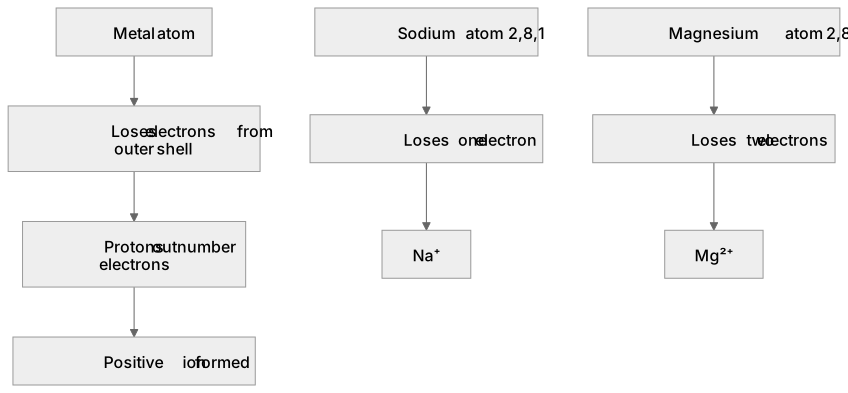
This statement links an element's position in the periodic table to the type of ion it forms. Metals occupy the left and centre of the periodic table, and their atoms lose electrons from the outer shell so that the number of protons exceeds the number of electrons, giving a positive ion. For example, a sodium atom (2,8,1) loses its single outer electron to become Na⁺, and a magnesium atom (2,8,2) loses two electrons to become Mg²⁺. Non-metals, found towards the upper right, gain or share electrons and typically form negative ions such as O²⁻ and Cl⁻. The statement is a classification rule: if an element reacts by forming positive ions, it is a metal. It does not claim that every metal reaction produces ions, nor that metals never form covalent bonds.
What earns the marks
- Metals are elements that lose electrons from their outer shell when they react, producing positively charged ions.
- A positive ion forms because the number of protons in the nucleus is greater than the number of electrons remaining.
- Sodium loses one electron to form Na⁺; magnesium loses two electrons to form Mg²⁺; aluminium loses three to form Al³⁺.
- Non-metals are located towards the upper right of the periodic table and typically gain electrons to form negative ions such as O²⁻ and Cl⁻.
- The rule is used to classify an element from its reaction behaviour or its position in the periodic table, not to predict every possible compound.
Common mistakes and how to put them right
Thinking that all metals form positive ions in every reaction.
Put it right: The statement describes the characteristic behaviour of metals when they do form ions, and some metal compounds are covalent.
Writing ion charges without superscript signs, for example using a plain plus sign after the symbol.
Put it right: Use Unicode superscript notation such as Na⁺ and Mg²⁺.
Confusing the number of electrons lost with the group number for every element.
Put it right: For main-group metals the group number usually equals the number of outer electrons lost, but transition metals can form more than one ion, such as Fe²⁺ and Fe³⁺.
Exam tips
- When asked to classify an element, quote both its position in the periodic table and the charge on the ion it forms.
- Show the electron loss explicitly, for example sodium 2,8,1 becomes Na⁺ with the configuration 2,8.
- Use the words positive ion and electron loss together so the link between structure and charge is clear.
Try the lesson
The start of the Metals and non-metals: Elements that react to form positive ions are metals. lesson, made from checked teaching notes for this specification point.
Have a go first
Which type of element reacts to form positive ions?
Listen
This statement links an element's position in the periodic table to the type of ion it forms. Metals occupy the left and centre of the periodic table, and their atoms lose electrons from the outer shell so that the number of protons exceeds the number of electrons, giving a positive ion. For example, a sodium atom (2,8,1) loses its single outer electron to become Na⁺, and a magnesium atom (2,8,2) loses two electrons to become Mg²⁺. Non-metals, found towards the upper right, gain or share electrons and typically form negative ions such as O²⁻ and Cl⁻. The statement is a classification rule: if an element reacts by forming positive ions, it is a metal. It does not claim that every metal reaction produces ions, nor that metals never form covalent bonds. A strong answer earns marks for these points. Metals are elements that lose electrons from their outer shell when they react, producing positively charged ions. A positive ion forms because the number of protons in the nucleus is greater than the number of electrons remaining. Sodium loses one electron to form Na⁺; magnesium loses two electrons to form Mg²⁺; aluminium loses three to form Al³⁺. Non-metals are located towards the upper right of the periodic table and typically gain electrons to form negative ions such as O²⁻ and Cl⁻. A common slip: Thinking that all metals form positive ions in every reaction. Instead, the statement describes the characteristic behaviour of metals when they do form ions, and some metal compounds are covalent. Exam tip: When asked to classify an element, quote both its position in the periodic table and the charge on the ion it forms.
See it
Key words
Say what each word means before you turn the card.
Metals
Try answering aloud or in your head before turning the card.
Positive ion
Try answering aloud or in your head before turning the card.
Non-metals
Try answering aloud or in your head before turning the card.
Electron loss
Try answering aloud or in your head before turning the card.
See every definition
- Metals
- Elements that react to form positive ions, occupying the left and centre of the periodic table.
- Positive ion
- Formed when an atom loses electrons from the outer shell so that the number of protons exceeds the number of electrons.
- Non-metals
- Elements found towards the upper right of the periodic table that gain or share electrons and typically form negative ions.
- Electron loss
- Process in which a metal atom loses electrons from its outer shell when it reacts, producing a positively charged ion.
Label the diagram
Some boxes have lost their names. Pick the right name for each number.
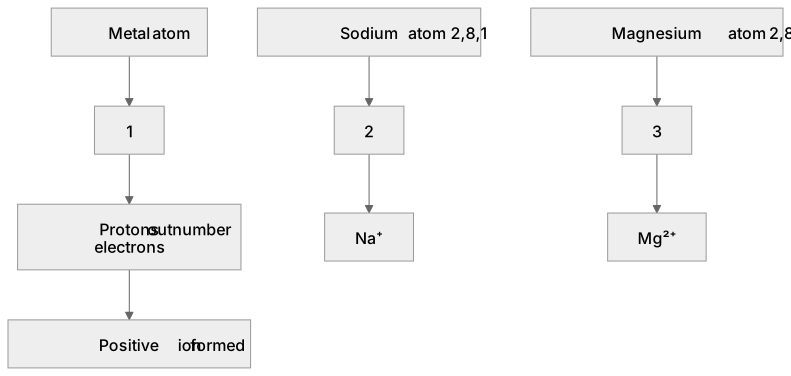
1Box 1
2Box 2
3Box 3
There is more to this lesson
The full lesson goes on to check your understanding and help you earn the marks. Create a free account to carry on, with your progress saved.
A week of Premium from your first lesson · Then the free plan continues · No card, no charge
Test your understanding of Metals and non-metals: Elements that react to form positive ions are metals.
Active recall beats re-reading. Take an instant quiz now to test what you’ve learned and lock it into long-term memory.
A week of Premium from your first lesson · Then the free plan continues · No card, no charge