AQA · GCSE · Combined Science
Course version: 8464 · Version from Sept 2018
Elements that do not form positive ions are non-metals.
Full specification wording
Metals and non-metals: Elements that do not form positive ions are non-metals.
This statement gives a practical way to classify an element as a non-metal: if it does not form positive ions, it is a non-metal.
Checked against the AQA 8464 specification (opens in a new tab) on .
- Point 2 of 6
- 4 key terms
Study notes
From the checked teaching notes for this specification point.
The idea
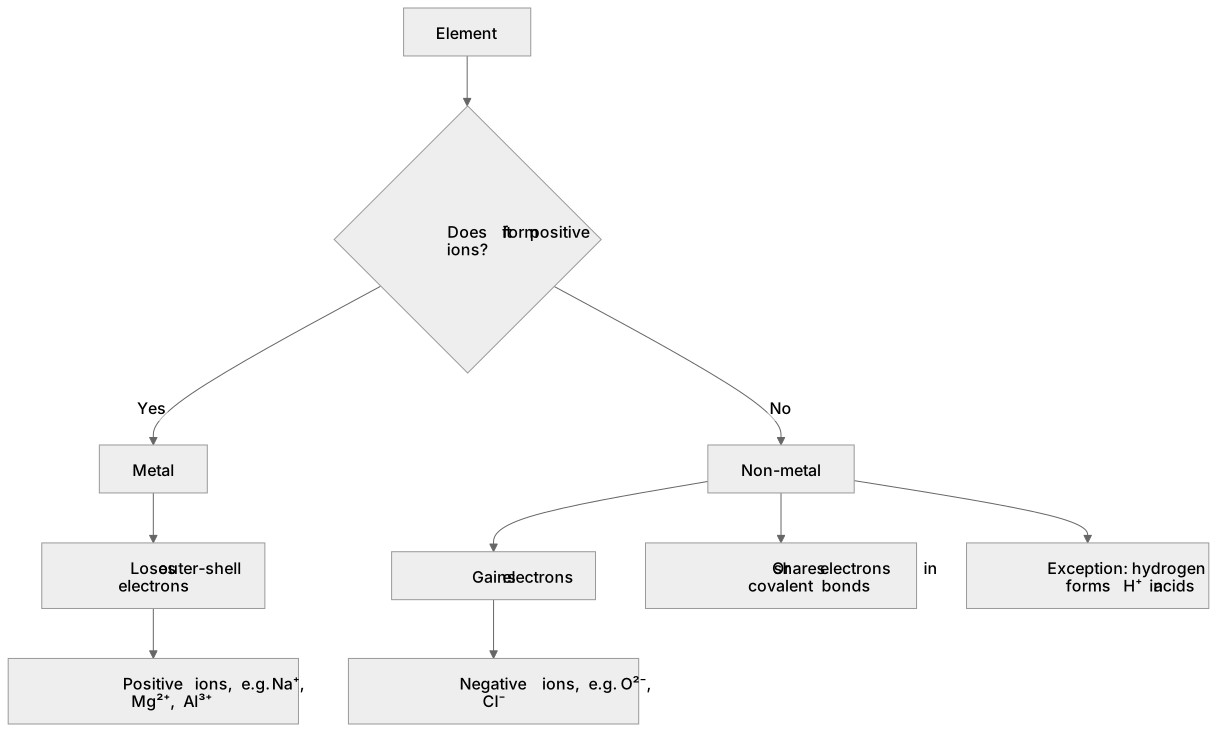
This statement gives a practical way to classify an element as a non-metal: if it does not form positive ions, it is a non-metal. Metals, on the left and centre of the periodic table, lose outer-shell electrons to form positive ions such as Na⁺, Mg²⁺ and Al³⁺. Non-metals, mostly on the right and top, gain or share electrons; they form negative ions such as O²⁻ and Cl⁻, or covalent bonds, and do not form positive ions. For example, oxygen gains two electrons to become O²⁻, and chlorine gains one electron to become Cl⁻. Hydrogen is a non-metal that forms H⁺ in acids, so the statement is a general rule with that familiar exception. Use electron configuration and position in the periodic table to decide whether an element tends to lose or gain electrons.
What earns the marks
- Metals lose electrons from their outer shell to form positive ions, for example Na → Na⁺ + e⁻ and Mg → Mg²⁺ + 2e⁻.
- Non-metals gain electrons to form negative ions, for example O + 2e⁻ → O²⁻ and Cl + e⁻ → Cl⁻.
- Elements that do not form positive ions are classified as non-metals, so the absence of positive-ion formation is the key test in this statement.
- Non-metals can also bond covalently by sharing electrons, so they do not need to form ions at all in many compounds.
- Position in the periodic table supports the classification: metals are mainly on the left and centre, non-metals mainly on the right and top.
- Hydrogen is a non-metal that can form H⁺ in acidic solution, so it is a recognised exception to the simple rule.
Common mistakes and how to put them right
Assuming every non-metal forms negative ions in all compounds.
Put it right: Many non-metals, such as carbon and hydrogen in covalent compounds, share electrons instead of forming ions.
Treating hydrogen as a metal because it can form a positive ion.
Put it right: Hydrogen is a non-metal, and its formation of H⁺ in acids is a specific exception to the general rule.
Confusing the charge number with the number of electrons gained or lost.
Put it right: O²⁻ shows a 2⁻ charge because oxygen gains two electrons, not because it gains one.
Thinking that all elements on the right of the periodic table are non-metals without checking.
Put it right: Use electron loss or gain and ion formation as the deciding evidence.
Exam tips
- Link each classification to electron transfer: metals lose electrons to form positive ions, non-metals gain or share electrons.
- When explaining an example, write the ion with a superscript charge, such as Mg²⁺ or O²⁻, and state the number of electrons gained or lost.
- If a question asks you to identify a non-metal, look for an element that forms negative ions or covalent bonds rather than positive ions.
- Use the periodic table position as supporting evidence, but base your final answer on ion formation or electron transfer.
Try the lesson
The start of the Metals and non-metals: Elements that do not form positive ions are non-metals. lesson, made from checked teaching notes for this specification point.
Have a go first
Which type of element is described by the statement that it does not form positive ions?
Listen
This statement gives a practical way to classify an element as a non-metal: if it does not form positive ions, it is a non-metal. Metals, on the left and centre of the periodic table, lose outer-shell electrons to form positive ions such as Na⁺, Mg²⁺ and Al³⁺. Non-metals, mostly on the right and top, gain or share electrons; they form negative ions such as O²⁻ and Cl⁻, or covalent bonds, and do not form positive ions. For example, oxygen gains two electrons to become O²⁻, and chlorine gains one electron to become Cl⁻. Hydrogen is a non-metal that forms H⁺ in acids, so the statement is a general rule with that familiar exception. Use electron configuration and position in the periodic table to decide whether an element tends to lose or gain electrons. A strong answer earns marks for these points. Metals lose electrons from their outer shell to form positive ions, for example Na → Na⁺ + e⁻ and Mg → Mg²⁺ + 2e⁻. Non-metals gain electrons to form negative ions, for example O + 2e⁻ → O²⁻ and Cl + e⁻ → Cl⁻. Elements that do not form positive ions are classified as non-metals, so the absence of positive-ion formation is the key test in this statement. Non-metals can also bond covalently by sharing electrons, so they do not need to form ions at all in many compounds. A common slip: Assuming every non-metal forms negative ions in all compounds. Instead, many non-metals, such as carbon and hydrogen in covalent compounds, share electrons instead of forming ions. Exam tip: Link each classification to electron transfer: metals lose electrons to form positive ions, non-metals gain or share electrons.
See it
Key words
Say what each word means before you turn the card.
Non-metals
Try answering aloud or in your head before turning the card.
Metals
Try answering aloud or in your head before turning the card.
Covalent bonds
Try answering aloud or in your head before turning the card.
Hydrogen
Try answering aloud or in your head before turning the card.
See every definition
- Non-metals
- Elements that do not form positive ions, mostly found on the right and top of the periodic table.
- Metals
- Elements on the left and centre of the periodic table that lose outer-shell electrons to form positive ions.
- Covalent bonds
- Bonds formed by non-metals sharing electrons, so they do not need to form ions at all in many compounds.
- Hydrogen
- A non-metal that forms H⁺ in acids, so it is a recognised exception to the simple rule.
There is more to this lesson
The full lesson goes on to check your understanding and help you earn the marks. Create a free account to carry on, with your progress saved.
A week of Premium from your first lesson · Then the free plan continues · No card, no charge
Test your understanding of Metals and non-metals: Elements that do not form positive ions are non-metals.
Active recall beats re-reading. Take an instant quiz now to test what you’ve learned and lock it into long-term memory.
A week of Premium from your first lesson · Then the free plan continues · No card, no charge