AQA · GCSE · Combined Science
Course version: 8464 · Version from Sept 2018
Required practical activity 19: investigate the effect of varying the…
Full specification wording
Newton's Second Law: Required practical activity 19: investigate the effect of varying the force on the acceleration of an object of constant mass, and the effect of varying the mass of an object on the acceleration produced by a constant force.
This required practical tests Newton's Second Law, a = F ÷ m, in two ways.
Checked against the AQA 8464 specification (opens in a new tab) on .
- Point 13 of 13
Study notes
From the checked teaching notes for this specification point.
The idea
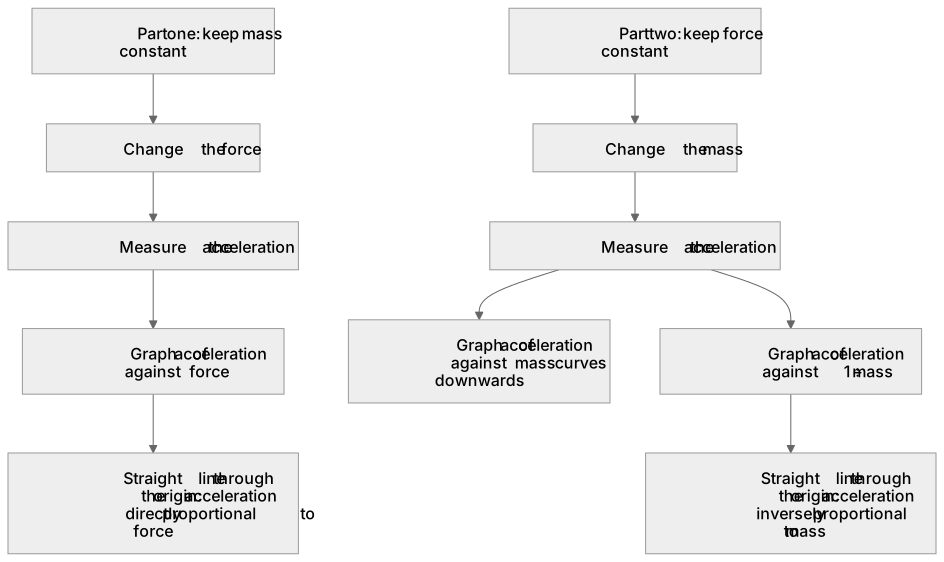
This required practical tests Newton's Second Law, a = F ÷ m, in two ways. In the first, keep the mass constant and change the force, then measure the acceleration; a graph of acceleration against force should be a straight line through the origin, showing that acceleration is directly proportional to force. In the second, keep the force constant and change the mass, then measure the acceleration; a graph of acceleration against mass curves downwards, and a graph of acceleration against 1 ÷ mass is a straight line through the origin, showing that acceleration is inversely proportional to mass. A typical method uses a trolley on a runway, a string over a pulley, and hanging masses to provide the force, with light gates or a motion sensor to time the trolley. Control variables include the same runway, the same trolley and the same starting position.
What earns the marks
- Identifies the independent variable, dependent variable and control variables for each part of the investigation, for example force changed and acceleration measured while mass is fixed in part one.
- Describes a workable method to apply a known force to a trolley of constant mass, such as hanging masses on a string over a pulley, and to measure the acceleration, such as using light gates or a motion sensor.
- Explains how to reduce the effect of friction, for example by tilting the runway slightly until the trolley moves at constant velocity before the force is applied.
- Processes results by plotting a graph of acceleration against force and recognising a straight line through the origin as evidence that acceleration is directly proportional to force.
- Evaluates the investigation by identifying sources of uncertainty, such as timing errors or friction, and suggesting improvements such as repeating readings and calculating a mean.
Common mistakes and how to put them right
Changing both force and mass in the same set of readings.
Put it right: Change only one variable at a time, keeping the other quantity constant so the effect on acceleration can be attributed to the chosen variable.
Ignoring friction and treating the hanging weight as the only force on the trolley.
Put it right: Compensate for friction by tilting the runway, or discuss friction as a source of error that makes the measured acceleration smaller than expected.
Plotting acceleration against mass and expecting a straight line through the origin.
Put it right: Acceleration is inversely proportional to mass, so the straight-line graph is acceleration against 1 ÷ mass.
Exam tips
- State clearly which quantity you change, which you measure and which you keep the same; examiners look for this control of variables in practical questions.
- When describing the graph, name both axes and the shape you expect, and link the shape to the relationship between the variables rather than just saying 'it goes up'.
- Include one realistic improvement, such as repeating each reading and taking a mean, and explain how it reduces the effect of random error.
Try the lesson
The start of the Newton's Second Law: Required practical activity 19: investigate the effect of varying the force on the acceleration of an object of constant mass, and the effect of varying the mass of an object on the acceleration produced by a constant force. lesson, made from checked teaching notes for this specification point.
Have a go first
In the required practical investigating the relationship between force and acceleration, a trolley is pulled along a track by a falling mass. Which pair of measurements is needed to determine the acceleration of the trolley?
Listen
This required practical tests Newton's Second Law, a = F ÷ m, in two ways. In the first, keep the mass constant and change the force, then measure the acceleration; a graph of acceleration against force should be a straight line through the origin, showing that acceleration is directly proportional to force. In the second, keep the force constant and change the mass, then measure the acceleration; a graph of acceleration against mass curves downwards, and a graph of acceleration against 1 ÷ mass is a straight line through the origin, showing that acceleration is inversely proportional to mass. A typical method uses a trolley on a runway, a string over a pulley, and hanging masses to provide the force, with light gates or a motion sensor to time the trolley. Control variables include the same runway, the same trolley and the same starting position. A strong answer earns marks for these points. Identifies the independent variable, dependent variable and control variables for each part of the investigation, for example force changed and acceleration measured while mass is fixed in part one. Describes a workable method to apply a known force to a trolley of constant mass, such as hanging masses on a string over a pulley, and to measure the acceleration, such as using light gates or a motion sensor. Explains how to reduce the effect of friction, for example by tilting the runway slightly until the trolley moves at constant velocity before the force is applied. Processes results by plotting a graph of acceleration against force and recognising a straight line through the origin as evidence that acceleration is directly proportional to force. A common slip: Changing both force and mass in the same set of readings. Instead, change only one variable at a time, keeping the other quantity constant so the effect on acceleration can be attributed to the chosen variable. Exam tip: State clearly which quantity you change, which you measure and which you keep the same; examiners look for this control of variables in practical questions.
See it
There is more to this lesson
The full lesson goes on to check your understanding and help you earn the marks. Create a free account to carry on, with your progress saved.
A week of Premium from your first lesson · Then the free plan continues · No card, no charge
Test your understanding of Newton's Second Law: Required practical activity 19: investigate the effect of varying the force on the acceleration of an object of constant mass, and the effect of varying the mass of an object on the acceleration produced by a constant force.
Active recall beats re-reading. Take an instant quiz now to test what you’ve learned and lock it into long-term memory.
A week of Premium from your first lesson · Then the free plan continues · No card, no charge