AQA · GCSE · Combined Science
Course version: 8464 · Version from Sept 2018
Students should recognise and be able to use the symbol that indicates an…
Full specification wording
Newton's Second Law: Students should recognise and be able to use the symbol that indicates an approximate value or approximate answer, ̴
In physics, measurements and calculated answers are rarely exact, so scientists show when a value is approximate.
Checked against the AQA 8464 specification (opens in a new tab) on .
- Point 12 of 13
- 2 key terms
Study notes
From the checked teaching notes for this specification point.
The idea
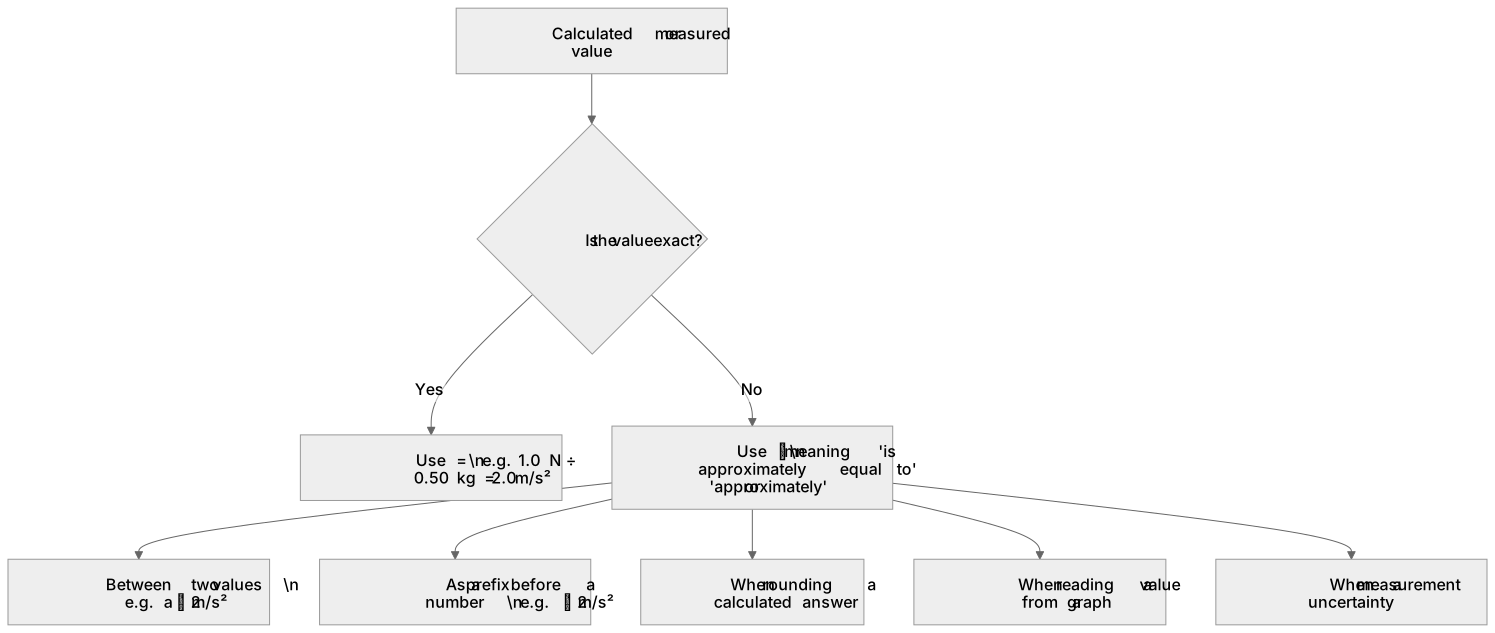
In physics, measurements and calculated answers are rarely exact, so scientists show when a value is approximate. The symbol ̴ (a single wavy line, read as 'is approximately equal to' or 'approximately') can be placed between two quantities that are close in value, or used as a prefix before a number. For example, if a trolley of mass 0.50 kg is pushed with a force of 1.0 N, the acceleration is a = F ÷ m = 1.0 N ÷ 0.50 kg = 2.0 m/s² exactly. If the force is 1.1 N, then a = 1.1 N ÷ 0.50 kg = 2.2 m/s², but if the mass is only known to be about 0.5 kg, you would write a ̴ 2 m/s² or simply state the acceleration is ̴ 2 m/s². Use ̴ when rounding a calculated answer, reading a value from a graph, or when a measurement has uncertainty. Do not use it for exact definitions.
What earns the marks
- Recognises the symbol ̴ as meaning 'is approximately equal to' or 'approximately' and reads it correctly.
- Uses ̴ correctly, either between two numerical values or expressions, or as a prefix before a number, for example writing a ̴ 2 m/s² or ̴ 2 m/s² after rounding a calculated acceleration.
- Distinguishes between situations that need an equals sign, such as exact arithmetic like 1.0 N ÷ 0.50 kg = 2.0 m/s², and situations that need ̴, such as a rounded or measured value.
- Applies the symbol when reporting results from Newton's Second Law calculations where force, mass or acceleration have been measured to limited precision or read from a graph.
- Interprets a value written with ̴ as an approximation, so a later calculation using that value should also be treated as approximate.
- Uses the symbol consistently in written answers, tables and graph labels without confusing it with the equals sign or the 'proportional to' symbol.
Common mistakes and how to put them right
Writing an equals sign for a rounded answer, for example 1.1 N ÷ 0.50 kg = 2 m/s².
Put it right: Use ̴ because 2 m/s² is a rounded value, so write 1.1 N ÷ 0.50 kg ̴ 2 m/s².
Confusing ̴ with the proportionality symbol ∝ or with a minus sign.
Put it right: ̴ is a single wavy line meaning 'approximately equal to', while ∝ means 'is proportional to' and links quantities whose ratio is constant.
Using ̴ instead of a decimal point.
Put it right: ̴ must be used to indicate approximation, either between values or as a prefix before a complete value, for example ̴ 2 m/s², not 2̴ 0 m/s².
Exam tips
- When a question asks for an answer to a given number of significant figures, show the unrounded value first and then the rounded value with ̴, so the examiner can see both the calculation and the approximation.
- If you read a value from a graph, quote it with ̴ and state the precision you used, for example 'from the graph, a ̴ 2.2 m/s²'.
- Check every symbol in your final line: use = only when the two sides are exactly equal, and use ̴ when rounding, estimating or reporting a measurement with uncertainty.
Try the lesson
The start of the Newton's Second Law: Students should recognise and be able to use the symbol that indicates an approximate value or approximate answer, ̴ lesson, made from checked teaching notes for this specification point.
Have a go first
A student calculates a force to be 4.98 N and decides to record it as an approximate value of 5 N. Which mathematical symbol should be written before the 5 N to show it is an approximate value?
Listen
In physics, measurements and calculated answers are rarely exact, so scientists show when a value is approximate. The symbol ̴ (a single wavy line, read as 'is approximately equal to' or 'approximately') can be placed between two quantities that are close in value, or used as a prefix before a number. For example, if a trolley of mass 0.50 kg is pushed with a force of 1.0 N, the acceleration is a = F ÷ m = 1.0 N ÷ 0.50 kg = 2.0 m/s² exactly. If the force is 1.1 N, then a = 1.1 N ÷ 0.50 kg = 2.2 m/s², but if the mass is only known to be about 0.5 kg, you would write a ̴ 2 m/s² or simply state the acceleration is ̴ 2 m/s². Use ̴ when rounding a calculated answer, reading a value from a graph, or when a measurement has uncertainty. Do not use it for exact definitions. A strong answer earns marks for these points. Recognises the symbol ̴ as meaning 'is approximately equal to' or 'approximately' and reads it correctly. Uses ̴ correctly, either between two numerical values or expressions, or as a prefix before a number, for example writing a ̴ 2 m/s² or ̴ 2 m/s² after rounding a calculated acceleration. Distinguishes between situations that need an equals sign, such as exact arithmetic like 1.0 N ÷ 0.50 kg = 2.0 m/s², and situations that need ̴, such as a rounded or measured value. Applies the symbol when reporting results from Newton's Second Law calculations where force, mass or acceleration have been measured to limited precision or read from a graph. A common slip: Writing an equals sign for a rounded answer, for example 1.1 N ÷ 0.50 kg = 2 m/s². Instead, use ̴ because 2 m/s² is a rounded value, so write 1.1 N ÷ 0.50 kg ̴ 2 m/s². Exam tip: When a question asks for an answer to a given number of significant figures, show the unrounded value first and then the rounded value with ̴, so the examiner can see both the calculation and the approximation.
See it
Key words
Say what each word means before you turn the card.
Approximation
Try answering aloud or in your head before turning the card.
Equals sign
Try answering aloud or in your head before turning the card.
See every definition
- Approximation
- A value or answer that is not exact, shown using the symbol ̴ placed between two quantities that are close in value or as a prefix before a number.
- Equals sign
- Used only when two sides are exactly equal, such as exact arithmetic like 1.0 N ÷ 0.50 kg = 2.0 m/s², and not for a rounded answer.
There is more to this lesson
The full lesson goes on to check your understanding and help you earn the marks. Create a free account to carry on, with your progress saved.
A week of Premium from your first lesson · Then the free plan continues · No card, no charge
Test your understanding of Newton's Second Law: Students should recognise and be able to use the symbol that indicates an approximate value or approximate answer, ̴
Active recall beats re-reading. Take an instant quiz now to test what you’ve learned and lock it into long-term memory.
A week of Premium from your first lesson · Then the free plan continues · No card, no charge