AQA · GCSE · Combined Science
Course version: 8464 · Version from Sept 2018
Students should be able to estimate the speed, accelerations and forces…
Full specification wording
Newton's Second Law: Students should be able to estimate the speed, accelerations and forces involved in large accelerations for everyday road transport.
Everyday road transport involves large accelerations, so you should estimate speeds, accelerations and forces rather than measure them precisely.
Checked against the AQA 8464 specification (opens in a new tab) on .
- Point 11 of 13
- 4 key terms
Study notes
From the checked teaching notes for this specification point.
The idea
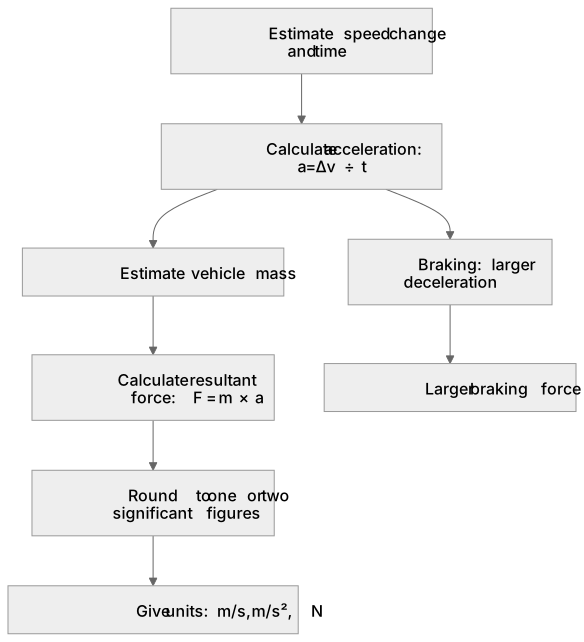
Everyday road transport involves large accelerations, so you should estimate speeds, accelerations and forces rather than measure them precisely. A car may accelerate from rest to about 27 m/s (roughly 60 mph) in about 10 s, giving an average acceleration of a = Δv ÷ t = 27 m/s ÷ 10 s = 2.7 m/s². For a 1200 kg car, the resultant force is F = m × a = 1200 kg × 2.7 m/s² = 3240 N. Braking gives a larger deceleration, perhaps 8 m/s², so the braking force is about 9600 N. Use sensible values, show the equation, substitute, and round the answer to one or two significant figures.
What earns the marks
- Estimate a realistic speed for road transport, such as about 13 m/s for a town car or about 30 m/s for a motorway car.
- Calculate acceleration from a speed change and time using a = Δv ÷ t, including deceleration as a negative acceleration.
- Use F = m × a with an estimated vehicle mass to estimate the resultant force during acceleration or braking.
- Choose sensible approximate values for speed, time and mass, and state the assumptions made.
- Round estimated answers to one or two significant figures and give correct units such as m/s, m/s² and N.
- Recognise that braking produces a larger deceleration and therefore a larger force than gentle acceleration.
Common mistakes and how to put them right
Mixing units, such as using speed in km/h with time in seconds.
Put it right by converting to m/s first, for example 72 km/h ÷ 3.6 = 20 m/s.
Using the final speed instead of the change in speed.
Put it right by calculating Δv = final velocity − initial velocity before dividing by time.
Forgetting that deceleration is a negative acceleration.
Put it right by keeping the sign or by stating the magnitude and direction of the braking force.
Exam tips
- State your estimated values clearly, for example 'assume the car reaches 30 m/s in 12 s', so your calculation can be followed.
- Show the equation, the substitution and the answer with its unit; an estimate with clear working earns more credit than a bare number.
- Sanity-check the answer: a family car's driving force is typically a few thousand newtons, not a few hundred or a few million.
Try the lesson
The start of the Newton's Second Law: Students should be able to estimate the speed, accelerations and forces involved in large accelerations for everyday road transport. lesson, made from checked teaching notes for this specification point.
Have a go first
Which of the following is a reasonable estimate for the acceleration of a typical family car setting off from a stationary position?
Listen
Everyday road transport involves large accelerations, so you should estimate speeds, accelerations and forces rather than measure them precisely. A car may accelerate from rest to about 27 m/s (roughly 60 mph) in about 10 s, giving an average acceleration of a = Δv ÷ t = 27 m/s ÷ 10 s = 2.7 m/s². For a 1200 kg car, the resultant force is F = m × a = 1200 kg × 2.7 m/s² = 3240 N. Braking gives a larger deceleration, perhaps 8 m/s², so the braking force is about 9600 N. Use sensible values, show the equation, substitute, and round the answer to one or two significant figures. A strong answer earns marks for these points. Estimate a realistic speed for road transport, such as about 13 m/s for a town car or about 30 m/s for a motorway car. Calculate acceleration from a speed change and time using a = Δv ÷ t, including deceleration as a negative acceleration. Use F = m × a with an estimated vehicle mass to estimate the resultant force during acceleration or braking. Choose sensible approximate values for speed, time and mass, and state the assumptions made. A common slip: Mixing units, such as using speed in km/h with time in seconds. Instead, converting to m/s first, for example 72 km/h ÷ 3.6 = 20 m/s. Exam tip: State your estimated values clearly, for example 'assume the car reaches 30 m/s in 12 s', so your calculation can be followed.
See it
Key words
Say what each word means before you turn the card.
Acceleration and deceleration
Try answering aloud or in your head before turning the card.
Force and mass in road transport
Try answering aloud or in your head before turning the card.
Significant figures and units
Try answering aloud or in your head before turning the card.
Estimating physical quantities
Try answering aloud or in your head before turning the card.
See every definition
- Acceleration and deceleration
- Acceleration is calculated from a speed change and time using a = Δv ÷ t, and deceleration is included as a negative acceleration.
- Force and mass in road transport
- The resultant force during acceleration or braking is estimated using F = m × a with an estimated vehicle mass.
- Significant figures and units
- Estimated answers are rounded to one or two significant figures and given correct units such as m/s, m/s² and N.
- Estimating physical quantities
- Sensible approximate values for speed, time and mass are chosen and the assumptions made are stated.
Label the diagram
Some boxes have lost their names. Pick the right name for each number.
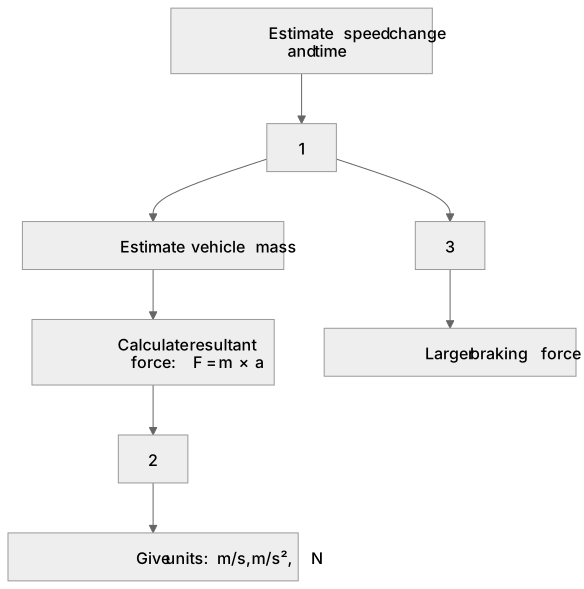
1Box 1
2Box 2
3Box 3
There is more to this lesson
The full lesson goes on to check your understanding and help you earn the marks. Create a free account to carry on, with your progress saved.
A week of Premium from your first lesson · Then the free plan continues · No card, no charge
Test your understanding of Newton's Second Law: Students should be able to estimate the speed, accelerations and forces involved in large accelerations for everyday road transport.
Active recall beats re-reading. Take an instant quiz now to test what you’ve learned and lock it into long-term memory.
A week of Premium from your first lesson · Then the free plan continues · No card, no charge