AQA · GCSE · Combined Science
Course version: 8464 · Version from Sept 2018
In a nuclear equation an alpha particle may be represented by the symbol:
Full specification wording
Nuclear equations: In a nuclear equation an alpha particle may be represented by the symbol:
An alpha particle is a helium nucleus, so in a nuclear equation it is represented by the symbol ⁴₂He or ⁴₂α.
Checked against the AQA 8464 specification (opens in a new tab) on .
- Point 2 of 8
Study notes
From the checked teaching notes for this specification point.
The idea
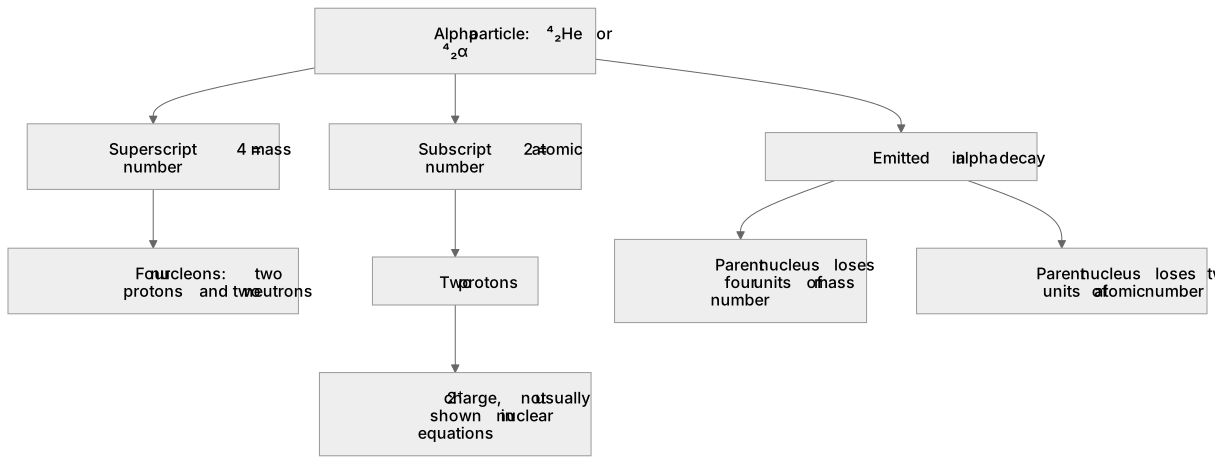
An alpha particle is a helium nucleus, so in a nuclear equation it is represented by the symbol ⁴₂He or ⁴₂α. The superscript 4 is the mass number, showing that the alpha particle contains four nucleons: two protons and two neutrons. The subscript 2 is the atomic number, showing that it contains two protons. Because an alpha particle has a 2⁺ charge, it is sometimes written as ⁴₂He²⁺, but in nuclear equations the charge is not usually shown. When an alpha particle is emitted, the parent nucleus loses four units of mass number and two units of atomic number. For example, radium-226 decays to radon-222: ²²⁶₈₈Ra → ²²²₈₆Rn + ⁴₂He. The symbol ⁴₂He is preferred in AQA GCSE Combined Science because it shows the helium nucleus clearly, while ⁴₂α is also accepted.
What earns the marks
- An alpha particle is a helium nucleus and is represented by the symbol ⁴₂He or ⁴₂α.
- The superscript 4 is the mass number and shows that the alpha particle contains four nucleons.
- The subscript 2 is the atomic number and shows that the alpha particle contains two protons.
- An alpha particle has a 2⁺ charge because it contains two protons and two neutrons, but the charge is not usually shown in a nuclear equation.
- When an alpha particle is emitted, the parent nucleus loses four units of mass number and two units of atomic number.
Common mistakes and how to put them right
Writing the alpha particle as ²₄He or ²₄α, which swaps the mass number and atomic number.
Put it right: The mass number is the superscript 4 and the atomic number is the subscript 2, so write ⁴₂He or ⁴₂α.
Using the symbol ⁰₋₁e for an alpha particle.
Put it right: ⁰₋₁e represents a beta particle, while an alpha particle is ⁴₂He or ⁴₂α.
Thinking that an alpha particle has a 2⁻ charge.
Put it right: An alpha particle contains two protons and two neutrons, so it has a 2⁺ charge.
Forgetting to include the alpha particle as a product in a decay equation.
Put it right: Write the alpha particle on the right-hand side of the arrow together with the daughter nucleus.
Exam tips
- Learn the symbol ⁴₂He or ⁴₂α for an alpha particle and ⁰₋₁e or ⁰₋₁β for a beta particle so you can recognise them quickly.
- When an equation includes an alpha particle, check that the mass numbers and atomic numbers balance on both sides.
- If a question asks for the symbol of an alpha particle, write ⁴₂He or ⁴₂α rather than just the word 'alpha'.
- Remember that the top number is the mass number and the bottom number is the atomic number; this helps you avoid swapping them.
Try the lesson
The start of the Nuclear equations: In a nuclear equation an alpha particle may be represented by the symbol: lesson, made from checked teaching notes for this specification point.
Have a go first
Which symbol represents an alpha particle in a nuclear equation?
Listen
An alpha particle is a helium nucleus, so in a nuclear equation it is represented by the symbol ⁴₂He or ⁴₂α. The superscript 4 is the mass number, showing that the alpha particle contains four nucleons: two protons and two neutrons. The subscript 2 is the atomic number, showing that it contains two protons. Because an alpha particle has a 2⁺ charge, it is sometimes written as ⁴₂He²⁺, but in nuclear equations the charge is not usually shown. When an alpha particle is emitted, the parent nucleus loses four units of mass number and two units of atomic number. For example, radium-226 decays to radon-222: ²²⁶₈₈Ra → ²²²₈₆Rn + ⁴₂He. The symbol ⁴₂He is preferred in AQA GCSE Combined Science because it shows the helium nucleus clearly, while ⁴₂α is also accepted. A strong answer earns marks for these points. An alpha particle is a helium nucleus and is represented by the symbol ⁴₂He or ⁴₂α. The superscript 4 is the mass number and shows that the alpha particle contains four nucleons. The subscript 2 is the atomic number and shows that the alpha particle contains two protons. An alpha particle has a 2⁺ charge because it contains two protons and two neutrons, but the charge is not usually shown in a nuclear equation. A common slip: Writing the alpha particle as ²₄He or ²₄α, which swaps the mass number and atomic number. Instead, the mass number is the superscript 4 and the atomic number is the subscript 2, so write ⁴₂He or ⁴₂α. Exam tip: Learn the symbol ⁴₂He or ⁴₂α for an alpha particle and ⁰₋₁e or ⁰₋₁β for a beta particle so you can recognise them quickly.
See it
Label the diagram
Some boxes have lost their names. Pick the right name for each number.
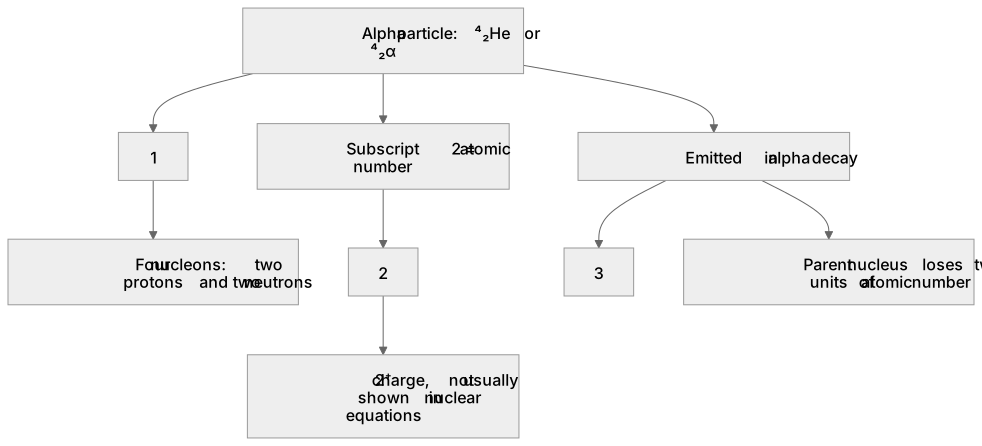
1Box 1
2Box 2
3Box 3
There is more to this lesson
The full lesson goes on to check your understanding and help you earn the marks. Create a free account to carry on, with your progress saved.
A week of Premium from your first lesson · Then the free plan continues · No card, no charge
Test your understanding of Nuclear equations: In a nuclear equation an alpha particle may be represented by the symbol:
Active recall beats re-reading. Take an instant quiz now to test what you’ve learned and lock it into long-term memory.
A week of Premium from your first lesson · Then the free plan continues · No card, no charge