AQA · GCSE · Combined Science
Course version: 8464 · Version from Sept 2018
Nuclear equations are used to represent radioactive decay.
Full specification wording
Nuclear equations: Nuclear equations are used to represent radioactive decay.
A nuclear equation is a symbolic summary of a radioactive decay process.
Checked against the AQA 8464 specification (opens in a new tab) on .
- Point 1 of 8
- 4 key terms
Study notes
From the checked teaching notes for this specification point.
The idea
A nuclear equation is a symbolic summary of a radioactive decay process. It shows the starting nucleus on the left and the products on the right, each written with its chemical symbol, mass number as a superscript and atomic number as a subscript. For alpha decay, the nucleus loses an alpha particle, so the mass number decreases by 4 and the atomic number decreases by 2. For beta decay, a neutron changes into a proton and an electron, so the mass number stays the same while the atomic number increases by 1. For gamma emission, the nucleus loses energy without changing its mass or atomic number. In every valid nuclear equation, the total mass numbers and total atomic numbers must balance on both sides. For example, americium-241 decays by alpha emission to neptunium-237: ²⁴¹₉₅Am → ⁴₂He + ²³⁷₉₃Np. Checking 241 = 4 + 237 and 95 = 2 + 93 confirms the equation is balanced.
What earns the marks
- A nuclear equation represents a radioactive decay by showing the parent nucleus and the emitted particle or radiation together with the daughter nucleus.
- Each nuclide is written with its chemical symbol, a mass number as a superscript and an atomic number as a subscript.
- In alpha decay, the mass number decreases by 4 and the atomic number decreases by 2 because an alpha particle (⁴₂He or ⁴₂α) is emitted.
- In beta decay, the mass number is unchanged and the atomic number increases by 1 because a neutron changes into a proton and an emitted beta particle (⁰₋₁e or ⁰₋₁β).
- In gamma emission, the mass number and atomic number are unchanged because gamma radiation is electromagnetic energy released from the nucleus.
- A balanced nuclear equation has equal totals of mass number and equal totals of atomic number on both sides.
Common mistakes and how to put them right
Writing the mass number as a subscript and the atomic number as a superscript.
Put it right: The mass number is the superscript and the atomic number is the subscript, for example ²³⁸₉₂U.
Forgetting to balance mass numbers and atomic numbers across the arrow.
Put it right: Check that the sum of mass numbers on the left equals the sum on the right, and do the same for atomic numbers.
Treating beta decay as if the mass number decreases.
Put it right: In beta decay the mass number stays the same because a neutron becomes a proton, and the atomic number increases by 1.
Omitting the emitted particle from the equation.
Put it right: Include the alpha particle, beta particle or gamma radiation as a product so the equation represents the full decay.
Exam tips
- Write nuclear symbols clearly with the mass number directly above the atomic number so the examiner can see both values.
- After writing any nuclear equation, spend a moment checking the mass-number and atomic-number totals on each side.
- If a question gives the parent nuclide and the type of decay, work out the daughter nuclide by subtracting or adding the correct numbers before writing the full equation.
- Use the correct symbol for an alpha particle, ⁴₂He or ⁴₂α, and for a beta particle, ⁰₋₁e or ⁰₋₁β, rather than writing words such as 'alpha' or 'beta' alone.
Try the lesson
The start of the Nuclear equations: Nuclear equations are used to represent radioactive decay. lesson, made from checked teaching notes for this specification point.
Have a go first
Which symbol is used in a nuclear equation to represent an alpha particle?
Listen
A nuclear equation is a symbolic summary of a radioactive decay process. It shows the starting nucleus on the left and the products on the right, each written with its chemical symbol, mass number as a superscript and atomic number as a subscript. For alpha decay, the nucleus loses an alpha particle, so the mass number decreases by 4 and the atomic number decreases by 2. For beta decay, a neutron changes into a proton and an electron, so the mass number stays the same while the atomic number increases by 1. For gamma emission, the nucleus loses energy without changing its mass or atomic number. In every valid nuclear equation, the total mass numbers and total atomic numbers must balance on both sides. For example, americium-241 decays by alpha emission to neptunium-237: ²⁴¹₉₅Am → ⁴₂He + ²³⁷₉₃Np. Checking 241 = 4 + 237 and 95 = 2 + 93 confirms the equation is balanced. A strong answer earns marks for these points. A nuclear equation represents a radioactive decay by showing the parent nucleus and the emitted particle or radiation together with the daughter nucleus. Each nuclide is written with its chemical symbol, a mass number as a superscript and an atomic number as a subscript. In alpha decay, the mass number decreases by 4 and the atomic number decreases by 2 because an alpha particle (⁴₂He or ⁴₂α) is emitted. In beta decay, the mass number is unchanged and the atomic number increases by 1 because a neutron changes into a proton and an emitted beta particle (⁰₋₁e or ⁰₋₁β). A common slip: Writing the mass number as a subscript and the atomic number as a superscript. Instead, the mass number is the superscript and the atomic number is the subscript, for example ²³⁸₉₂U. Exam tip: Write nuclear symbols clearly with the mass number directly above the atomic number so the examiner can see both values.
See it
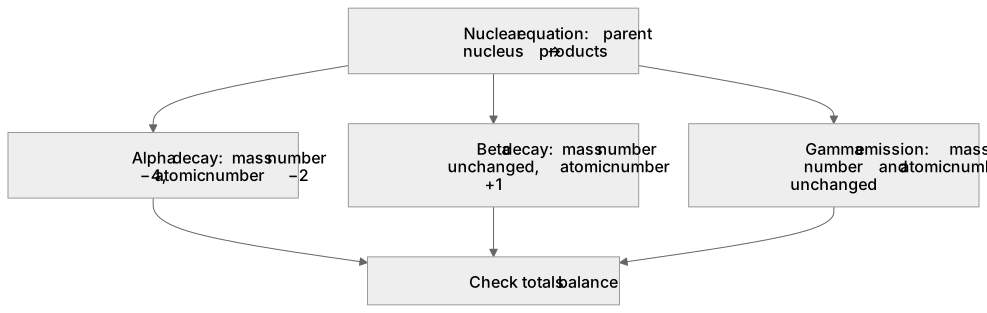
Key words
Say what each word means before you turn the card.
Nuclear equation
Try answering aloud or in your head before turning the card.
Alpha decay
Try answering aloud or in your head before turning the card.
Beta decay
Try answering aloud or in your head before turning the card.
Gamma emission
Try answering aloud or in your head before turning the card.
See every definition
- Nuclear equation
- A symbolic summary of a radioactive decay process, showing the starting nucleus on the left and the products on the right.
- Alpha decay
- A decay in which the nucleus loses an alpha particle, so the mass number decreases by 4 and the atomic number decreases by 2.
- Beta decay
- A decay in which a neutron changes into a proton and an electron, so the mass number stays the same while the atomic number increases by 1.
- Gamma emission
- A process in which the nucleus loses energy without changing its mass or atomic number.
Label the diagram
Some boxes have lost their names. Pick the right name for each number.
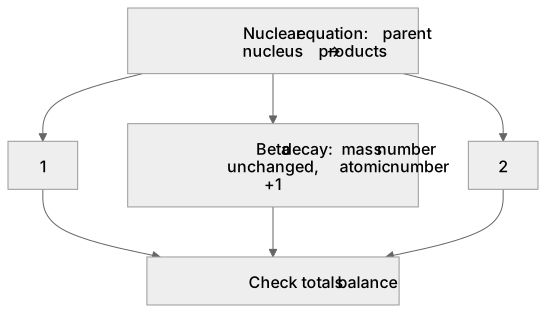
1Box 1
2Box 2
There is more to this lesson
The full lesson goes on to check your understanding and help you earn the marks. Create a free account to carry on, with your progress saved.
A week of Premium from your first lesson · Then the free plan continues · No card, no charge
Test your understanding of Nuclear equations: Nuclear equations are used to represent radioactive decay.
Active recall beats re-reading. Take an instant quiz now to test what you’ve learned and lock it into long-term memory.
A week of Premium from your first lesson · Then the free plan continues · No card, no charge