AQA · GCSE · Combined Science
Course version: 8464 · Version from Sept 2018
So alpha decay causes both the mass and charge of the nucleus to decrease.
Full specification wording
Nuclear equations: So alpha decay causes both the mass and charge of the nucleus to decrease.
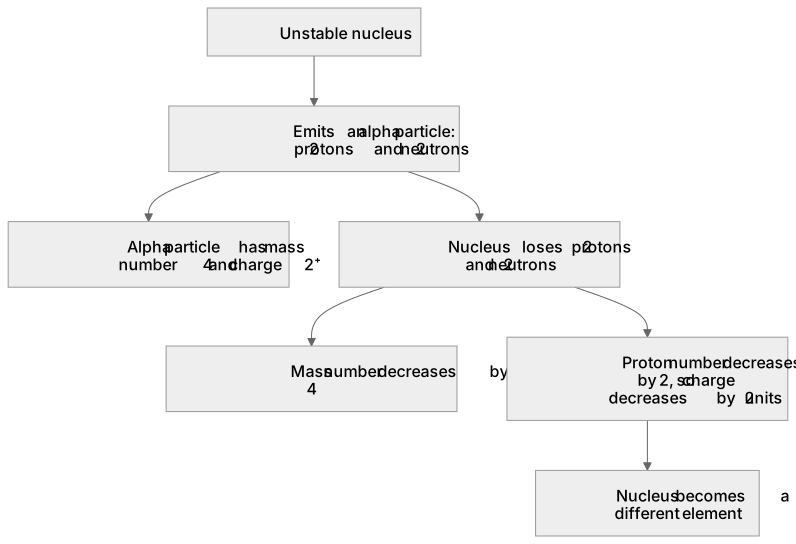
An alpha particle is a helium nucleus: two protons and two neutrons, so it has mass number 4 and charge 2⁺.
Checked against the AQA 8464 specification (opens in a new tab) on .
- Point 5 of 8
- 2 key terms
Study notes
From the checked teaching notes for this specification point.
The idea
An alpha particle is a helium nucleus: two protons and two neutrons, so it has mass number 4 and charge 2⁺. When an unstable nucleus emits an alpha particle, it loses those two protons and two neutrons, so its mass number falls by 4 and its proton number falls by 2. For example, uranium-238 decays to thorium-234: ²³⁸₉₂U → ⁴₂He + ²³⁴₉₀Th. The mass number decreases because nucleons leave the nucleus, and the charge decreases because two positive protons leave. The nucleus becomes a different element because its proton number changes. Alpha emission is common in very heavy nuclei and is stopped by a few centimetres of air or a sheet of paper.
What earns the marks
- An alpha particle consists of 2 protons and 2 neutrons, so it has mass number 4 and charge 2⁺.
- Emitting an alpha particle removes 2 protons and 2 neutrons from the nucleus.
- The mass number of the nucleus decreases by 4 because 4 nucleons are lost.
- The proton number (atomic number) decreases by 2, so the nuclear charge decreases by 2 units.
- The nucleus changes into a different element because its proton number changes.
- In a nuclear equation, the total mass number and total proton number must balance on both sides.
Common mistakes and how to put them right
Thinking the mass number decreases by 2 rather than 4.
Put it right by counting both protons and neutrons in the alpha particle.
Believing the charge stays the same because neutrons are also lost.
Put it right by noting only protons carry nuclear charge, and 2 protons are lost.
Writing the alpha particle as ⁴₂He with the wrong charge or mass.
Put it right by remembering it is a helium nucleus, mass number 4 and charge 2⁺.
Exam tips
- Write the nuclear equation and check that mass numbers and proton numbers balance on both sides.
- State clearly that the proton number decreases by 2, so the charge decreases by 2 units.
- Use the term nucleon when explaining why mass number falls by 4.
Try the lesson
The start of the Nuclear equations: So alpha decay causes both the mass and charge of the nucleus to decrease. lesson, made from checked teaching notes for this specification point.
Have a go first
An unstable nucleus emits an alpha particle. What happens to the mass number and the atomic number of the nucleus?
Listen
An alpha particle is a helium nucleus: two protons and two neutrons, so it has mass number 4 and charge 2⁺. When an unstable nucleus emits an alpha particle, it loses those two protons and two neutrons, so its mass number falls by 4 and its proton number falls by 2. For example, uranium-238 decays to thorium-234: ²³⁸₉₂U → ⁴₂He + ²³⁴₉₀Th. The mass number decreases because nucleons leave the nucleus, and the charge decreases because two positive protons leave. The nucleus becomes a different element because its proton number changes. Alpha emission is common in very heavy nuclei and is stopped by a few centimetres of air or a sheet of paper. A strong answer earns marks for these points. An alpha particle consists of 2 protons and 2 neutrons, so it has mass number 4 and charge 2⁺. Emitting an alpha particle removes 2 protons and 2 neutrons from the nucleus. The mass number of the nucleus decreases by 4 because 4 nucleons are lost. The proton number (atomic number) decreases by 2, so the nuclear charge decreases by 2 units. A common slip: Thinking the mass number decreases by 2 rather than 4. Instead, counting both protons and neutrons in the alpha particle. Exam tip: Write the nuclear equation and check that mass numbers and proton numbers balance on both sides.
See it
Key words
Say what each word means before you turn the card.
Nuclear equations
Try answering aloud or in your head before turning the card.
Conservation of mass number and proton number
Try answering aloud or in your head before turning the card.
See every definition
- Nuclear equations
- Equations in which the total mass number and total proton number must balance on both sides.
- Conservation of mass number and proton number
- In a nuclear equation, the total mass number and total proton number must balance on both sides.
Label the diagram
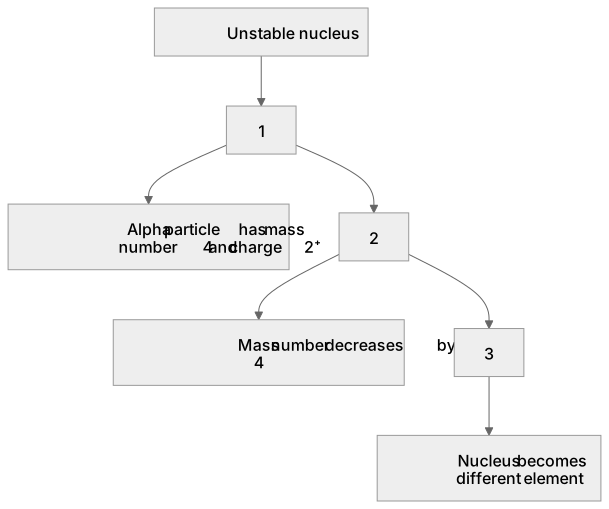
Some boxes have lost their names. Pick the right name for each number.
1Box 1
2Box 2
3Box 3
There is more to this lesson
The full lesson goes on to check your understanding and help you earn the marks. Create a free account to carry on, with your progress saved.
A week of Premium from your first lesson · Then the free plan continues · No card, no charge
Test your understanding of Nuclear equations: So alpha decay causes both the mass and charge of the nucleus to decrease.
Active recall beats re-reading. Take an instant quiz now to test what you’ve learned and lock it into long-term memory.
A week of Premium from your first lesson · Then the free plan continues · No card, no charge