AQA · GCSE · Combined Science
Course version: 8464 · Version from Sept 2018
So beta decay does not cause the mass of the nucleus to change but does…
Full specification wording
Nuclear equations: So beta decay does not cause the mass of the nucleus to change but does cause the charge of the nucleus to increase.
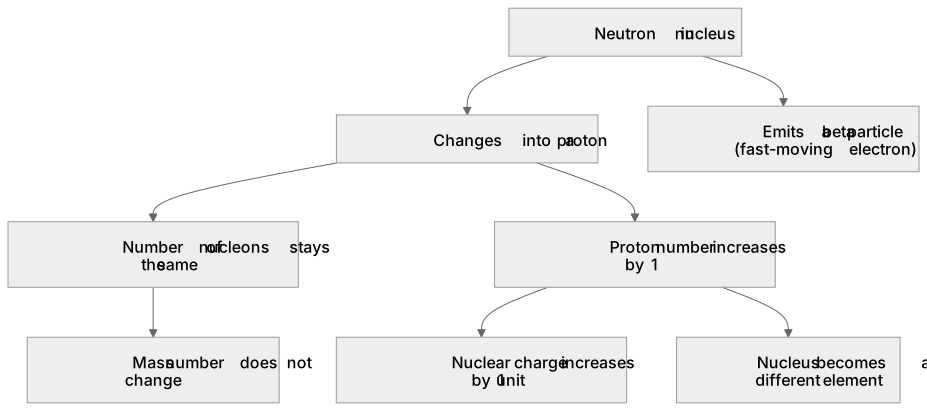
In beta decay, a neutron in the nucleus changes into a proton and emits a beta particle, which is a fast-moving electron.
Checked against the AQA 8464 specification (opens in a new tab) on .
- Point 6 of 8
Study notes
From the checked teaching notes for this specification point.
The idea
In beta decay, a neutron in the nucleus changes into a proton and emits a beta particle, which is a fast-moving electron. The electron has negligible mass compared with nucleons, so the mass number stays the same. However, the nucleus gains one proton, so its proton number increases by 1 and its charge increases by 1 unit. For example, carbon-14 decays to nitrogen-14: ¹⁴₆C → ⁰₋₁e + ¹⁴₇N. The beta particle is written with mass number 0 and charge 1⁻. Because the proton number changes, the nucleus becomes a different element. Beta emission is common in nuclei with too many neutrons and is stopped by a few millimetres of aluminium.
What earns the marks
- A beta particle is a fast-moving electron emitted from the nucleus.
- In beta decay, a neutron changes into a proton and an electron.
- The mass number does not change because a neutron is replaced by a proton, so the number of nucleons stays the same.
- The proton number increases by 1, so the nuclear charge increases by 1 unit.
- The beta particle has mass number 0 and charge 1⁻ in a nuclear equation.
- The nucleus becomes a different element because its proton number increases by 1.
Common mistakes and how to put them right
Saying the mass number increases by 1.
Put it right by noting a neutron is replaced by a proton, so the total number of nucleons is unchanged.
Thinking the charge decreases because an electron is emitted.
Put it right by tracking the proton number, which increases by 1.
Writing the beta particle as ⁰₊₁e.
Put it right by using ⁰₋₁e, since the electron has charge 1⁻.
Exam tips
- Check that the mass number is the same on both sides of a beta decay equation.
- Show the proton number increasing by 1 from reactant to product.
- Remember that beta particles are electrons, so their charge is 1⁻ and their mass number is 0.
Try the lesson
The start of the Nuclear equations: So beta decay does not cause the mass of the nucleus to change but does cause the charge of the nucleus to increase. lesson, made from checked teaching notes for this specification point.
Have a go first
A nucleus of carbon-14 (¹⁴₆C) undergoes beta decay. Which statement describes what happens to the mass number and the charge of the nucleus?
Listen
In beta decay, a neutron in the nucleus changes into a proton and emits a beta particle, which is a fast-moving electron. The electron has negligible mass compared with nucleons, so the mass number stays the same. However, the nucleus gains one proton, so its proton number increases by 1 and its charge increases by 1 unit. For example, carbon-14 decays to nitrogen-14: ¹⁴₆C → ⁰₋₁e + ¹⁴₇N. The beta particle is written with mass number 0 and charge 1⁻. Because the proton number changes, the nucleus becomes a different element. Beta emission is common in nuclei with too many neutrons and is stopped by a few millimetres of aluminium. A strong answer earns marks for these points. A beta particle is a fast-moving electron emitted from the nucleus. In beta decay, a neutron changes into a proton and an electron. The mass number does not change because a neutron is replaced by a proton, so the number of nucleons stays the same. The proton number increases by 1, so the nuclear charge increases by 1 unit. A common slip: Saying the mass number increases by 1. Instead, noting a neutron is replaced by a proton, so the total number of nucleons is unchanged. Exam tip: Check that the mass number is the same on both sides of a beta decay equation.
See it
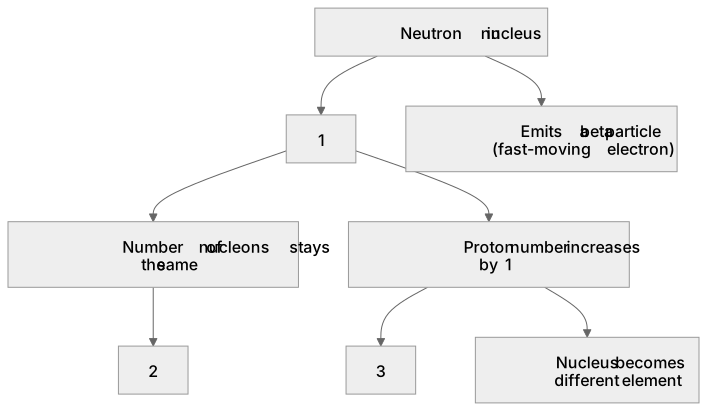
Label the diagram
Some boxes have lost their names. Pick the right name for each number.
1Box 1
2Box 2
3Box 3
There is more to this lesson
The full lesson goes on to check your understanding and help you earn the marks. Create a free account to carry on, with your progress saved.
A week of Premium from your first lesson · Then the free plan continues · No card, no charge
Test your understanding of Nuclear equations: So beta decay does not cause the mass of the nucleus to change but does cause the charge of the nucleus to increase.
Active recall beats re-reading. Take an instant quiz now to test what you’ve learned and lock it into long-term memory.
A week of Premium from your first lesson · Then the free plan continues · No card, no charge