AQA · GCSE · Combined Science
Course version: 8464 · Version from Sept 2018
Students should be able to use the names and symbols of common nuclei and…
Full specification wording
Nuclear equations: Students should be able to use the names and symbols of common nuclei and particles to write balanced equations that show single alpha (α) and beta (β) decay. This is limited to balancing the atomic numbers and mass numbers. The identification of daughter elements from such decays is not required.
Nuclear equations represent changes in the nucleus during radioactive decay.
Checked against the AQA 8464 specification (opens in a new tab) on .
- Point 7 of 8
- 4 key terms
Study notes
From the checked teaching notes for this specification point.
The idea
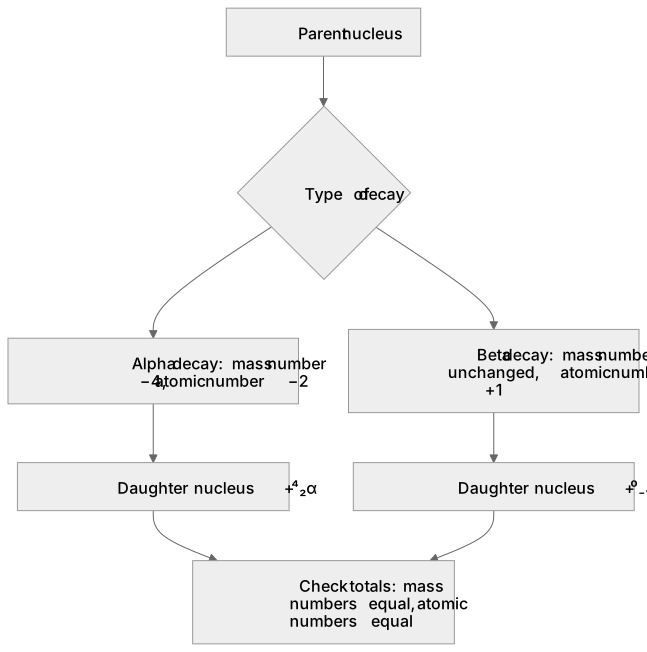
Nuclear equations represent changes in the nucleus during radioactive decay. You must use the standard symbols for common nuclei and particles, such as ²³⁸₉₂U for uranium-238, ⁴₂α for an alpha particle and ⁰₋₁β for a beta particle. In every balanced equation, the total mass number (top number) and the total atomic number (bottom number) must be the same on both sides. For alpha decay, the parent loses 4 from its mass number and 2 from its atomic number. For beta decay, the mass number is unchanged and the atomic number increases by 1. You are not required to name the daughter element; balancing the numbers is sufficient.
For example: ²³⁸₉₂U → ²³⁴₉₀Th + ⁴₂α is balanced because 238 = 234 + 4 and 92 = 90 + 2.
What earns the marks
- Use correct symbols for common nuclei, showing mass number as a superscript and atomic number as a subscript.
- Represent an alpha particle as ⁴₂α and a beta particle as ⁰₋₁β.
- Balance mass numbers so that the sum before decay equals the sum after decay.
- Balance atomic numbers so that the sum before decay equals the sum after decay.
- Write equations for single alpha decay by reducing the parent mass number by 4 and atomic number by 2.
- Write equations for single beta decay by keeping the mass number the same and increasing the atomic number by 1.
- Complete an equation by deducing the missing nucleus from the conservation of mass number and atomic number.
Common mistakes and how to put them right
Writing the mass number and atomic number the wrong way round on a symbol.
Put it right: Mass number is the superscript and atomic number is the subscript.
Balancing only the mass number and ignoring the atomic number.
Put it right: Check both totals separately on each side of the equation.
Giving the beta particle a mass number of 1.
Put it right: A beta particle has mass number 0 and atomic number −1.
Trying to name the daughter element when the question only asks for a balanced equation.
Put it right: Focus on the numbers; naming is not required.
Exam tips
- Draw a vertical line between the two sides of the equation and compare the top totals and bottom totals separately.
- If a nucleus is missing, use the difference between the two sides to find its mass number and atomic number.
- Write the alpha and beta symbols with their mass and atomic numbers so the balancing is visible.
- Do not waste time identifying element names unless the question explicitly asks for them.
Try the lesson
The start of the Nuclear equations: Students should be able to use the names and symbols of common nuclei and particles to write balanced equations that show single alpha (α) and beta (β) decay. This is limited to balancing the atomic numbers and mass numbers. The identification of daughter elements from such decays is not required. lesson, made from checked teaching notes for this specification point.
Have a go first
An alpha particle is emitted from a nucleus. Which symbol correctly represents an alpha particle in a nuclear equation?
Listen
Nuclear equations represent changes in the nucleus during radioactive decay. You must use the standard symbols for common nuclei and particles, such as ²³⁸₉₂U for uranium-238, ⁴₂α for an alpha particle and ⁰₋₁β for a beta particle. In every balanced equation, the total mass number (top number) and the total atomic number (bottom number) must be the same on both sides. For alpha decay, the parent loses 4 from its mass number and 2 from its atomic number. For beta decay, the mass number is unchanged and the atomic number increases by 1. You are not required to name the daughter element; balancing the numbers is sufficient. For example, ²³⁸₉₂U → ²³⁴₉₀Th + ⁴₂α is balanced because 238 = 234 + 4 and 92 = 90 + 2. A strong answer earns marks for these points. Use correct symbols for common nuclei, showing mass number as a superscript and atomic number as a subscript. Represent an alpha particle as ⁴₂α and a beta particle as ⁰₋₁β. Balance mass numbers so that the sum before decay equals the sum after decay. Balance atomic numbers so that the sum before decay equals the sum after decay. A common slip: writing the mass number and atomic number the wrong way round on a symbol. Instead, mass number is the superscript and atomic number is the subscript. Exam tip: Draw a vertical line between the two sides of the equation and compare the top totals and bottom totals separately.
See it
Key words
Say what each word means before you turn the card.
Conservation of nucleon number
Try answering aloud or in your head before turning the card.
Conservation of proton number
Try answering aloud or in your head before turning the card.
Alpha particle emission
Try answering aloud or in your head before turning the card.
Beta particle emission
Try answering aloud or in your head before turning the card.
See every definition
- Conservation of nucleon number
- In every balanced equation, the total mass number (top number) must be the same on both sides.
- Conservation of proton number
- In every balanced equation, the total atomic number (bottom number) must be the same on both sides.
- Alpha particle emission
- The parent loses 4 from its mass number and 2 from its atomic number, with the alpha particle represented as ⁴₂α.
- Beta particle emission
- The mass number is unchanged and the atomic number increases by 1, with the beta particle represented as ⁰₋₁β.
There is more to this lesson
The full lesson goes on to check your understanding and help you earn the marks. Create a free account to carry on, with your progress saved.
A week of Premium from your first lesson · Then the free plan continues · No card, no charge
Test your understanding of Nuclear equations: Students should be able to use the names and symbols of common nuclei and particles to write balanced equations that show single alpha (α) and beta (β) decay. This is limited to balancing the atomic numbers and mass numbers. The identification of daughter elements from such decays is not required.
Active recall beats re-reading. Take an instant quiz now to test what you’ve learned and lock it into long-term memory.
A week of Premium from your first lesson · Then the free plan continues · No card, no charge