AQA · GCSE · Combined Science
Course version: 8464 · Version from Sept 2018
Students should be able to describe photosynthesis as an endothermic…
Full specification wording
Photosynthetic reaction: Students should be able to describe photosynthesis as an endothermic reaction in which energy is transferred from the environment to the chloroplasts by light.
Photosynthesis is the process by which plants, algae and some bacteria make glucose and oxygen from carbon dioxide and water.
Checked against the AQA 8464 specification (opens in a new tab) on .
- Point 5 of 5
- 4 key terms
Study notes
From the checked teaching notes for this specification point.
The idea
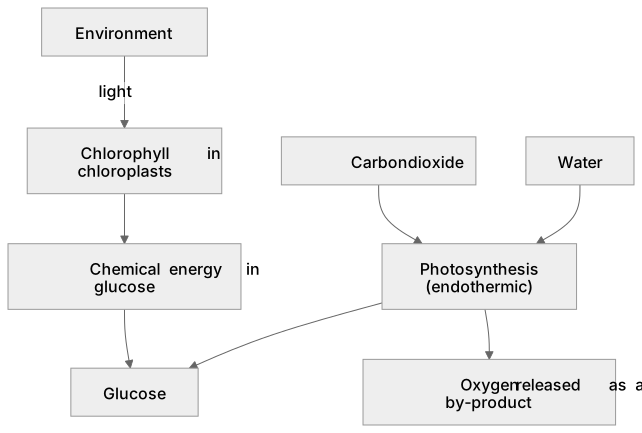
Photosynthesis is the process by which plants, algae and some bacteria make glucose and oxygen from carbon dioxide and water. It is endothermic: overall, energy is transferred from the environment to the organism, not released to the surroundings. Light is absorbed by chlorophyll inside chloroplasts, so the energy transfer is from the environment to the chloroplasts by light. The balanced equation is 6CO₂ + 6H₂O → C₆H₁₂O₆ + 6O₂. The glucose stores chemical energy in its bonds, and oxygen is released as a by-product. A useful check is that energy must be supplied continuously for the reaction to continue; in darkness it stops. Compare this with exothermic respiration, which transfers energy to the surroundings.
What earns the marks
- States that photosynthesis is endothermic, meaning energy is transferred from the environment to the organism overall.
- Identifies the reactants carbon dioxide and water and the products glucose and oxygen, with the balanced equation 6CO₂ + 6H₂O → C₆H₁₂O₆ + 6O₂.
- Explains that light energy is absorbed by chlorophyll in the chloroplasts and transferred to the chloroplasts.
- Describes the energy transfer pathway: environment → light → chlorophyll in chloroplasts → chemical energy in glucose.
- Recognises that the energy is stored in the chemical bonds of glucose and that oxygen is released as a by-product.
- Contrasts endothermic photosynthesis with exothermic respiration to justify the direction of energy transfer.
Common mistakes and how to put them right
Saying photosynthesis is exothermic because it makes glucose.
Put it right by stressing that energy is taken in from the environment, so the overall transfer is endothermic.
Writing the equation with the wrong products or unbalanced formulae, such as CO₂ + H₂O → C₆H₁₂O₆ + O₂.
Put it right by balancing to 6CO₂ + 6H₂O → C₆H₁₂O₆ + 6O₂.
Claiming energy is transferred to the chloroplasts by carbon dioxide or by heat.
Put it right by stating that light is absorbed by chlorophyll in the chloroplasts.
Exam tips
- Use the word endothermic explicitly and link it to the direction of energy transfer from the environment.
- When asked to describe, give the equation and name the energy transfer pathway rather than only naming the reactants.
- If asked to compare with respiration, state that respiration is exothermic and transfers energy to the surroundings.
Try the lesson
The start of the Photosynthetic reaction: Students should be able to describe photosynthesis as an endothermic reaction in which energy is transferred from the environment to the chloroplasts by light. lesson, made from checked teaching notes for this specification point.
Have a go first
Which word describes the overall energy change of photosynthesis?
Listen
Photosynthesis is the process by which plants, algae and some bacteria make glucose and oxygen from carbon dioxide and water. It is endothermic: overall, energy is transferred from the environment to the organism, not released to the surroundings. Light is absorbed by chlorophyll inside chloroplasts, so the energy transfer is from the environment to the chloroplasts by light. The balanced equation is 6CO₂ + 6H₂O → C₆H₁₂O₆ + 6O₂. The glucose stores chemical energy in its bonds, and oxygen is released as a by-product. A useful check is that energy must be supplied continuously for the reaction to continue; in darkness it stops. Compare this with exothermic respiration, which transfers energy to the surroundings. A strong answer earns marks for these points. States that photosynthesis is endothermic, meaning energy is transferred from the environment to the organism overall. Identifies the reactants carbon dioxide and water and the products glucose and oxygen, with the balanced equation 6CO₂ + 6H₂O → C₆H₁₂O₆ + 6O₂. Explains that light energy is absorbed by chlorophyll in the chloroplasts and transferred to the chloroplasts. Describes the energy transfer pathway: environment → light → chlorophyll in chloroplasts → chemical energy in glucose. A common slip: Saying photosynthesis is exothermic because it makes glucose. Instead, stressing that energy is taken in from the environment, so the overall transfer is endothermic. Exam tip: Use the word endothermic explicitly and link it to the direction of energy transfer from the environment.
See it
Key words
Say what each word means before you turn the card.
Photosynthesis
Try answering aloud or in your head before turning the card.
Endothermic
Try answering aloud or in your head before turning the card.
Chloroplasts
Try answering aloud or in your head before turning the card.
Respiration
Try answering aloud or in your head before turning the card.
See every definition
- Photosynthesis
- The process by which plants, algae and some bacteria make glucose and oxygen from carbon dioxide and water.
- Endothermic
- Overall, energy is transferred from the environment to the organism, not released to the surroundings.
- Chloroplasts
- Light is absorbed by chlorophyll inside these, so the energy transfer is from the environment to them by light.
- Respiration
- An exothermic process that transfers energy to the surroundings, contrasted with photosynthesis.
Label the diagram
Some boxes have lost their names. Pick the right name for each number.
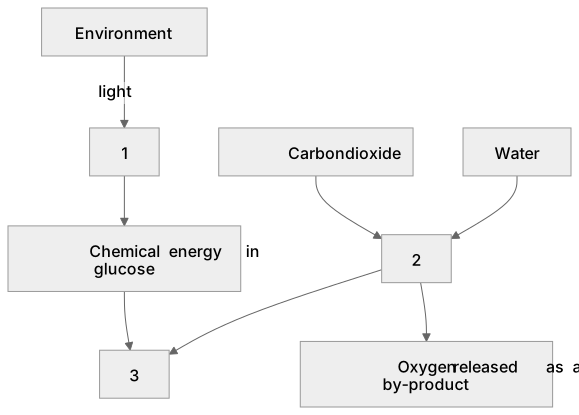
1Box 1
2Box 2
3Box 3
There is more to this lesson
The full lesson goes on to check your understanding and help you earn the marks. Create a free account to carry on, with your progress saved.
A week of Premium from your first lesson · Then the free plan continues · No card, no charge
Test your understanding of Photosynthetic reaction: Students should be able to describe photosynthesis as an endothermic reaction in which energy is transferred from the environment to the chloroplasts by light.
Active recall beats re-reading. Take an instant quiz now to test what you’ve learned and lock it into long-term memory.
A week of Premium from your first lesson · Then the free plan continues · No card, no charge