AQA · GCSE · Combined Science
Course version: 8464 · Version from Sept 2018
The attraction and repulsion between unlike and like poles for permanent…
Full specification wording
Poles of a magnet: the attraction and repulsion between unlike and like poles for permanent magnets
This point requires you to describe the forces between the poles of permanent magnets.
Checked against the AQA 8464 specification (opens in a new tab) on .
- Point 4 of 5
Study notes
From the checked teaching notes for this specification point.
The idea
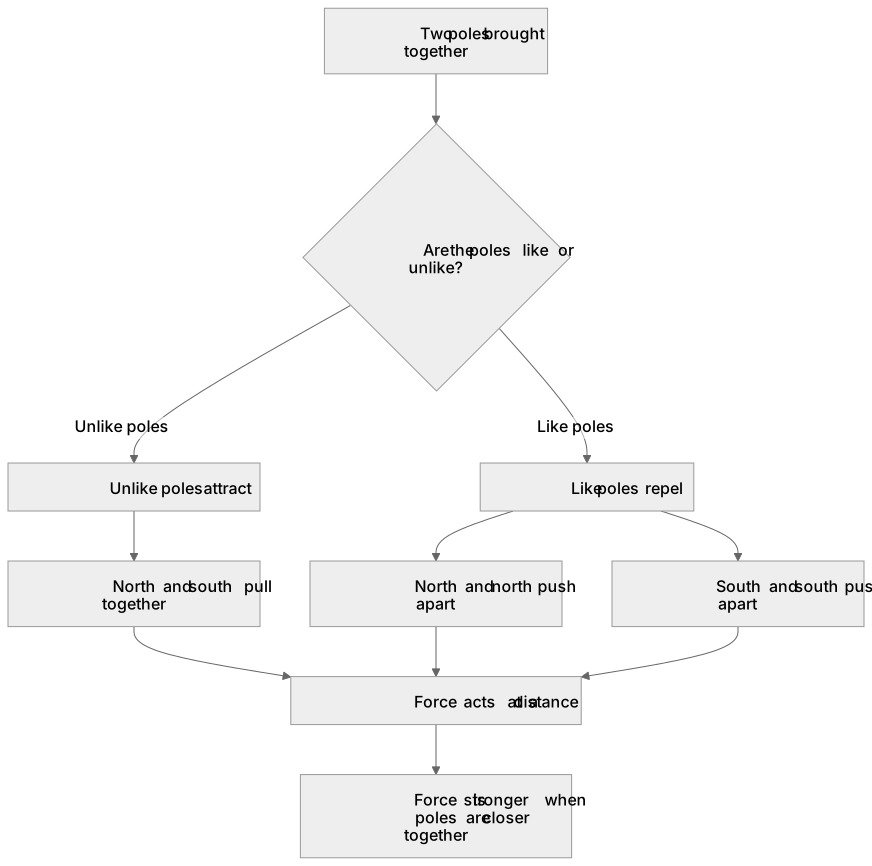
This point requires you to describe the forces between the poles of permanent magnets. Unlike poles attract each other, so a north pole and a south pole pull together. Like poles repel each other, so two north poles or two south poles push apart. These forces act at a distance and become stronger as the magnets are brought closer together. You can demonstrate the rule by bringing two bar magnets end to end: if the ends are unlike they snap together, and if the ends are like they twist away or resist being pushed together. A freely suspended bar magnet also shows this, because its north-seeking pole points north, attracted by the Earth's magnetic south pole.
What earns the marks
- States the rule that unlike poles attract and like poles repel.
- Applies the rule correctly to named pairs, for example north and south attract, while north and north repel.
- Describes the force as acting at a distance, without the magnets needing to touch.
- Describes a practical test, such as bringing two bar magnets end to end and observing whether they pull together or push apart.
- Recognises that the force is stronger when the poles are closer together.
Common mistakes and how to put them right
Reversing the rule and saying like poles attract.
Put it right: Unlike attract, like repel, and check each named pair against the rule.
Thinking the magnets must touch for a force to act.
Put it right: State that magnetic forces act at a distance and can be felt before contact.
Assuming all magnets attract each other.
Put it right: Explain that two like poles repel, so attraction is not universal.
Exam tips
- Name the poles in your answer, for example north and south attract, rather than writing only unlike poles attract.
- Use the words attract and repel precisely; do not use them interchangeably.
- Link the rule to a described observation so your answer shows understanding, not just recall.
Try the lesson
The start of the Poles of a magnet: the attraction and repulsion between unlike and like poles for permanent magnets lesson, made from checked teaching notes for this specification point.
Have a go first
A permanent bar magnet is brought near to a second permanent bar magnet. The north pole of the first magnet is placed close to the north pole of the second magnet. What happens between the two north poles?
Listen
This point requires you to describe the forces between the poles of permanent magnets. Unlike poles attract each other, so a north pole and a south pole pull together. Like poles repel each other, so two north poles or two south poles push apart. These forces act at a distance and become stronger as the magnets are brought closer together. You can demonstrate the rule by bringing two bar magnets end to end: if the ends are unlike they snap together, and if the ends are like they twist away or resist being pushed together. A freely suspended bar magnet also shows this, because its north-seeking pole points north, attracted by the Earth's magnetic south pole. A strong answer earns marks for these points. States the rule that unlike poles attract and like poles repel. Applies the rule correctly to named pairs, for example north and south attract, while north and north repel. Describes the force as acting at a distance, without the magnets needing to touch. Describes a practical test, such as bringing two bar magnets end to end and observing whether they pull together or push apart. A common slip: Reversing the rule and saying like poles attract. Instead, unlike attract, like repel, and check each named pair against the rule. Exam tip: Name the poles in your answer, for example north and south attract, rather than writing only unlike poles attract.
See it
There is more to this lesson
The full lesson goes on to check your understanding and help you earn the marks. Create a free account to carry on, with your progress saved.
A week of Premium from your first lesson · Then the free plan continues · No card, no charge
Test your understanding of Poles of a magnet: the attraction and repulsion between unlike and like poles for permanent magnets
Active recall beats re-reading. Take an instant quiz now to test what you’ve learned and lock it into long-term memory.
A week of Premium from your first lesson · Then the free plan continues · No card, no charge