AQA · GCSE · Combined Science
Course version: 8464 · Version from Sept 2018
Poles of a magnet: Students should be able to describe:
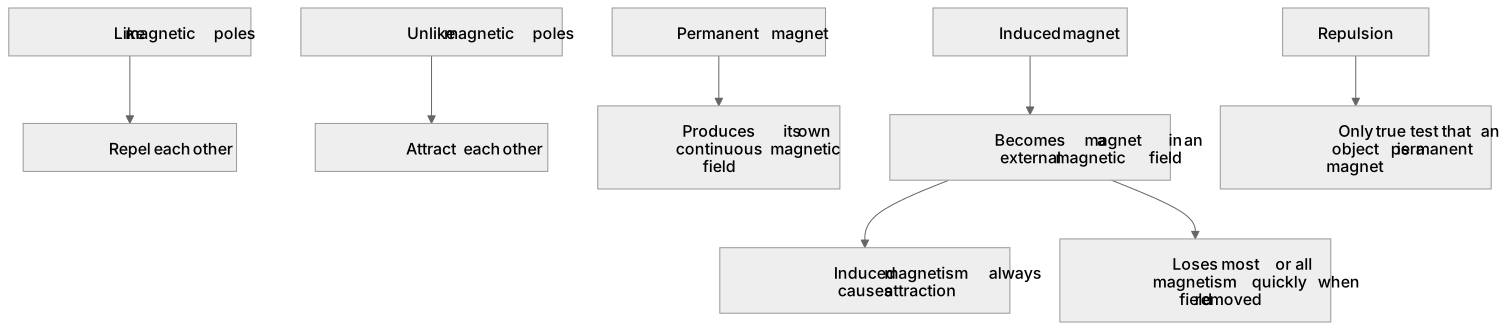
They must also distinguish between permanent magnets, which produce their own magnetic field, and induced magnets, which become magnetic only when placed in an external magnetic field.
Checked against the AQA 8464 specification (opens in a new tab) on .
- Point 3 of 5
Study notes
From the checked teaching notes for this specification point.
The idea
They must also distinguish between permanent magnets, which produce their own magnetic field, and induced magnets, which become magnetic only when placed in an external magnetic field. Induced magnetism always causes a force of attraction. When removed from the magnetic field, an induced magnet loses most or all of its magnetism quickly. A concrete example is bringing a permanent magnet near a steel paperclip; the field induces a temporary opposite pole in the paperclip, causing attraction. Repulsion is the only true test that an object is a permanent magnet, as induced magnets will only ever attract.
What earns the marks
- Describe that like magnetic poles repel each other and unlike magnetic poles attract each other.
- Define a permanent magnet as one that produces its own continuous magnetic field.
- Define an induced magnet as a material that becomes a magnet when it is placed in an external magnetic field.
- State that induced magnetism always causes a force of attraction and that the magnetism is lost quickly when the external field is removed.
Common mistakes and how to put them right
Confusing permanent and induced magnets.
Put it right by stating induced magnets only exhibit magnetism within an external field.
Assuming induced magnets can repel each other or a permanent magnet.
Put it right by stating induced magnetism always causes a force of attraction.
Believing that attraction proves an object is a permanent magnet.
Put it right by explaining that only repulsion can confirm an object is a permanent magnet, as unmagnetised magnetic materials will also be attracted.
Exam tips
- Clearly distinguish between attraction (which can occur with an induced magnet) and repulsion (which proves an object is a permanent magnet).
- When defining induced magnets, always mention that they lose their magnetism when removed from the magnetic field.
Try the lesson
The start of the Poles of a magnet: Students should be able to describe: lesson, made from checked teaching notes for this specification point.
Have a go first
Which statement correctly describes the difference between a permanent magnet and an induced magnet?
Listen
They must also distinguish between permanent magnets, which produce their own magnetic field, and induced magnets, which become magnetic only when placed in an external magnetic field. Induced magnetism always causes a force of attraction. When removed from the magnetic field, an induced magnet loses most or all of its magnetism quickly. A concrete example is bringing a permanent magnet near a steel paperclip; the field induces a temporary opposite pole in the paperclip, causing attraction. Repulsion is the only true test that an object is a permanent magnet, as induced magnets will only ever attract. A strong answer earns marks for these points. Describe that like magnetic poles repel each other and unlike magnetic poles attract each other. Define a permanent magnet as one that produces its own continuous magnetic field. Define an induced magnet as a material that becomes a magnet when it is placed in an external magnetic field. State that induced magnetism always causes a force of attraction and that the magnetism is lost quickly when the external field is removed. A common slip: Confusing permanent and induced magnets. Instead, stating induced magnets only exhibit magnetism within an external field. Exam tip: Clearly distinguish between attraction (which can occur with an induced magnet) and repulsion (which proves an object is a permanent magnet).
See it
Label the diagram
Some boxes have lost their names. Pick the right name for each number.
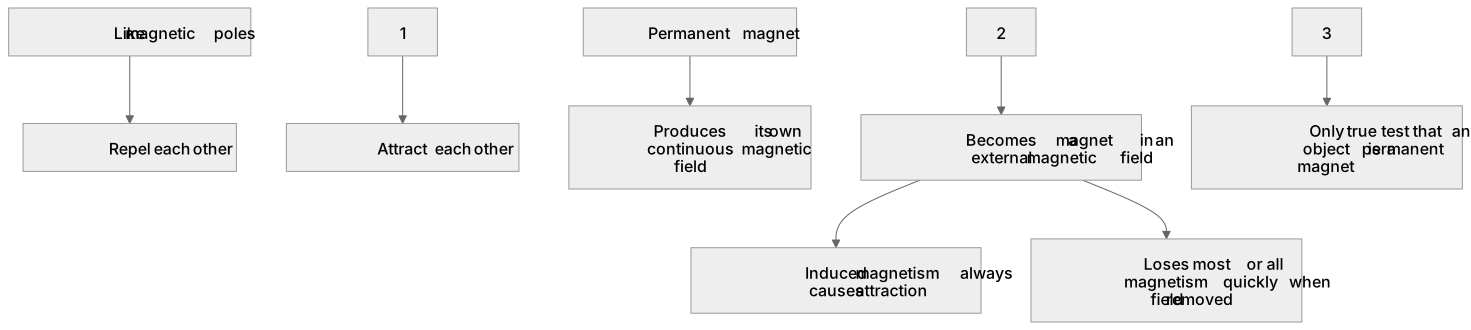
1Box 1
2Box 2
3Box 3
There is more to this lesson
The full lesson goes on to check your understanding and help you earn the marks. Create a free account to carry on, with your progress saved.
A week of Premium from your first lesson · Then the free plan continues · No card, no charge
Test your understanding of Poles of a magnet: Students should be able to describe:
Active recall beats re-reading. Take an instant quiz now to test what you’ve learned and lock it into long-term memory.
A week of Premium from your first lesson · Then the free plan continues · No card, no charge