AQA · GCSE · Combined Science
Course version: 8464 · Version from Sept 2018
(HT only) Radio waves can be produced by oscillations in electrical…
Full specification wording
Properties of electromagnetic waves 2: (HT only) Radio waves can be produced by oscillations in electrical circuits.
Radio waves are electromagnetic waves with the longest wavelengths and lowest frequencies.
Checked against the AQA 8464 specification (opens in a new tab) on .
- Point 1 of 7
Study notes
From the checked teaching notes for this specification point.
The idea
Radio waves are electromagnetic waves with the longest wavelengths and lowest frequencies. In a metal conductor, such as an aerial, electrons can be made to oscillate. When electrons oscillate, they generate radio waves. An alternating potential difference applied to an aerial drives electrons back and forth at the frequency of the supply, producing radio waves of that exact frequency. This principle underlies radio, television and mobile phone communication.
What earns the marks
- States that radio waves are produced when charges (electrons) oscillate in an electrical circuit.
- Explains that an alternating potential difference or alternating current causes electrons to oscillate at a particular frequency.
- Relates the frequency of the electrical oscillation to the frequency of the emitted radio wave.
- Applies the idea to a communication context, such as radio broadcasting or mobile phones.
Common mistakes and how to put them right
Saying radio waves are sound waves.
Put it right: Radio waves are electromagnetic waves and can travel through a vacuum; sound waves are mechanical and need a medium.
Thinking a steady direct current produces radio waves.
Put it right: A steady current does not produce radio waves; the current must oscillate or change direction, as in an alternating current.
Confusing the frequency of the electrical supply with the speed of the radio wave.
Put it right: The frequency of oscillation determines the frequency of the radio wave, but all electromagnetic waves travel at the same speed in a vacuum.
Exam tips
- Use the phrase 'oscillating charges' or 'oscillating electrons' when explaining how radio waves are produced.
- Make clear that the frequency of the emitted radio wave equals the frequency of the alternating current in the circuit.
Try the lesson
The start of the Properties of electromagnetic waves 2: (HT only) Radio waves can be produced by oscillations in electrical circuits. lesson, made from checked teaching notes for this specification point.
Have a go first
Which process in an electrical circuit produces radio waves?
Listen
Radio waves are electromagnetic waves with the longest wavelengths and lowest frequencies. In a metal conductor, such as an aerial, electrons can be made to oscillate. When electrons oscillate, they generate radio waves. An alternating potential difference applied to an aerial drives electrons back and forth at the frequency of the supply, producing radio waves of that exact frequency. This principle underlies radio, television and mobile phone communication. A strong answer earns marks for these points. States that radio waves are produced when charges (electrons) oscillate in an electrical circuit. Explains that an alternating potential difference or alternating current causes electrons to oscillate at a particular frequency. Relates the frequency of the electrical oscillation to the frequency of the emitted radio wave. Applies the idea to a communication context, such as radio broadcasting or mobile phones. A common slip: saying radio waves are sound waves. Instead, radio waves are electromagnetic waves and can travel through a vacuum; sound waves are mechanical and need a medium. Exam tip: Use the phrase 'oscillating charges' or 'oscillating electrons' when explaining how radio waves are produced.
See it
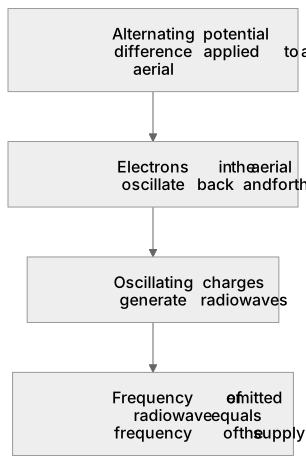
Put it in order
Put these steps in the order they happen.
- 1. Oscillating charges generate radio waves
- 2. Frequency of emitted radio wave equals frequency of the supply
- 3. Electrons in the aerial oscillate back and forth
- 4. Alternating potential difference applied to an aerial
Label the diagram
Some boxes have lost their names. Pick the right name for each number.
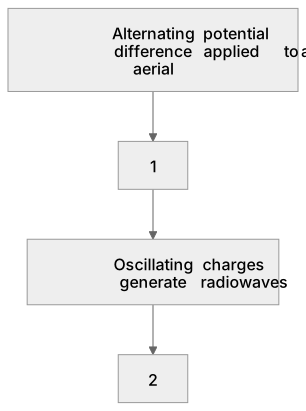
1Box 1
2Box 2
There is more to this lesson
The full lesson goes on to check your understanding and help you earn the marks. Create a free account to carry on, with your progress saved.
A week of Premium from your first lesson · Then the free plan continues · No card, no charge
Test your understanding of Properties of electromagnetic waves 2: (HT only) Radio waves can be produced by oscillations in electrical circuits.
Active recall beats re-reading. Take an instant quiz now to test what you’ve learned and lock it into long-term memory.
A week of Premium from your first lesson · Then the free plan continues · No card, no charge