AQA · GCSE · Combined Science
Course version: 8464 · Version from Sept 2018
A beta particle (β) – a high speed electron ejected from the nucleus as a…
Full specification wording
Radioactive decay and nuclear radiation: a beta particle (β) – a high speed electron ejected from the nucleus as a neutron turns into a proton
A beta particle is a high-speed electron emitted from the nucleus when a neutron changes into a proton.
Checked against the AQA 8464 specification (opens in a new tab) on .
- Point 7 of 10
Study notes
From the checked teaching notes for this specification point.
The idea
A beta particle is a high-speed electron emitted from the nucleus when a neutron changes into a proton. The nucleus gains a proton but loses a neutron, so the proton number increases by 1 while the nucleon number stays the same. The emitted beta particle is written as ⁰₋₁e or β, with a relative mass of 0 and a charge of 1⁻. For example, carbon-14 decays to nitrogen-14: ¹⁴₆C → ¹⁴₇N + ⁰₋₁e. Beta particles are less ionising than alpha particles but have a longer range, typically a few metres in air, and are stopped by a few millimetres of aluminium.
What earns the marks
- A beta particle is a high-speed electron ejected from the nucleus, not from the electron shells.
- The beta particle has a relative mass of 0 and a charge of 1⁻, written as ⁰₋₁e or β.
- In beta decay, the proton number increases by 1 and the nucleon number stays the same, so the element changes.
- A balanced nuclear equation for beta decay must conserve nucleon number and total charge, for example ¹⁴₆C → ¹⁴₇N + ⁰₋₁e.
- Beta particles are less ionising than alpha particles but have a greater range in air, being stopped by a few millimetres of aluminium.
Common mistakes and how to put them right
Saying the beta particle comes from the electron shells.
Put it right: It is ejected from the nucleus when a neutron changes into a proton.
Writing the beta particle as ⁰₊₁e or ⁰₁e.
Put it right: The correct symbol is ⁰₋₁e, showing zero mass number and a 1⁻ charge.
Changing the nucleon number during beta decay.
Put it right: The nucleon number stays the same because a neutron is replaced by a proton.
Exam tips
- In beta decay equations, check that the total charge is balanced: the 1⁻ charge of the beta particle is balanced by the increase of 1⁺ in the proton number of the daughter nucleus.
- Use the phrase neutron turns into a proton when explaining the origin of beta radiation, and link this to the increase in proton number.
- Compare beta with alpha in terms of ionising power and range, and use the correct stopping material: aluminium for beta, paper for alpha.
Try the lesson
The start of the Radioactive decay and nuclear radiation: a beta particle (β) – a high speed electron ejected from the nucleus as a neutron turns into a proton lesson, made from checked teaching notes for this specification point.
Have a go first
Which particle is emitted from the nucleus of an atom during beta decay?
Listen
A beta particle is a high-speed electron emitted from the nucleus when a neutron changes into a proton. The nucleus gains a proton but loses a neutron, so the proton number increases by 1 while the nucleon number stays the same. The emitted beta particle is written as ⁰₋₁e or β, with a relative mass of 0 and a charge of 1⁻. For example, carbon-14 decays to nitrogen-14: ¹⁴₆C → ¹⁴₇N + ⁰₋₁e. Beta particles are less ionising than alpha particles but have a longer range, typically a few metres in air, and are stopped by a few millimetres of aluminium. A strong answer earns marks for these points. A beta particle is a high-speed electron ejected from the nucleus, not from the electron shells. The beta particle has a relative mass of 0 and a charge of 1⁻, written as ⁰₋₁e or β. In beta decay, the proton number increases by 1 and the nucleon number stays the same, so the element changes. A balanced nuclear equation for beta decay must conserve nucleon number and total charge, for example ¹⁴₆C → ¹⁴₇N + ⁰₋₁e. Exam tip: In beta decay equations, check that the total charge is balanced: the 1⁻ charge of the beta particle is balanced by the increase of 1⁺ in the proton number of the daughter nucleus.
See it
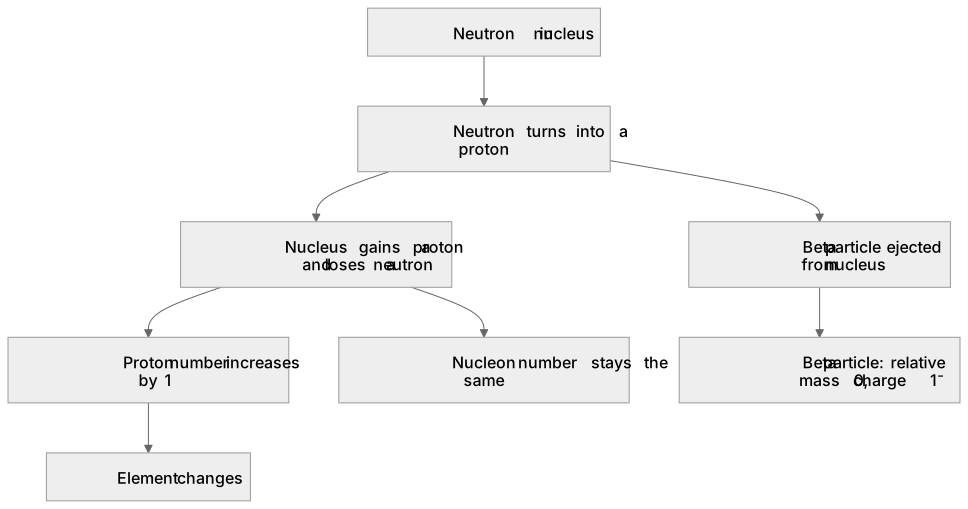
Label the diagram
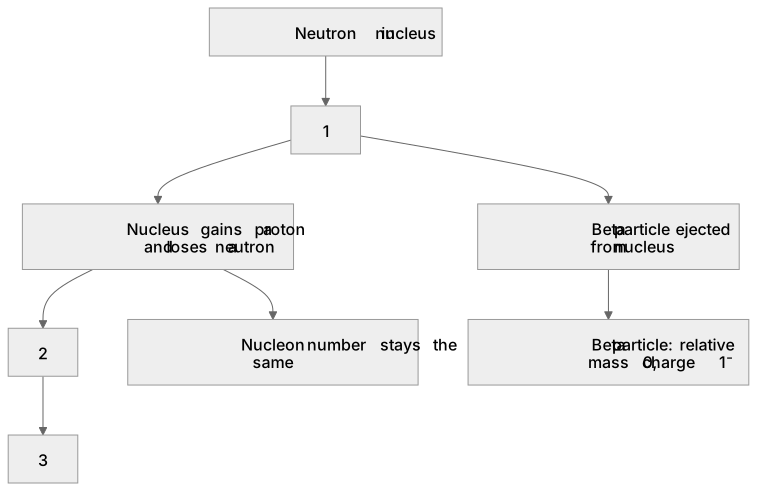
Some boxes have lost their names. Pick the right name for each number.
1Box 1
2Box 2
3Box 3
There is more to this lesson
The full lesson goes on to check your understanding and help you earn the marks. Create a free account to carry on, with your progress saved.
A week of Premium from your first lesson · Then the free plan continues · No card, no charge
Test your understanding of Radioactive decay and nuclear radiation: a beta particle (β) – a high speed electron ejected from the nucleus as a neutron turns into a proton
Active recall beats re-reading. Take an instant quiz now to test what you’ve learned and lock it into long-term memory.
A week of Premium from your first lesson · Then the free plan continues · No card, no charge