AQA · GCSE · Combined Science
Course version: 8464 · Version from Sept 2018
A gamma ray (γ) – electromagnetic radiation from the nucleus
Full specification wording
Radioactive decay and nuclear radiation: a gamma ray (γ) – electromagnetic radiation from the nucleus
A gamma ray is a high-energy electromagnetic wave emitted from an unstable nucleus during radioactive decay.
Checked against the AQA 8464 specification (opens in a new tab) on .
- Point 8 of 10
Study notes
From the checked teaching notes for this specification point.
The idea
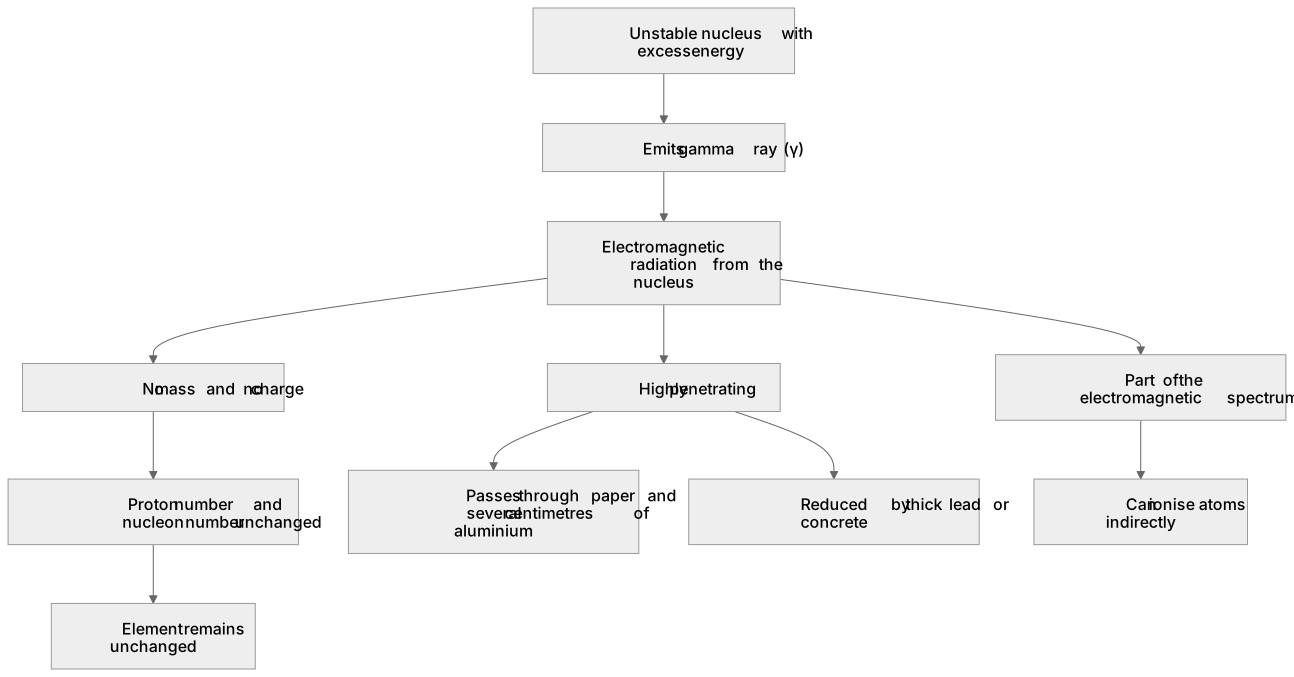
A gamma ray is a high-energy electromagnetic wave emitted from an unstable nucleus during radioactive decay. Unlike alpha or beta particles, it has no mass and no charge, so its emission does not change the proton number or the nucleon number of the nucleus. It travels at the speed of light and is highly penetrating: it passes through paper and several centimetres of aluminium, and is only significantly reduced by thick lead or concrete. For example, after a nucleus emits an alpha or beta particle, it may still hold excess energy; it then releases that energy as one or more gamma rays. In equations, gamma emission is shown by adding γ to the products, with the mass and atomic numbers unchanged. Because gamma is electromagnetic radiation, it is part of the electromagnetic spectrum and can ionise atoms indirectly.
What earns the marks
- Gamma radiation is electromagnetic radiation emitted from the nucleus of an unstable atom.
- A gamma ray has no mass and no electric charge, so emitting it does not alter the proton number or nucleon number of the nucleus.
- Gamma radiation is highly penetrating and is absorbed most effectively by thick lead or concrete, not by paper or a few centimetres of aluminium.
- Gamma emission often follows alpha or beta decay, when a nucleus still has excess energy to release.
- In a nuclear equation, gamma is represented by the symbol γ and the mass number and atomic number of the nucleus remain unchanged.
- Gamma rays are part of the electromagnetic spectrum and can ionise atoms indirectly, which is why they are hazardous to living cells.
Common mistakes and how to put them right
Thinking that gamma emission changes the element.
Put it right: The proton number and nucleon number stay the same, so the element remains unchanged.
Confusing penetrating power with ionising power.
Put it right: Alpha is the most ionising and least penetrating; gamma is the least ionising and most penetrating.
Writing gamma as a particle with mass or charge, such as treating it like a beta particle.
Put it right: Gamma is electromagnetic radiation with no mass and no charge, shown as γ in equations.
Exam tips
- State clearly that gamma is electromagnetic radiation from the nucleus, not a particle with mass or charge.
- When balancing a nuclear equation involving gamma, check that the mass number and atomic number are unchanged.
- Link penetrating power to absorption materials: paper stops alpha, aluminium stops beta, thick lead reduces gamma.
Try the lesson
The start of the Radioactive decay and nuclear radiation: a gamma ray (γ) – electromagnetic radiation from the nucleus lesson, made from checked teaching notes for this specification point.
Have a go first
Which of the following correctly describes the nature of a gamma ray?
Listen
A gamma ray is a high-energy electromagnetic wave emitted from an unstable nucleus during radioactive decay. Unlike alpha or beta particles, it has no mass and no charge, so its emission does not change the proton number or the nucleon number of the nucleus. It travels at the speed of light and is highly penetrating: it passes through paper and several centimetres of aluminium, and is only significantly reduced by thick lead or concrete. For example, after a nucleus emits an alpha or beta particle, it may still hold excess energy; it then releases that energy as one or more gamma rays. In equations, gamma emission is shown by adding γ to the products, with the mass and atomic numbers unchanged. Because gamma is electromagnetic radiation, it is part of the electromagnetic spectrum and can ionise atoms indirectly. A strong answer earns marks for these points. Gamma radiation is electromagnetic radiation emitted from the nucleus of an unstable atom. A gamma ray has no mass and no electric charge, so emitting it does not alter the proton number or nucleon number of the nucleus. Gamma radiation is highly penetrating and is absorbed most effectively by thick lead or concrete, not by paper or a few centimetres of aluminium. Gamma emission often follows alpha or beta decay, when a nucleus still has excess energy to release. A common slip: Thinking that gamma emission changes the element: it does not, because no protons or neutrons are lost. Instead, the proton number and nucleon number stay the same, so the element remains unchanged. Exam tip: State clearly that gamma is electromagnetic radiation from the nucleus, not a particle with mass or charge.
See it
Label the diagram
Some boxes have lost their names. Pick the right name for each number.
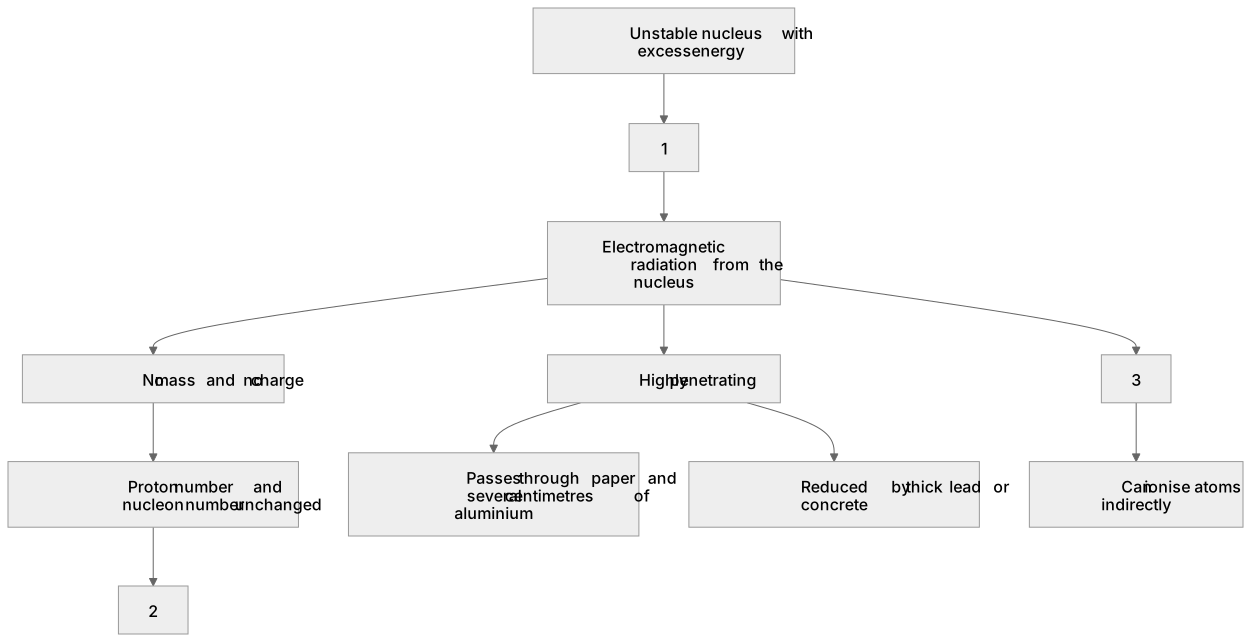
1Box 1
2Box 2
3Box 3
There is more to this lesson
The full lesson goes on to check your understanding and help you earn the marks. Create a free account to carry on, with your progress saved.
A week of Premium from your first lesson · Then the free plan continues · No card, no charge
Test your understanding of Radioactive decay and nuclear radiation: a gamma ray (γ) – electromagnetic radiation from the nucleus
Active recall beats re-reading. Take an instant quiz now to test what you’ve learned and lock it into long-term memory.
A week of Premium from your first lesson · Then the free plan continues · No card, no charge