AQA · GCSE · Combined Science
Course version: 8464 · Version from Sept 2018
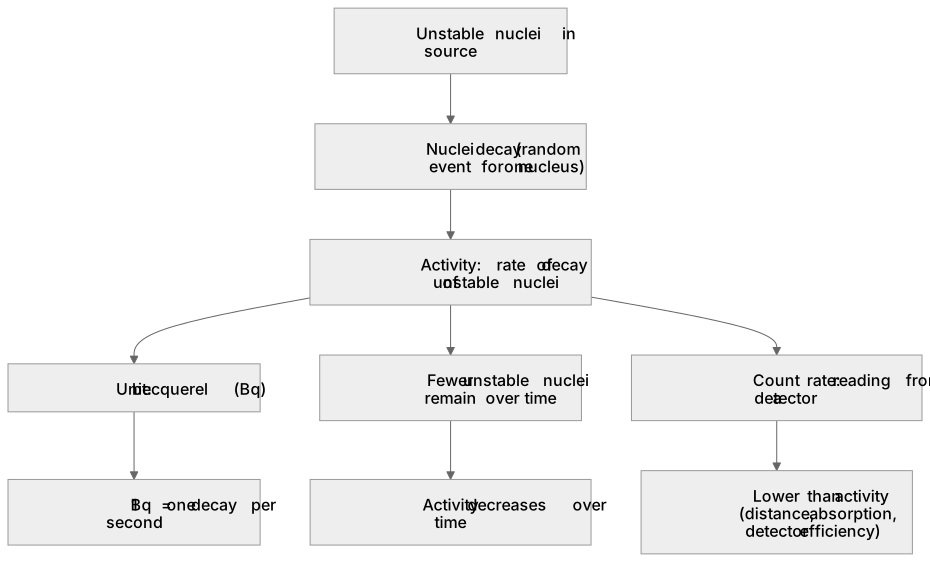
Activity is the rate at which a source of unstable nuclei decays.
Full specification wording
Radioactive decay and nuclear radiation: Activity is the rate at which a source of unstable nuclei decays.
Activity describes how quickly unstable nuclei in a radioactive source decay.
Checked against the AQA 8464 specification (opens in a new tab) on .
- Point 2 of 10
- 3 key terms
Study notes
From the checked teaching notes for this specification point.
The idea
Activity describes how quickly unstable nuclei in a radioactive source decay. Each decay is a random event for one nucleus, but a large sample gives a steady average rate. Activity is therefore the number of nuclear decays per unit time, not the number of nuclei present and not the count rate measured by a detector. For example, a source with an activity of 200 Bq has, on average, 200 nuclei decaying each second. Activity decreases over time because fewer unstable nuclei remain, following the half-life pattern.
What earns the marks
- Activity is defined as the rate of decay of unstable nuclei, meaning decays per unit time.
- The unit of activity is the becquerel (Bq), where 1 Bq equals one decay per second.
- Activity depends on the number of unstable nuclei remaining in the source, so it falls as the source decays.
- Activity is a property of the source, whereas count rate is measured by a detector and is affected by distance, absorption and detector efficiency.
- A stated activity such as 500 Bq means an average of 500 nuclear decays each second, not 500 nuclei present.
Common mistakes and how to put them right
Confusing activity with count rate.
Put it right: Activity is the rate of nuclear decay in the source, while count rate is the reading from a detector, which is usually lower.
Thinking activity is the total number of unstable nuclei.
Put it right: Activity is a rate per second, so it has units of Bq, not a pure number of nuclei.
Believing every nucleus in a source decays at the same instant.
Put it right: Decay is random, so activity is an average rate over a large number of nuclei.
Exam tips
- Always give the unit Bq when quoting an activity value, and remember that 1 Bq = 1 decay per second.
- If a question gives a count rate and asks about activity, explain that the detector does not record every decay because of distance, absorption or inefficiency.
- Link decreasing activity to decreasing numbers of unstable nuclei and to half-life when explaining graphs or calculations.
Try the lesson
The start of the Radioactive decay and nuclear radiation: Activity is the rate at which a source of unstable nuclei decays. lesson, made from checked teaching notes for this specification point.
Have a go first
A radioactive source contains unstable nuclei that decay. What name is given to the rate at which these unstable nuclei decay?
Listen
Activity describes how quickly unstable nuclei in a radioactive source decay. Each decay is a random event for one nucleus, but a large sample gives a steady average rate. Activity is therefore the number of nuclear decays per unit time, not the number of nuclei present and not the count rate measured by a detector. For example, a source with an activity of 200 Bq has, on average, 200 nuclei decaying each second. Activity decreases over time because fewer unstable nuclei remain, following the half-life pattern. A strong answer earns marks for these points. Activity is defined as the rate of decay of unstable nuclei, meaning decays per unit time. The unit of activity is the becquerel (Bq), where 1 Bq equals one decay per second. Activity depends on the number of unstable nuclei remaining in the source, so it falls as the source decays. Activity is a property of the source, whereas count rate is measured by a detector and is affected by distance, absorption and detector efficiency. Exam tip: Always give the unit Bq when quoting an activity value, and remember that 1 Bq = 1 decay per second.
See it
Key words
Say what each word means before you turn the card.
Activity
Try answering aloud or in your head before turning the card.
Becquerel
Try answering aloud or in your head before turning the card.
Count rate
Try answering aloud or in your head before turning the card.
See every definition
- Activity
- The rate at which a source of unstable nuclei decays, measured in decays per unit time.
- Becquerel
- The unit of activity, where one becquerel equals one decay per second.
- Count rate
- The reading from a detector, which is usually lower than activity because not every emitted particle or wave reaches the detector.
Label the diagram
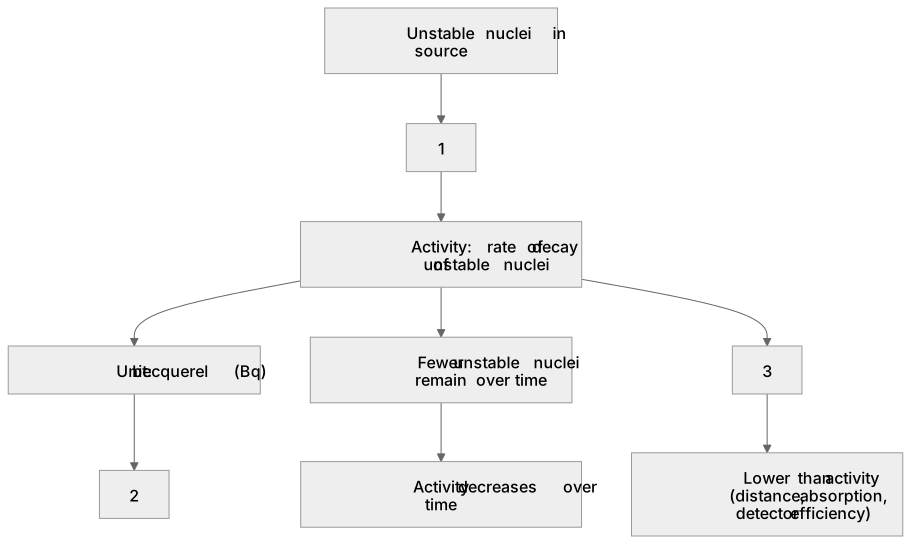
Some boxes have lost their names. Pick the right name for each number.
1Box 1
2Box 2
3Box 3
There is more to this lesson
The full lesson goes on to check your understanding and help you earn the marks. Create a free account to carry on, with your progress saved.
A week of Premium from your first lesson · Then the free plan continues · No card, no charge
Test your understanding of Radioactive decay and nuclear radiation: Activity is the rate at which a source of unstable nuclei decays.
Active recall beats re-reading. Take an instant quiz now to test what you’ve learned and lock it into long-term memory.
A week of Premium from your first lesson · Then the free plan continues · No card, no charge