AQA · GCSE · Combined Science
Course version: 8464 · Version from Sept 2018
Some atomic nuclei are unstable. The nucleus gives out radiation as it…
Full specification wording
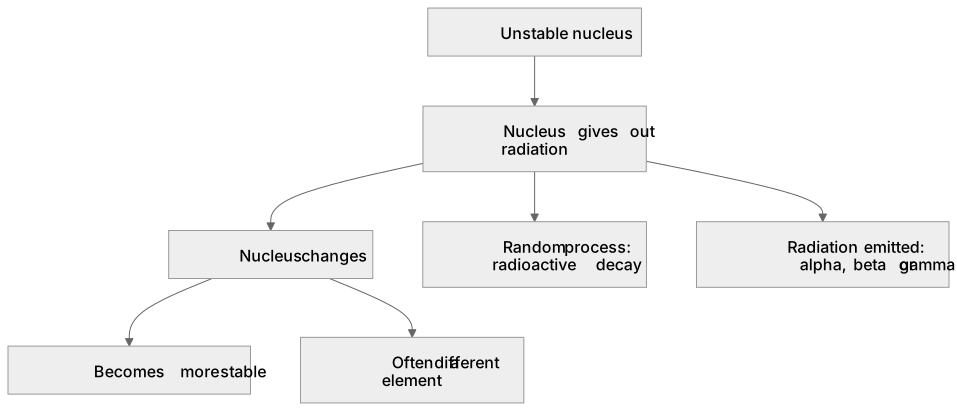
Radioactive decay and nuclear radiation: Some atomic nuclei are unstable. The nucleus gives out radiation as it changes to become more stable. This is a random process called radioactive decay.
Radioactive decay happens when an unstable nucleus emits radiation to become more stable.
Checked against the AQA 8464 specification (opens in a new tab) on .
- Point 1 of 10
- 2 key terms
Study notes
From the checked teaching notes for this specification point.
The idea
Radioactive decay happens when an unstable nucleus emits radiation to become more stable. The process is random: you cannot predict when a particular nucleus will decay, nor which nucleus in a sample will decay next. Each decay changes the nucleus, often into a different element, and releases radiation such as alpha, beta or gamma. Stability improves because the nucleus loses energy or changes its proton-to-neutron balance. For example, carbon-14 decays by beta emission to nitrogen-14, and its half-life of about 5730 years lets archaeologists date once-living material. In exams you may be asked to define radioactive decay, explain why it is random, or describe how emission changes the nucleus.
What earns the marks
- State that radioactive decay occurs in unstable nuclei.
- Explain that the nucleus emits radiation in order to become more stable.
- Define radioactive decay as a random process.
- Explain that randomness means you cannot predict which nucleus decays next or exactly when a given nucleus will decay.
- Describe that decay changes the nucleus, often producing a different element.
- Link the emitted radiation to alpha particles, beta particles or gamma rays.
Common mistakes and how to put them right
Saying decay happens at a steady, predictable rate for each nucleus.
Put it right by stating that decay is random, so individual decay events cannot be predicted, although large samples show a measurable half-life.
Confusing stability with the nucleus 'wanting' to decay.
Put it right by explaining that unstable nuclei emit radiation to become more stable, without implying a conscious choice.
Thinking radiation is always gamma.
Put it right by noting that unstable nuclei may emit alpha or beta particles as well as gamma radiation, depending on the nucleus.
Exam tips
- When defining radioactive decay, include both key ideas: unstable nucleus and random process.
- If asked why decay is random, refer to the inability to predict which nucleus or when, rather than saying it is simply 'unpredictable' without explanation.
- Use a named example such as carbon-14 decaying to nitrogen-14 to show how emission changes the nucleus.
Try the lesson
The start of the Radioactive decay and nuclear radiation: Some atomic nuclei are unstable. The nucleus gives out radiation as it changes to become more stable. This is a random process called radioactive decay. lesson, made from checked teaching notes for this specification point.
Have a go first
Which statement describes what happens during radioactive decay?
Listen
Radioactive decay happens when an unstable nucleus emits radiation to become more stable. The process is random: you cannot predict when a particular nucleus will decay, nor which nucleus in a sample will decay next. Each decay changes the nucleus, often into a different element, and releases radiation such as alpha, beta or gamma. Stability improves because the nucleus loses energy or changes its proton-to-neutron balance. For example, carbon-14 decays by beta emission to nitrogen-14, and its half-life of about 5730 years lets archaeologists date once-living material. In exams you may be asked to define radioactive decay, explain why it is random, or describe how emission changes the nucleus. A strong answer earns marks for these points. State that radioactive decay occurs in unstable nuclei. Explain that the nucleus emits radiation in order to become more stable. Define radioactive decay as a random process. Explain that randomness means you cannot predict which nucleus decays next or exactly when a given nucleus will decay. A common slip: Saying decay happens at a steady, predictable rate for each nucleus. Instead, stating that decay is random, so individual decay events cannot be predicted, although large samples show a measurable half-life. Exam tip: When defining radioactive decay, include both key ideas: unstable nucleus and random process.
See it
Key words
Say what each word means before you turn the card.
Radioactive decay
Try answering aloud or in your head before turning the card.
Random process
Try answering aloud or in your head before turning the card.
See every definition
- Radioactive decay
- A random process in which an unstable nucleus gives out radiation as it changes to become more stable.
- Random process
- You cannot predict when a particular nucleus will decay, nor which nucleus in a sample will decay next.
Label the diagram
Some boxes have lost their names. Pick the right name for each number.
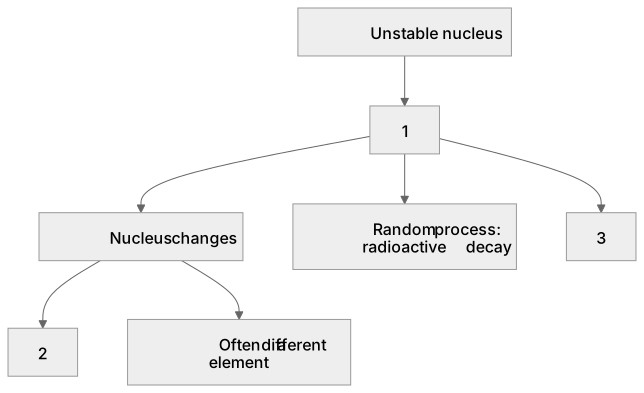
1Box 1
2Box 2
3Box 3
There is more to this lesson
The full lesson goes on to check your understanding and help you earn the marks. Create a free account to carry on, with your progress saved.
A week of Premium from your first lesson · Then the free plan continues · No card, no charge
Test your understanding of Radioactive decay and nuclear radiation: Some atomic nuclei are unstable. The nucleus gives out radiation as it changes to become more stable. This is a random process called radioactive decay.
Active recall beats re-reading. Take an instant quiz now to test what you’ve learned and lock it into long-term memory.
A week of Premium from your first lesson · Then the free plan continues · No card, no charge