AQA · GCSE · Combined Science
Course version: 8464 · Version from Sept 2018
(HT only) These factors interact and any one of them may be the factor…
Full specification wording
Rate of photosynthesis: (HT only) These factors interact and any one of them may be the factor that limits photosynthesis.
Higher tier only.
Checked against the AQA 8464 specification (opens in a new tab) on .
- Point 6 of 10
- 4 key terms
Study notes
From the checked teaching notes for this specification point.
The idea
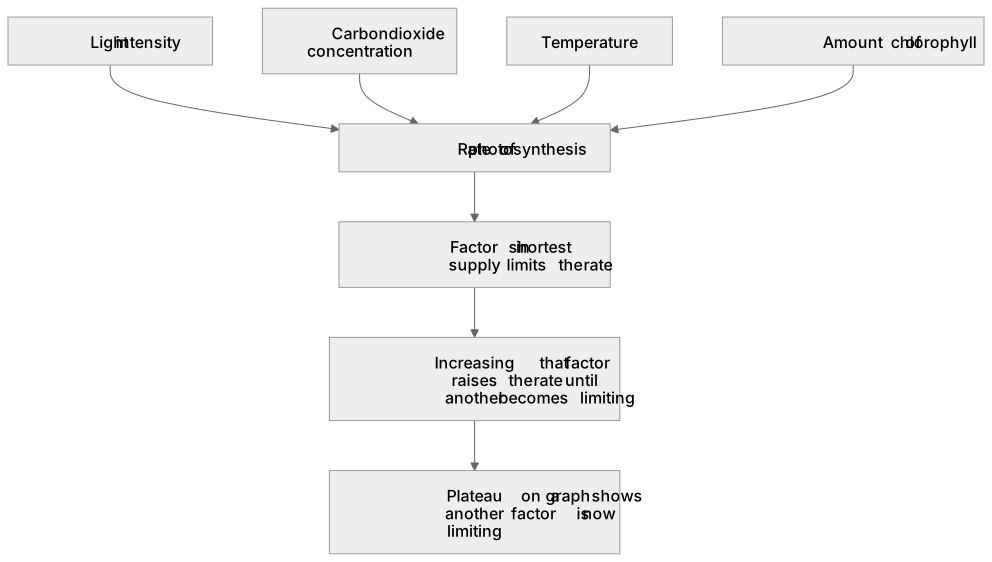
Higher tier only. The rate of photosynthesis is limited by light intensity, carbon dioxide concentration, temperature, or the amount of chlorophyll. These factors interact; any one can limit the rate if it is in shortest supply. For example, increasing light intensity increases the rate until it plateaus, meaning another factor (like carbon dioxide or temperature) is now limiting. Raising carbon dioxide can lift this plateau, provided other factors are adequate. Temperature affects enzyme activity, peaking at an optimum before denaturation reduces the rate. Chlorophyll levels, affected by disease or mineral deficiency, can also limit photosynthesis.
What earns the marks
- Identify light intensity, carbon dioxide concentration, temperature, and chlorophyll amount as interacting limiting factors.
- State that the factor in shortest supply relative to demand limits the overall rate of photosynthesis.
- Explain that increasing a limiting factor increases the rate until a different factor becomes limiting, causing a plateau on a graph.
- Deduce the limiting factor from a graph: a rising curve indicates the x-axis factor is limiting, while a plateau indicates another factor is limiting.
- Explain that temperature affects kinetic energy and enzyme activity, with rates falling above the optimum due to denaturation.
- Describe how reduced chlorophyll (e.g., due to magnesium deficiency) limits photosynthesis by absorbing less light.
Common mistakes and how to put them right
Forgetting that chlorophyll amount can be a limiting factor.
Put it right: Chlorophyll is essential for absorbing light, so low levels limit the rate.
Claiming the factor with the highest value is limiting.
Put it right: The limiting factor is the one in shortest supply.
Stating that increasing light always increases the rate.
Put it right: It only increases the rate until another factor limits it.
Exam tips
- When analysing a graph with multiple curves, identify what changes between the plateaus to find the new limiting factor.
- Remember to include chlorophyll amount when listing factors that can limit photosynthesis.
Try the lesson
The start of the Rate of photosynthesis: (HT only) These factors interact and any one of them may be the factor that limits photosynthesis. lesson, made from checked teaching notes for this specification point.
Have a go first
A plant's rate of photosynthesis is measured at increasing light intensities. At 15 °C and 0.04% CO₂, the maximum rate is 20 arbitrary units. At 25 °C and 0.04% CO₂, the maximum rate is 30 arbitrary units. At 25 °C and 0.1% CO₂, the maximum rate is 50 arbitrary units. What does this show about the factors limiting photosynthesis?
Listen
Higher tier only. The rate of photosynthesis is limited by light intensity, carbon dioxide concentration, temperature, or the amount of chlorophyll. These factors interact; any one can limit the rate if it is in shortest supply. For example, increasing light intensity increases the rate until it plateaus, meaning another factor (like carbon dioxide or temperature) is now limiting. Raising carbon dioxide can lift this plateau, provided other factors are adequate. Temperature affects enzyme activity, peaking at an optimum before denaturation reduces the rate. Chlorophyll levels, affected by disease or mineral deficiency, can also limit photosynthesis. A strong answer earns marks for these points. Identify light intensity, carbon dioxide concentration, temperature, and chlorophyll amount as interacting limiting factors. State that the factor in shortest supply relative to demand limits the overall rate of photosynthesis. Explain that increasing a limiting factor increases the rate until a different factor becomes limiting, causing a plateau on a graph. Deduce the limiting factor from a graph: a rising curve indicates the x-axis factor is limiting, while a plateau indicates another factor is limiting. A common slip: Forgetting that chlorophyll amount can be a limiting factor. Instead, Chlorophyll is essential for absorbing light, so low levels limit the rate. Exam tip: When analysing a graph with multiple curves, identify what changes between the plateaus to find the new limiting factor.
See it
Key words
Say what each word means before you turn the card.
Limiting factors
Try answering aloud or in your head before turning the card.
Interaction of factors
Try answering aloud or in your head before turning the card.
Enzyme activity
Try answering aloud or in your head before turning the card.
Graphical analysis
Try answering aloud or in your head before turning the card.
See every definition
- Limiting factors
- Light intensity, carbon dioxide concentration, temperature, or the amount of chlorophyll, which interact so that any one of them may limit photosynthesis.
- Interaction of factors
- The way these factors interact so that any one of them may be the factor that limits photosynthesis.
- Enzyme activity
- Affected by temperature, peaking at an optimum before denaturation reduces the rate.
- Graphical analysis
- Deducing limiting factors from graphs, where a rising curve indicates the x-axis factor is limiting and a plateau indicates another factor is limiting.
Label the diagram
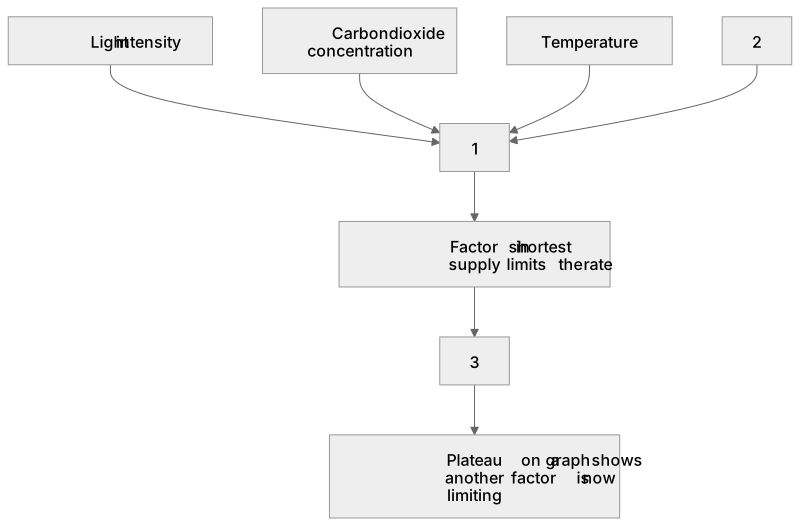
Some boxes have lost their names. Pick the right name for each number.
1Box 1
2Box 2
3Box 3
There is more to this lesson
The full lesson goes on to check your understanding and help you earn the marks. Create a free account to carry on, with your progress saved.
A week of Premium from your first lesson · Then the free plan continues · No card, no charge
Test your understanding of Rate of photosynthesis: (HT only) These factors interact and any one of them may be the factor that limits photosynthesis.
Active recall beats re-reading. Take an instant quiz now to test what you’ve learned and lock it into long-term memory.
A week of Premium from your first lesson · Then the free plan continues · No card, no charge