AQA · GCSE · Combined Science
Course version: 8464 · Version from Sept 2018
Explain methods used to measure human reaction times and recall typical…
Full specification wording
Reaction time: explain methods used to measure human reaction times and recall typical results
You must explain how human reaction time is measured and recall typical results.
Checked against the AQA 8464 specification (opens in a new tab) on .
- Point 3 of 5
- 4 key terms
Study notes
From the checked teaching notes for this specification point.
The idea
You must explain how human reaction time is measured and recall typical results. The main method is the ruler drop test: a partner holds a ruler vertically with the zero mark level with your open thumb and finger, then releases it without warning. You catch it as quickly as possible. The distance the ruler falls is read from the zero mark to the top of your thumb. A larger distance means a slower reaction time. Convert this distance to time using a standard conversion table. Repeat the test several times and calculate a mean, ignoring anomalies. Typical human reaction time is between 0.2 s and 0.9 s. It varies with factors like tiredness, distraction, caffeine and practice. A computer-based test can also be used, where a stimulus appears on screen and you press a key; this reduces the effect of hand movement and is more precise.
What earns the marks
- Describe the ruler drop test: a partner holds a ruler vertically with the zero mark between the participant's open thumb and finger, releases it without warning, and the participant catches it.
- Explain that the distance fallen is measured from the zero mark to the top of the thumb, and that a larger distance indicates a longer reaction time.
- State that the measured fall distance is converted into a reaction time using a standard conversion table.
- State that repeat readings should be taken and a mean calculated, with anomalous results identified and excluded, to improve reliability.
- Recall that typical human reaction time is between 0.2 s and 0.9 s, and that it can be affected by factors such as tiredness, distraction, caffeine, age and practice.
- Describe a computer-based method in which a stimulus appears on screen and the participant presses a key, explaining that this can be more precise and reduces the effect of hand movement.
Common mistakes and how to put them right
Measuring the distance from the bottom of the ruler rather than from the zero mark.
Put it right by reading the scale at the top of the thumb, starting from zero.
Stating typical reaction times as 0.2 s to 0.3 s.
Put it right by recalling the specification range of 0.2 s to 0.9 s.
Recording only one measurement and treating it as exact.
Put it right by taking at least three repeats and calculating a mean, ignoring obvious anomalies.
Exam tips
- Learn the ruler drop method in a clear sequence: hold, release, catch, measure, repeat, use a conversion table.
- Quote typical reaction times as a range, 0.2 s to 0.9 s, rather than a single value, and link any variation to named factors.
Try the lesson
The start of the Reaction time: explain methods used to measure human reaction times and recall typical results lesson, made from checked teaching notes for this specification point.
Have a go first
A student investigates human responses using the ruler drop test. A partner holds a ruler vertically and releases it without warning, and the student catches it as quickly as possible. What does the distance the ruler falls allow the student to determine?
Listen
You must explain how human reaction time is measured and recall typical results. The main method is the ruler drop test: a partner holds a ruler vertically with the zero mark level with your open thumb and finger, then releases it without warning. You catch it as quickly as possible. The distance the ruler falls is read from the zero mark to the top of your thumb. A larger distance means a slower reaction time. Convert this distance to time using a standard conversion table. Repeat the test several times and calculate a mean, ignoring anomalies. Typical human reaction time is between 0.2 s and 0.9 s. It varies with factors like tiredness, distraction, caffeine and practice. A computer-based test can also be used, where a stimulus appears on screen and you press a key; this reduces the effect of hand movement and is more precise. A strong answer earns marks for these points. Describe the ruler drop test: a partner holds a ruler vertically with the zero mark between the participant's open thumb and finger, releases it without warning, and the participant catches it. Explain that the distance fallen is measured from the zero mark to the top of the thumb, and that a larger distance indicates a longer reaction time. State that the measured fall distance is converted into a reaction time using a standard conversion table. State that repeat readings should be taken and a mean calculated, with anomalous results identified and excluded, to improve reliability. A common slip: Measuring the distance from the bottom of the ruler rather than from the zero mark. Instead, reading the scale at the top of the thumb, starting from zero. Exam tip: Learn the ruler drop method in a clear sequence: hold, release, catch, measure, repeat, use a conversion table.
See it
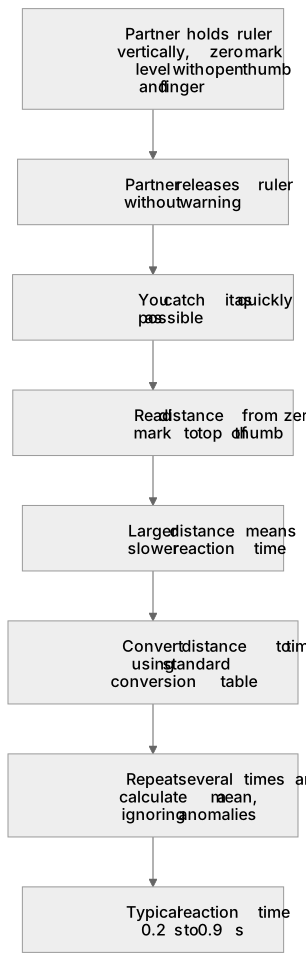
Put it in order
Put these steps in the order they happen.
- 1. Larger distance means slower reaction time
- 2. Typical reaction time 0.2 s to 0.9 s
- 3. Convert distance to time using standard conversion table
- 4. Partner holds ruler vertically, zero mark level with open thumb and finger
- 5. Partner releases ruler without warning
- 6. Repeat several times and calculate a mean, ignoring anomalies
- 7. You catch it as quickly as possible
- 8. Read distance from zero mark to top of thumb
Key words
Say what each word means before you turn the card.
Ruler drop test
Try answering aloud or in your head before turning the card.
Conversion table
Try answering aloud or in your head before turning the card.
Mean
Try answering aloud or in your head before turning the card.
Reaction time
Try answering aloud or in your head before turning the card.
See every definition
- Ruler drop test
- A partner holds a ruler vertically with the zero mark level with your open thumb and finger, then releases it without warning and you catch it as quickly as possible.
- Conversion table
- A standard table used to convert the distance the ruler falls into a reaction time.
- Mean
- A value calculated after repeating the test several times, ignoring anomalies, to improve reliability.
- Reaction time
- Typically between 0.2 s and 0.9 s in humans, and varies with factors like tiredness, distraction, caffeine and practice.
Label the diagram
Some boxes have lost their names. Pick the right name for each number.
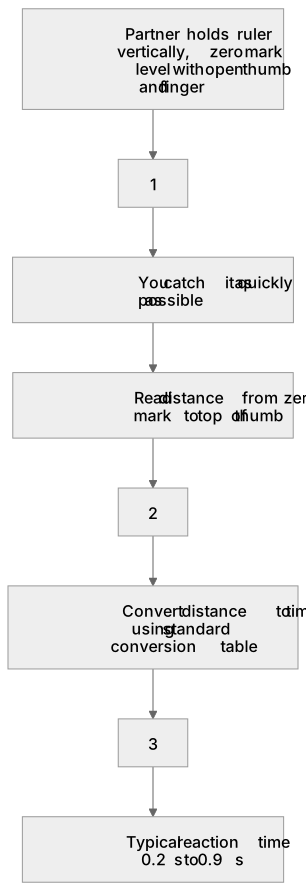
1Box 1
2Box 2
3Box 3
There is more to this lesson
The full lesson goes on to check your understanding and help you earn the marks. Create a free account to carry on, with your progress saved.
A week of Premium from your first lesson · Then the free plan continues · No card, no charge
Test your understanding of Reaction time: explain methods used to measure human reaction times and recall typical results
Active recall beats re-reading. Take an instant quiz now to test what you’ve learned and lock it into long-term memory.
A week of Premium from your first lesson · Then the free plan continues · No card, no charge