AQA · GCSE · Combined Science
Course version: 8464 · Version from Sept 2018
A driver’s reaction time can be affected by tiredness, drugs and alcohol.…
Full specification wording
Reaction time: A driver’s reaction time can be affected by tiredness, drugs and alcohol. Distractions may also affect a driver’s ability to react.
A driver’s reaction time is not fixed; it depends on the driver’s state and surroundings.
Checked against the AQA 8464 specification (opens in a new tab) on .
- Point 2 of 5
- 4 key terms
Study notes
From the checked teaching notes for this specification point.
The idea
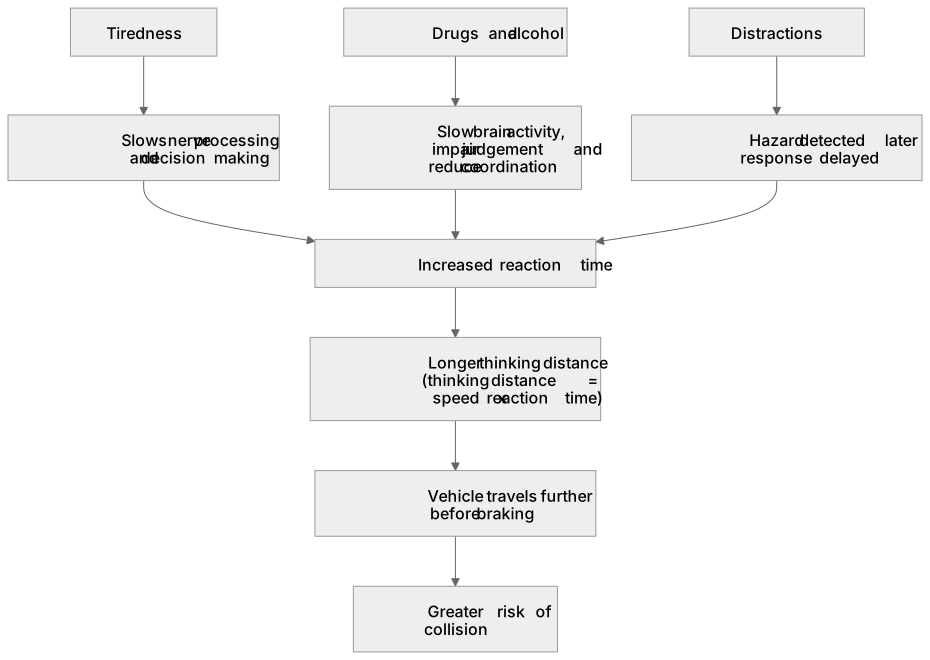
A driver’s reaction time is not fixed; it depends on the driver’s state and surroundings. Tiredness slows nerve processing and decision making, so the interval between seeing a hazard and braking increases. Drugs and alcohol can slow brain activity, impair judgement and reduce coordination, again lengthening reaction time. Distractions such as a ringing phone, loud passengers or looking at a satnav compete for attention, so the hazard may be detected later or the response may be delayed. Because thinking distance equals speed multiplied by reaction time, any increase in reaction time increases the distance travelled before braking begins, raising the risk of a collision.
What earns the marks
- Tiredness slows the driver’s processing of information and increases reaction time.
- Drugs and alcohol impair brain function, judgement and coordination, which increases reaction time.
- Distractions divide the driver’s attention, so a hazard may be detected later or the response may be delayed.
- An increased reaction time increases thinking distance because thinking distance = speed × reaction time.
- A longer thinking distance at a given speed means the vehicle travels further before braking, increasing collision risk.
- Reaction time is affected by both the driver’s physiological state and external distractions, so it is not a fixed value.
Common mistakes and how to put them right
Thinking alcohol only affects judgement and not reaction time.
Put it right: Link alcohol to a longer interval between stimulus and response.
Assuming distractions change braking distance.
Put it right: Separate thinking distance from braking distance.
Treating tiredness as harmless because the driver is still awake.
Put it right: Explain that tiredness increases reaction time.
Exam tips
- Link each factor to the effect on reaction time and then to the effect on thinking distance, using thinking distance = speed × reaction time.
- Use comparative language such as increases, lengthens or delays rather than vague words such as affects.
- When describing distractions, name a specific example such as using a phone or talking to a passenger, and state how it delays the response.
Try the lesson
The start of the Reaction time: A driver’s reaction time can be affected by tiredness, drugs and alcohol. Distractions may also affect a driver’s ability to react. lesson, made from checked teaching notes for this specification point.
Have a go first
Which of these is a distraction that may increase a driver’s reaction time?
Listen
A driver’s reaction time is not fixed; it depends on the driver’s state and surroundings. Tiredness slows nerve processing and decision making, so the interval between seeing a hazard and braking increases. Drugs and alcohol can slow brain activity, impair judgement and reduce coordination, again lengthening reaction time. Distractions such as a ringing phone, loud passengers or looking at a satnav compete for attention, so the hazard may be detected later or the response may be delayed. Because thinking distance equals speed multiplied by reaction time, any increase in reaction time increases the distance travelled before braking begins, raising the risk of a collision. A strong answer earns marks for these points. Tiredness slows the driver’s processing of information and increases reaction time. Drugs and alcohol impair brain function, judgement and coordination, which increases reaction time. Distractions divide the driver’s attention, so a hazard may be detected later or the response may be delayed. An increased reaction time increases thinking distance because thinking distance = speed × reaction time. A common slip: Thinking alcohol only affects judgement and not reaction time: alcohol also slows reactions and coordination. Instead, link alcohol to a longer interval between stimulus and response. Exam tip: Link each factor to the effect on reaction time and then to the effect on thinking distance, using thinking distance = speed × reaction time.
See it
Key words
Say what each word means before you turn the card.
Reaction time
Try answering aloud or in your head before turning the card.
Tiredness
Try answering aloud or in your head before turning the card.
Drugs and alcohol
Try answering aloud or in your head before turning the card.
Distractions
Try answering aloud or in your head before turning the card.
See every definition
- Reaction time
- The interval between seeing a hazard and braking, which is not fixed and depends on the driver's state and surroundings.
- Tiredness
- Slows nerve processing and decision making, so the interval between seeing a hazard and braking increases.
- Drugs and alcohol
- Can slow brain activity, impair judgement and reduce coordination, again lengthening reaction time.
- Distractions
- Things such as a ringing phone, loud passengers or looking at a satnav compete for attention, so a hazard may be detected later or the response delayed.
Label the diagram
Some boxes have lost their names. Pick the right name for each number.
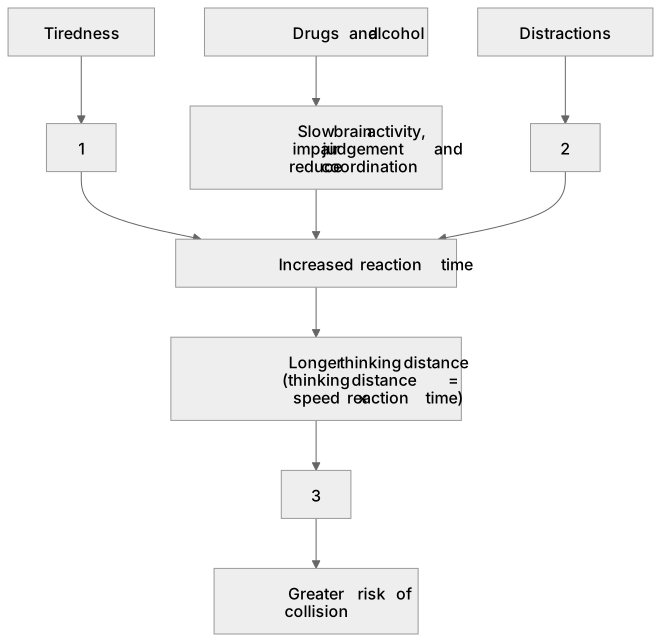
1Box 1
2Box 2
3Box 3
There is more to this lesson
The full lesson goes on to check your understanding and help you earn the marks. Create a free account to carry on, with your progress saved.
A week of Premium from your first lesson · Then the free plan continues · No card, no charge
Test your understanding of Reaction time: A driver’s reaction time can be affected by tiredness, drugs and alcohol. Distractions may also affect a driver’s ability to react.
Active recall beats re-reading. Take an instant quiz now to test what you’ve learned and lock it into long-term memory.
A week of Premium from your first lesson · Then the free plan continues · No card, no charge