AQA · GCSE · Combined Science
Course version: 8464 · Version from Sept 2018
Reaction times vary from person to person. Typical values range from 0.2 s…
Full specification wording
Reaction time: Reaction times vary from person to person. Typical values range from 0.2 s to 0.9 s.
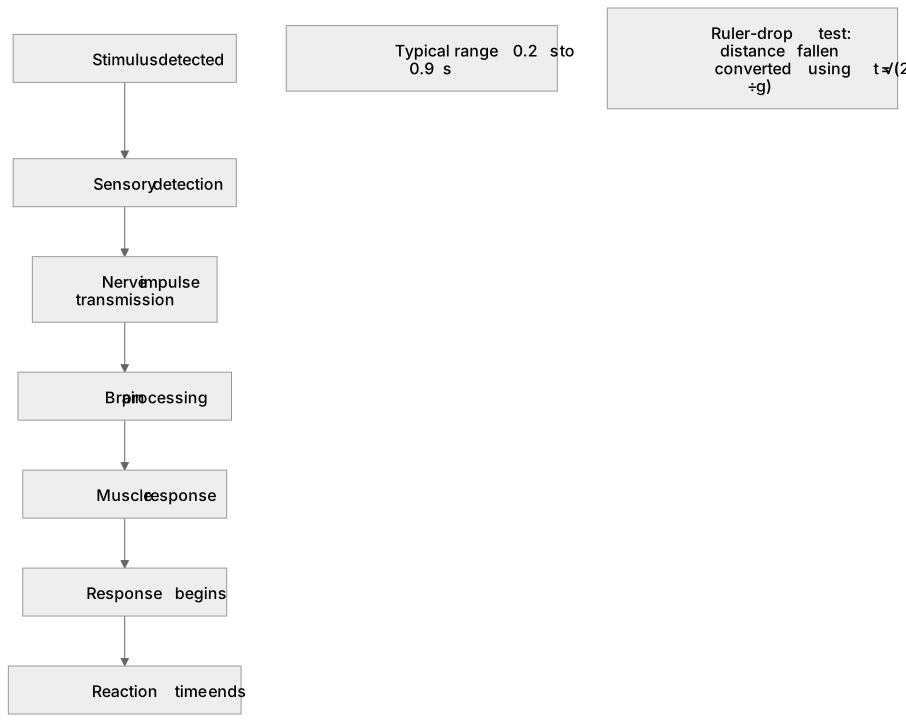
Reaction time is the interval between detecting a stimulus and starting a response.
Checked against the AQA 8464 specification (opens in a new tab) on .
- Point 1 of 5
- 3 key terms
Study notes
From the checked teaching notes for this specification point.
The idea
Reaction time is the interval between detecting a stimulus and starting a response. It varies between people because of differences in sensory detection, nerve conduction, processing in the brain and muscle activation. A typical human reaction time lies between 0.2 s and 0.9 s, so a driver travelling at speed covers a considerable distance before braking. For example, at 20 m/s a reaction time of 0.2 s gives a thinking distance of 4 m, while 0.9 s gives 18 m. Reaction time can be measured using a ruler-drop test: a partner releases a ruler without warning and the distance it falls before being caught is converted to time using the equation for free fall, t = √(2s ÷ g).
What earns the marks
- Reaction time is the time taken to detect a stimulus and initiate a response, not the total stopping time of a vehicle.
- Typical human reaction times range from about 0.2 s to 0.9 s, and values outside this range are unusual for a healthy alert person.
- Reaction time varies between individuals because of differences in sensory receptors, nerve impulse transmission, brain processing and muscle response.
- During the reaction time a vehicle continues at its original speed, so thinking distance equals speed multiplied by reaction time.
- The ruler-drop test measures reaction time by timing a falling ruler; the distance fallen is converted to time using t = √(2s ÷ g).
- Reaction time is only one contribution to stopping distance; braking distance depends on speed, road conditions and braking force.
Common mistakes and how to put them right
Confusing reaction time with stopping time.
Put it right: Define reaction time as the interval from stimulus to the start of the response.
Assuming every person has the same reaction time.
Put it right: Quote the typical range 0.2 s to 0.9 s and treat single values as examples, not fixed constants.
Using the ruler-drop distance directly as a time in seconds.
Put it right: Apply t = √(2s ÷ g) with s in metres and g = 9.8 m/s².
Exam tips
- State the stimulus and the response explicitly when defining reaction time, for example the driver sees a hazard and moves a foot to the brake.
- When calculating thinking distance, use thinking distance = speed × reaction time and keep speed in m/s and time in s.
- If a question gives a ruler-drop distance, convert it to metres before substituting into t = √(2s ÷ g), and show the substitution clearly.
Try the lesson
The start of the Reaction time: Reaction times vary from person to person. Typical values range from 0.2 s to 0.9 s. lesson, made from checked teaching notes for this specification point.
Have a go first
Which of these is a typical human reaction time?
Listen
Reaction time is the interval between detecting a stimulus and starting a response. It varies between people because of differences in sensory detection, nerve conduction, processing in the brain and muscle activation. A typical human reaction time lies between 0.2 s and 0.9 s, so a driver travelling at speed covers a considerable distance before braking. For example, at 20 m/s a reaction time of 0.2 s gives a thinking distance of 4 m, while 0.9 s gives 18 m. Reaction time can be measured using a ruler-drop test: a partner releases a ruler without warning and the distance it falls before being caught is converted to time using the equation for free fall, t = √(2s ÷ g). A strong answer earns marks for these points. Reaction time is the time taken to detect a stimulus and initiate a response, not the total stopping time of a vehicle. Typical human reaction times range from about 0.2 s to 0.9 s, and values outside this range are unusual for a healthy alert person. Reaction time varies between individuals because of differences in sensory receptors, nerve impulse transmission, brain processing and muscle response. During the reaction time a vehicle continues at its original speed, so thinking distance equals speed multiplied by reaction time. A common slip: Confusing reaction time with stopping time: reaction time ends when the driver begins to brake, whereas stopping time includes the whole braking period. Instead, define reaction time as the interval from stimulus to the start of the response. Exam tip: State the stimulus and the response explicitly when defining reaction time, for example the driver sees a hazard and moves a foot to the brake.
See it
Key words
Say what each word means before you turn the card.
Reaction time
Try answering aloud or in your head before turning the card.
Thinking distance
Try answering aloud or in your head before turning the card.
Ruler-drop test
Try answering aloud or in your head before turning the card.
See every definition
- Reaction time
- The interval between detecting a stimulus and starting a response, not the total stopping time of a vehicle.
- Thinking distance
- The distance covered while a vehicle continues at its original speed during the reaction time, equal to speed multiplied by reaction time.
- Ruler-drop test
- A method that measures reaction time by timing a falling ruler, converting the distance fallen to time using t = √(2s ÷ g).
Label the diagram
Some boxes have lost their names. Pick the right name for each number.
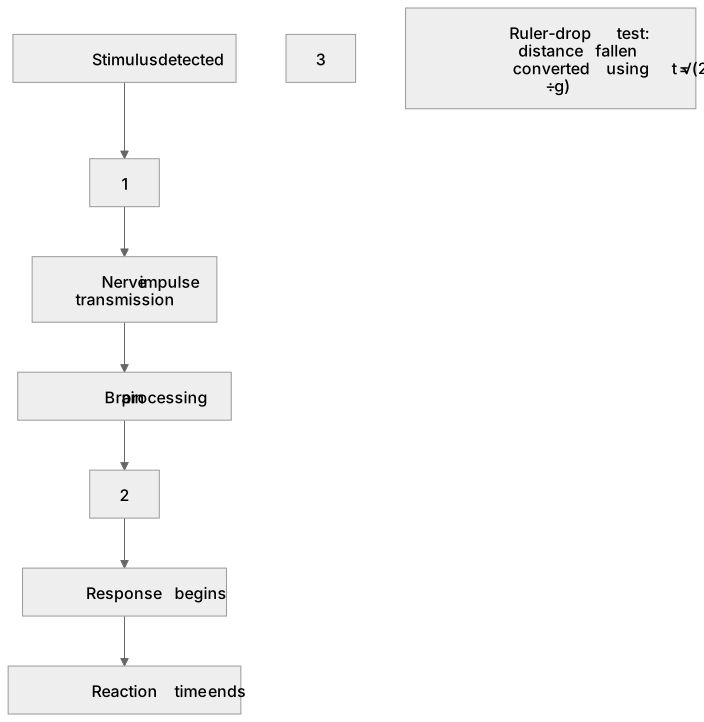
1Box 1
2Box 2
3Box 3
There is more to this lesson
The full lesson goes on to check your understanding and help you earn the marks. Create a free account to carry on, with your progress saved.
A week of Premium from your first lesson · Then the free plan continues · No card, no charge
Test your understanding of Reaction time: Reaction times vary from person to person. Typical values range from 0.2 s to 0.9 s.
Active recall beats re-reading. Take an instant quiz now to test what you’ve learned and lock it into long-term memory.
A week of Premium from your first lesson · Then the free plan continues · No card, no charge