AQA · GCSE · Combined Science
Course version: 8464 · Version from Sept 2018
(HT only) A single force can be resolved into two components acting at…
Full specification wording
Resultant forces: (HT only) A single force can be resolved into two components acting at right angles to each other. The two component forces together have the same effect as the single force.
This Higher Tier only statement requires resolving a single force into two perpendicular components using scale drawings, not trigonometry.
Checked against the AQA 8464 specification (opens in a new tab) on .
- Point 5 of 6
- 3 key terms
Study notes
From the checked teaching notes for this specification point.
The idea
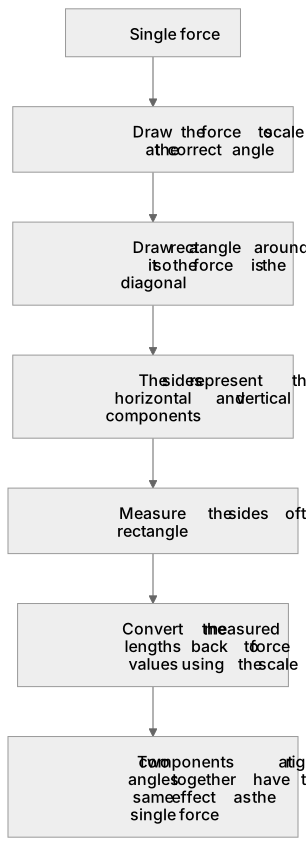
This Higher Tier only statement requires resolving a single force into two perpendicular components using scale drawings, not trigonometry. Any single force can be replaced by two components at right angles that together produce the same effect. To resolve a force, draw it to scale at the correct angle (e.g., 1 cm = 10 N). Draw a rectangle around it so the force is the diagonal. The sides represent the horizontal and vertical components. For example, to resolve a 50 N force at 30°, draw a 5 cm diagonal at 30°, complete the rectangle, and measure the sides. A 4.3 cm horizontal side means a 43 N component, and a 2.5 cm vertical side means a 25 N component. The components are a mathematical replacement simplifying analysis.
What earns the marks
- States that a single force can be resolved into two components acting at right angles to each other.
- Explains that the two component forces together have the exact same effect as the original single force.
- Uses a scale drawing to resolve a force, drawing the original force to scale at the given angle.
- Constructs a rectangle or right-angled triangle to find the perpendicular components graphically.
- Measures the lengths of the component arrows on the scale drawing and converts them back to force values using the scale.
Common mistakes and how to put them right
Using trigonometry (sine and cosine) to resolve forces.
Put it right by using scale drawings, as trigonometry for force resolution is not required at GCSE.
Treating the components as additional forces that change the overall effect.
Put it right by stressing that the components replace the single force and are equivalent to it.
Drawing the components shorter or longer than the rectangle's sides.
Put it right by ensuring the original force forms the exact diagonal of the rectangle.
Exam tips
- Always state your scale clearly (e.g., 1 cm = 10 N) and use a protractor to measure angles accurately.
- Draw the original force first, then use a set square or protractor to draw the perpendicular components forming a rectangle.
Try the lesson
The start of the Resultant forces: (HT only) A single force can be resolved into two components acting at right angles to each other. The two component forces together have the same effect as the single force. lesson, made from checked teaching notes for this specification point.
Have a go first
A single force of 10 N acts vertically, at 90° to the horizontal. What is the size of the horizontal component of this force?
Listen
This Higher Tier only statement requires resolving a single force into two perpendicular components using scale drawings, not trigonometry. Any single force can be replaced by two components at right angles that together produce the same effect. To resolve a force, draw it to scale at the correct angle (e.g., 1 cm = 10 N). Draw a rectangle around it so the force is the diagonal. The sides represent the horizontal and vertical components. For example, to resolve a 50 N force at 30°, draw a 5 cm diagonal at 30°, complete the rectangle, and measure the sides. A 4.3 cm horizontal side means a 43 N component, and a 2.5 cm vertical side means a 25 N component. The components are a mathematical replacement simplifying analysis. A strong answer earns marks for these points. States that a single force can be resolved into two components acting at right angles to each other. Explains that the two component forces together have the exact same effect as the original single force. Uses a scale drawing to resolve a force, drawing the original force to scale at the given angle. Constructs a rectangle or right-angled triangle to find the perpendicular components graphically. A common slip: Using trigonometry (sine and cosine) to resolve forces. Instead, using scale drawings, as trigonometry for force resolution is not required at GCSE. Exam tip: Always state your scale clearly (e.g., 1 cm = 10 N) and use a protractor to measure angles accurately.
See it
Put it in order
Put these steps in the order they happen.
- 1. Two components at right angles together have the same effect as the single force
- 2. Convert the measured lengths back to force values using the scale
- 3. Draw a rectangle around it so the force is the diagonal
- 4. Measure the sides of the rectangle
- 5. Single force
- 6. Draw the force to scale at the correct angle
- 7. The sides represent the horizontal and vertical components
Key words
Say what each word means before you turn the card.
Vector resolution using scale drawings
Try answering aloud or in your head before turning the card.
Perpendicular components of a force
Try answering aloud or in your head before turning the card.
Equivalence of force systems
Try answering aloud or in your head before turning the card.
See every definition
- Vector resolution using scale drawings
- A single force can be resolved into two components acting at right angles to each other by drawing it to scale at the correct angle.
- Perpendicular components of a force
- Two component forces acting at right angles to each other that together have the same effect as the single force.
- Equivalence of force systems
- The two component forces together have the same effect as the single force, so the components are a mathematical replacement simplifying analysis.
Label the diagram
Some boxes have lost their names. Pick the right name for each number.
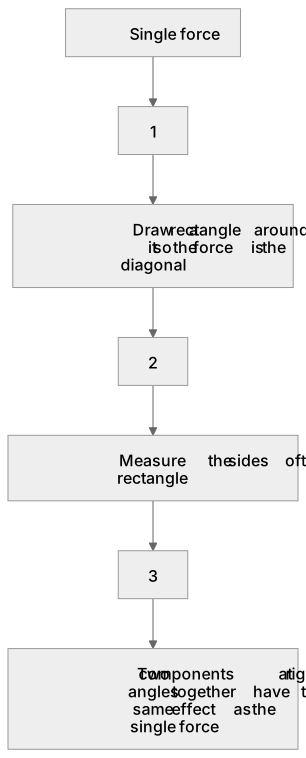
1Box 1
2Box 2
3Box 3
There is more to this lesson
The full lesson goes on to check your understanding and help you earn the marks. Create a free account to carry on, with your progress saved.
A week of Premium from your first lesson · Then the free plan continues · No card, no charge
Test your understanding of Resultant forces: (HT only) A single force can be resolved into two components acting at right angles to each other. The two component forces together have the same effect as the single force.
Active recall beats re-reading. Take an instant quiz now to test what you’ve learned and lock it into long-term memory.
A week of Premium from your first lesson · Then the free plan continues · No card, no charge