AQA · GCSE · Combined Science
Course version: 8464 · Version from Sept 2018
(HT only) Students should be able to use vector diagrams to illustrate…
Full specification wording
Resultant forces: (HT only) Students should be able to use vector diagrams to illustrate resolution of forces, equilibrium situations and determine the resultant of two forces, to include both magnitude and direction (scale drawings only).
Vector diagrams show forces as arrows whose length represents magnitude and whose direction represents the force direction.
Checked against the AQA 8464 specification (opens in a new tab) on .
- Point 6 of 6
Study notes
From the checked teaching notes for this specification point.
The idea
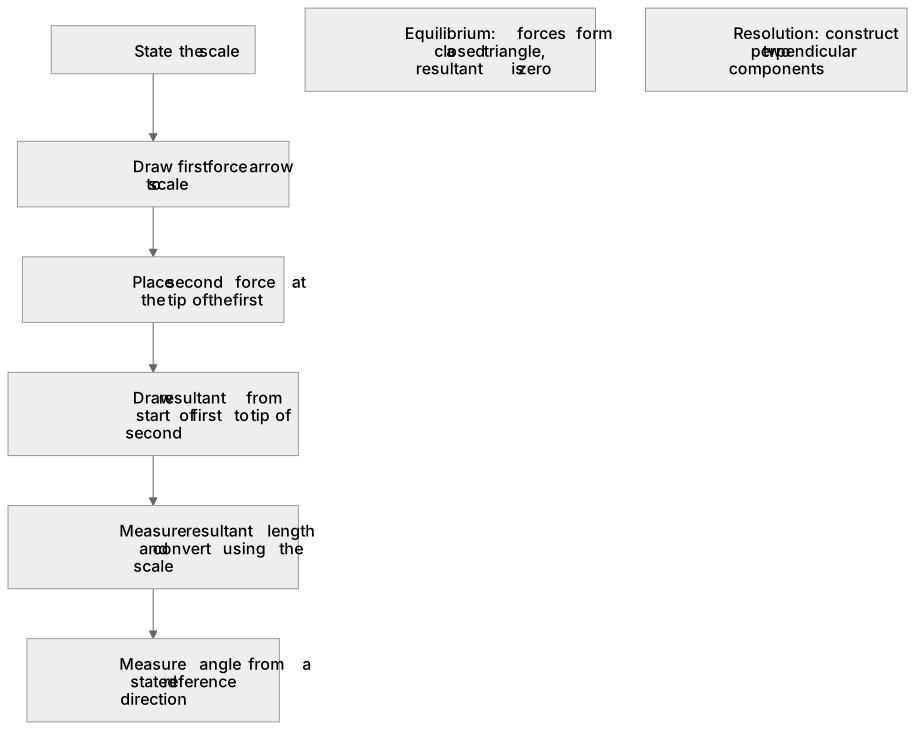
Vector diagrams show forces as arrows whose length represents magnitude and whose direction represents the force direction. Choose a scale such as 1 cm = 10 N. To find the resultant of two forces, draw them tip-to-tail; the resultant is the arrow from the start of the first to the tip of the second. Measure its length and convert using the scale, then measure its angle with a protractor to give direction. For equilibrium, the forces form a closed triangle: the resultant is zero. To illustrate resolution, draw the single force and construct perpendicular components that meet at right angles, then measure or calculate their magnitudes. Always state the scale and measure angles from a stated reference direction.
What earns the marks
- Selects and states a sensible scale that makes the diagram large enough for accurate measurement.
- Draws force arrows with correct length and direction, using a ruler and protractor.
- For two forces, arranges them tip-to-tail and draws the resultant from the start of the first to the tip of the second.
- Measures the resultant length and converts it to newtons using the stated scale.
- Measures the direction of the resultant as an angle from a clearly stated reference direction.
- For equilibrium, shows that the vector triangle closes so the resultant is zero.
- For resolution, constructs two perpendicular components whose combined effect equals the single force.
Common mistakes and how to put them right
Drawing arrows not to scale or not stating the scale.
Put it right by choosing a scale, writing it on the diagram and using a ruler for every arrow.
Joining the two force arrows tail-to-tail and measuring between them, which gives the wrong resultant.
Put it right by placing the second force at the tip of the first.
Forgetting to convert a measured length back to newtons, or measuring the angle from an unstated direction.
Put it right by applying the scale and labelling the reference direction.
Exam tips
- Use a sharp pencil, a ruler and a protractor; freehand sketches are not accurate enough for scale-drawing questions.
- Label each arrow with its force and write the scale prominently so the examiner can follow your method.
- For equilibrium, check that the arrows form a closed triangle; if they do not, the object is not in equilibrium.
- Note that scale vector diagrams and resolution of forces are Higher Tier only topics.
Try the lesson
The start of the Resultant forces: (HT only) Students should be able to use vector diagrams to illustrate resolution of forces, equilibrium situations and determine the resultant of two forces, to include both magnitude and direction (scale drawings only). lesson, made from checked teaching notes for this specification point.
Have a go first
A student is using a scale drawing to determine the resultant of two forces acting on an object. Which method correctly describes how to find the resultant force?
Listen
Vector diagrams show forces as arrows whose length represents magnitude and whose direction represents the force direction. Choose a scale such as 1 cm = 10 N. To find the resultant of two forces, draw them tip-to-tail; the resultant is the arrow from the start of the first to the tip of the second. Measure its length and convert using the scale, then measure its angle with a protractor to give direction. For equilibrium, the forces form a closed triangle: the resultant is zero. To illustrate resolution, draw the single force and construct perpendicular components that meet at right angles, then measure or calculate their magnitudes. Always state the scale and measure angles from a stated reference direction. A strong answer earns marks for these points. Selects and states a sensible scale that makes the diagram large enough for accurate measurement. Draws force arrows with correct length and direction, using a ruler and protractor. For two forces, arranges them tip-to-tail and draws the resultant from the start of the first to the tip of the second. Measures the resultant length and converts it to newtons using the stated scale. A common slip: Drawing arrows not to scale or not stating the scale. Instead, choosing a scale, writing it on the diagram and using a ruler for every arrow. Exam tip: Use a sharp pencil, a ruler and a protractor; freehand sketches are not accurate enough for scale-drawing questions.
See it
Label the diagram
Some boxes have lost their names. Pick the right name for each number.
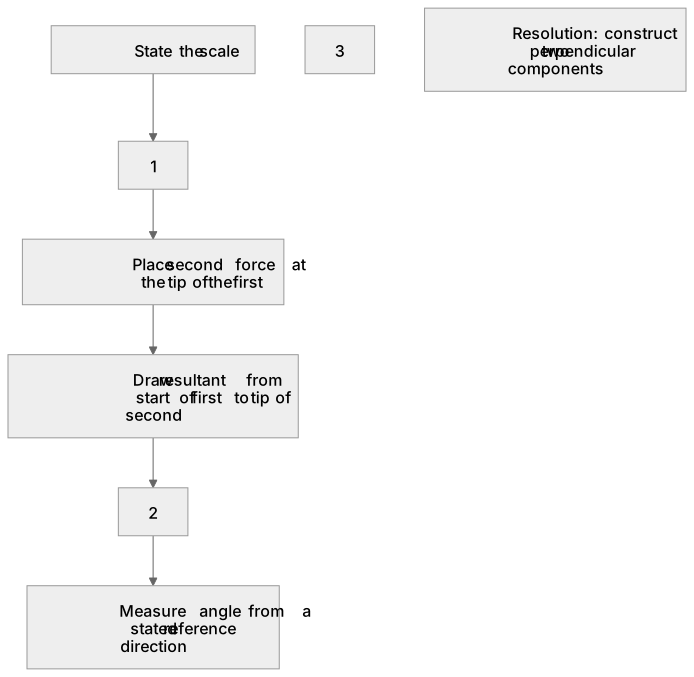
1Box 1
2Box 2
3Box 3
There is more to this lesson
The full lesson goes on to check your understanding and help you earn the marks. Create a free account to carry on, with your progress saved.
A week of Premium from your first lesson · Then the free plan continues · No card, no charge
Test your understanding of Resultant forces: (HT only) Students should be able to use vector diagrams to illustrate resolution of forces, equilibrium situations and determine the resultant of two forces, to include both magnitude and direction (scale drawings only).
Active recall beats re-reading. Take an instant quiz now to test what you’ve learned and lock it into long-term memory.
A week of Premium from your first lesson · Then the free plan continues · No card, no charge