AQA · GCSE · Combined Science
Course version: 8464 · Version from Sept 2018
The speed of a moving object is rarely constant. When people walk, run or…
Full specification wording
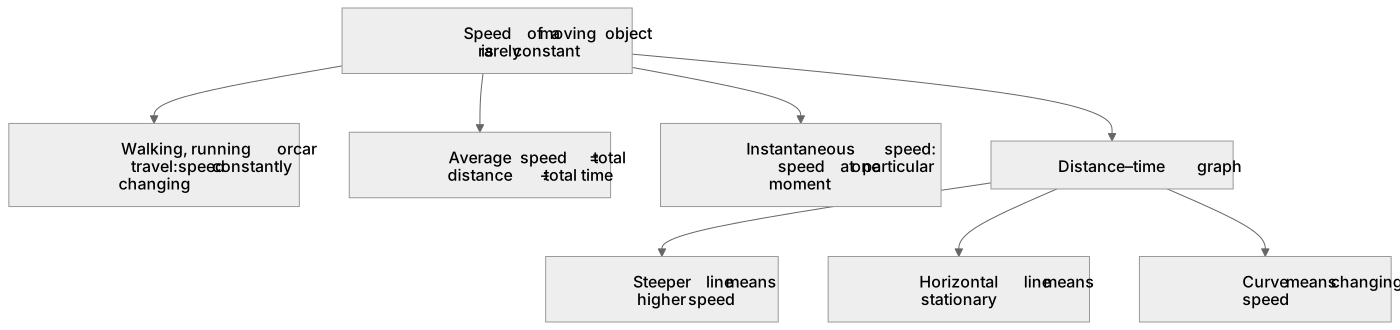
Speed: The speed of a moving object is rarely constant. When people walk, run or travel in a car their speed is constantly changing.
In real journeys, speed changes from moment to moment.
Checked against the AQA 8464 specification (opens in a new tab) on .
- Point 2 of 18
- 3 key terms
Study notes
From the checked teaching notes for this specification point.
The idea
In real journeys, speed changes from moment to moment. A person walking may slow at a crossing, speed up downhill, then stop; a car accelerates away from traffic lights, cruises, brakes and turns. Because speed is rarely constant, a single value usually describes an average over the whole journey rather than the speed at every instant. You calculate average speed using total distance divided by total time, which smooths out the changes. Instantaneous speed is the speed at one particular moment, such as a car speedometer reading. Distance–time graphs show these changes: a steeper line means higher speed, a horizontal line means stationary, and a curve means changing speed. Recognising that speed varies helps you interpret journey data and choose average speed when the motion is not steady.
What earns the marks
- States that the speed of a moving object is rarely constant.
- Gives everyday examples such as walking, running or car travel where speed changes.
- Explains that average speed is calculated from total distance divided by total time.
- Distinguishes average speed from instantaneous speed at a particular moment.
- Interprets a distance–time graph, linking steeper gradient to greater speed and a horizontal line to stationary motion.
Common mistakes and how to put them right
Assuming a journey happens at one constant speed.
Put it right by using total distance and total time to find average speed.
Treating a speedometer reading as the average speed for the whole trip.
Put it right by identifying it as instantaneous speed.
Reading a horizontal line on a distance–time graph as fast motion.
Put it right by stating that a horizontal line means the object is stationary.
Exam tips
- For a journey with changing speed, calculate average speed from total distance divided by total time.
- On a distance–time graph, compare gradients to compare speeds at different stages.
- Use everyday contexts such as walking or driving to explain why speed changes during a journey.
Try the lesson
The start of the Speed: The speed of a moving object is rarely constant. When people walk, run or travel in a car their speed is constantly changing. lesson, made from checked teaching notes for this specification point.
Have a go first
A pupil says that a car travelling along a road keeps the same speed for the whole journey. Which statement best describes the speed of the car during a real journey?
Listen
In real journeys, speed changes from moment to moment. A person walking may slow at a crossing, speed up downhill, then stop; a car accelerates away from traffic lights, cruises, brakes and turns. Because speed is rarely constant, a single value usually describes an average over the whole journey rather than the speed at every instant. You calculate average speed using total distance divided by total time, which smooths out the changes. Instantaneous speed is the speed at one particular moment, such as a car speedometer reading. Distance–time graphs show these changes: a steeper line means higher speed, a horizontal line means stationary, and a curve means changing speed. Recognising that speed varies helps you interpret journey data and choose average speed when the motion is not steady. A strong answer earns marks for these points. States that the speed of a moving object is rarely constant. Gives everyday examples such as walking, running or car travel where speed changes. Explains that average speed is calculated from total distance divided by total time. Distinguishes average speed from instantaneous speed at a particular moment. A common slip: Assuming a journey happens at one constant speed. Instead, using total distance and total time to find average speed. Exam tip: For a journey with changing speed, calculate average speed from total distance divided by total time.
See it
Key words
Say what each word means before you turn the card.
Average speed
Try answering aloud or in your head before turning the card.
Instantaneous speed
Try answering aloud or in your head before turning the card.
Distance–time graph
Try answering aloud or in your head before turning the card.
See every definition
- Average speed
- A single value that describes the whole journey, calculated using total distance divided by total time, which smooths out the changes.
- Instantaneous speed
- The speed at one particular moment, such as a car speedometer reading.
- Distance–time graph
- A graph showing changes in motion, where a steeper line means higher speed, a horizontal line means stationary, and a curve means changing speed.
Label the diagram
Some boxes have lost their names. Pick the right name for each number.
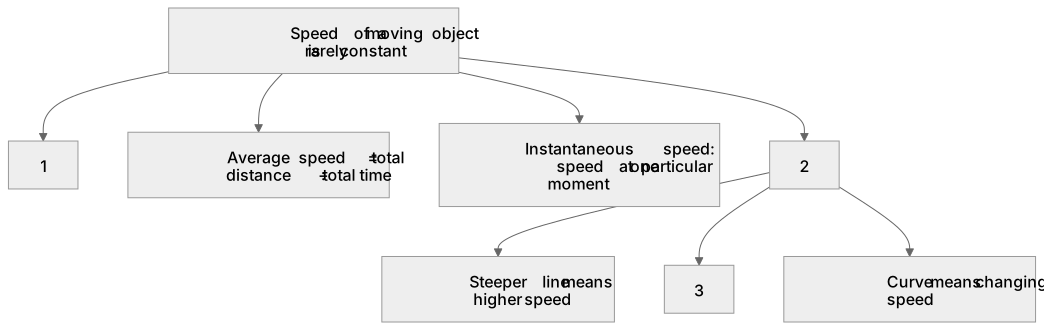
1Box 1
2Box 2
3Box 3
There is more to this lesson
The full lesson goes on to check your understanding and help you earn the marks. Create a free account to carry on, with your progress saved.
A week of Premium from your first lesson · Then the free plan continues · No card, no charge
Test your understanding of Speed: The speed of a moving object is rarely constant. When people walk, run or travel in a car their speed is constantly changing.
Active recall beats re-reading. Take an instant quiz now to test what you’ve learned and lock it into long-term memory.
A week of Premium from your first lesson · Then the free plan continues · No card, no charge