AQA · GCSE · Combined Science
Course version: 8464 · Version from Sept 2018
The speed at which a person can walk, run or cycle depends on many factors…
Full specification wording
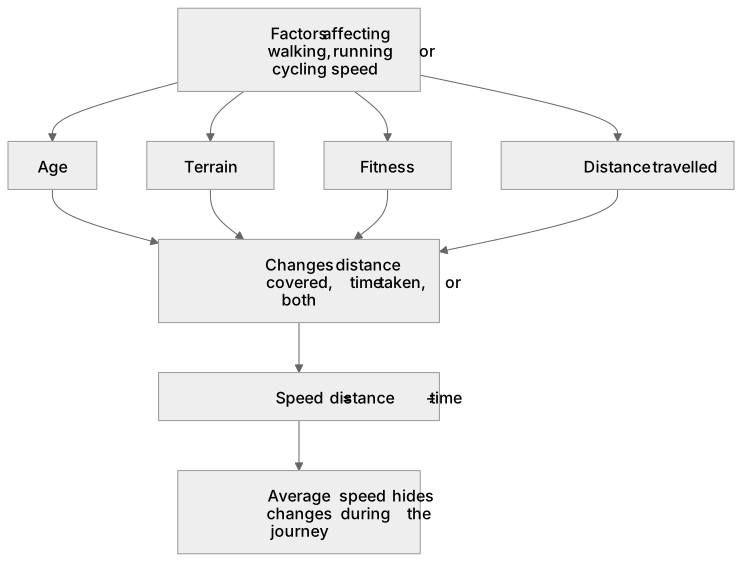
Speed: The speed at which a person can walk, run or cycle depends on many factors including: age, terrain, fitness and distance travelled.
Speed describes how far a person moves in a given time, but it is not a fixed personal constant.
Checked against the AQA 8464 specification (opens in a new tab) on .
- Point 3 of 18
- 4 key terms
Study notes
From the checked teaching notes for this specification point.
The idea
Speed describes how far a person moves in a given time, but it is not a fixed personal constant. A child walking to school may average about 1 m/s, while a fit adult running may exceed 5 m/s; the same person slows on steep, muddy terrain or when carrying a heavy bag. Age affects strength, stamina and reaction time; fitness affects sustainable power output; terrain changes friction and gradient; and distance travelled matters because a short sprint can be faster than a long journey where fatigue builds. To compare journeys fairly, calculate speed using speed = distance ÷ time, keeping units consistent, for example 300 m ÷ 150 s = 2 m/s. Recognise that an average speed hides changes during the journey, so two people with equal averages may have moved very differently.
What earns the marks
- State that speed is calculated from distance travelled divided by time taken, and that the factors listed change either the distance covered, the time taken, or both.
- Explain that age can reduce maximum walking, running or cycling speed because of lower muscle strength, stamina or reaction time.
- Describe how terrain affects speed: uphill or rough ground increases resistance and reduces speed, while smooth, level ground allows faster movement.
- Explain that better fitness allows a person to sustain a higher speed for longer, especially over greater distances.
- Recognise that distance travelled influences average speed because fatigue and the need to pace oneself reduce speed on longer journeys.
- Use a calculation such as 1200 m ÷ 600 s = 2 m/s to show how a stated distance and time give a speed, and compare two sets of data.
- Interpret a distance–time graph by relating a steeper gradient to a higher speed and a shallower gradient to a lower speed.
Common mistakes and how to put them right
Treating speed as a fixed value for a person.
Put it right by stating that speed varies with conditions and by comparing calculated values from different journeys.
Confusing speed with distance or time.
Put it right by writing speed = distance ÷ time and checking that the answer has units of m/s or km/h.
Assuming a longer distance always means a higher speed.
Put it right by explaining that time must also be considered, since a long journey can have a low average speed.
Ignoring unit conversion: correct this by converting km to m or minutes to seconds before dividing, for example 3 km = 3000 m and 5 min = 300 s.
Exam tips
- When asked to compare speeds, calculate both values using speed = distance ÷ time and quote the units with each answer.
- Link each named factor to a clear mechanism, such as terrain increasing friction or fitness increasing sustainable power, rather than listing factors alone.
- If a question gives a graph, read the gradient or use two points to find speed, and state that a steeper line means a faster speed.
- Show substitution clearly, for example speed = 400 m ÷ 80 s = 5 m/s, so the examiner can follow your method.
Try the lesson
The start of the Speed: The speed at which a person can walk, run or cycle depends on many factors including: age, terrain, fitness and distance travelled. lesson, made from checked teaching notes for this specification point.
Have a go first
A group of students are planning a sponsored walk. They want to estimate how long it will take them to complete the route. Which combination of factors will have the greatest effect on their average walking speed?
Listen
Speed describes how far a person moves in a given time, but it is not a fixed personal constant. A child walking to school may average about 1 m/s, while a fit adult running may exceed 5 m/s; the same person slows on steep, muddy terrain or when carrying a heavy bag. Age affects strength, stamina and reaction time; fitness affects sustainable power output; terrain changes friction and gradient; and distance travelled matters because a short sprint can be faster than a long journey where fatigue builds. To compare journeys fairly, calculate speed using speed = distance ÷ time, keeping units consistent, for example 300 m ÷ 150 s = 2 m/s. Recognise that an average speed hides changes during the journey, so two people with equal averages may have moved very differently. A strong answer earns marks for these points. State that speed is calculated from distance travelled divided by time taken, and that the factors listed change either the distance covered, the time taken, or both. Explain that age can reduce maximum walking, running or cycling speed because of lower muscle strength, stamina or reaction time. Describe how terrain affects speed: uphill or rough ground increases resistance and reduces speed, while smooth, level ground allows faster movement. Explain that better fitness allows a person to sustain a higher speed for longer, especially over greater distances. A common slip: Treating speed as a fixed value for a person. Instead, stating that speed varies with conditions and by comparing calculated values from different journeys. Exam tip: When asked to compare speeds, calculate both values using speed = distance ÷ time and quote the units with each answer.
See it
Key words
Say what each word means before you turn the card.
Speed
Try answering aloud or in your head before turning the card.
Age
Try answering aloud or in your head before turning the card.
Terrain
Try answering aloud or in your head before turning the card.
Fitness
Try answering aloud or in your head before turning the card.
See every definition
- Speed
- Calculated from distance travelled divided by time taken, keeping units consistent.
- Age
- Can reduce maximum walking, running or cycling speed because of lower muscle strength, stamina or reaction time.
- Terrain
- Uphill or rough ground increases resistance and reduces speed, while smooth, level ground allows faster movement.
- Fitness
- Allows a person to sustain a higher speed for longer, especially over greater distances.
Label the diagram
Some boxes have lost their names. Pick the right name for each number.
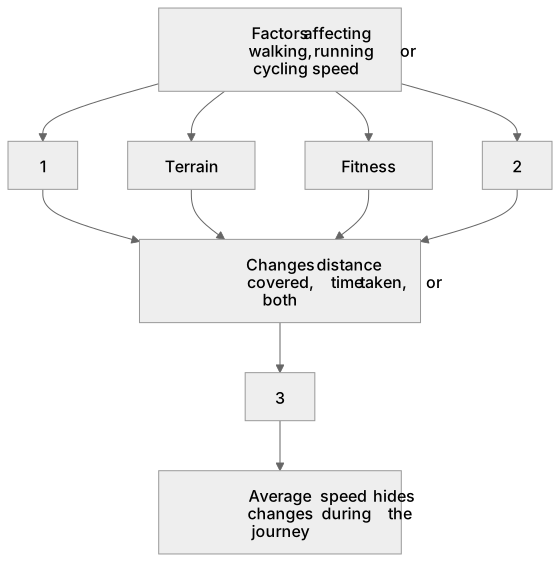
1Box 1
2Box 2
3Box 3
There is more to this lesson
The full lesson goes on to check your understanding and help you earn the marks. Create a free account to carry on, with your progress saved.
A week of Premium from your first lesson · Then the free plan continues · No card, no charge
Test your understanding of Speed: The speed at which a person can walk, run or cycle depends on many factors including: age, terrain, fitness and distance travelled.
Active recall beats re-reading. Take an instant quiz now to test what you’ve learned and lock it into long-term memory.
A week of Premium from your first lesson · Then the free plan continues · No card, no charge