AQA · GCSE · Combined Science
Course version: 8464 · Version from Sept 2018
Speed: Typical values may be taken as:
This statement introduces the typical speed values that support the earlier idea that walking, running and cycling speeds vary.
Checked against the AQA 8464 specification (opens in a new tab) on .
- Point 4 of 18
- 4 key terms
Study notes
From the checked teaching notes for this specification point.
The idea
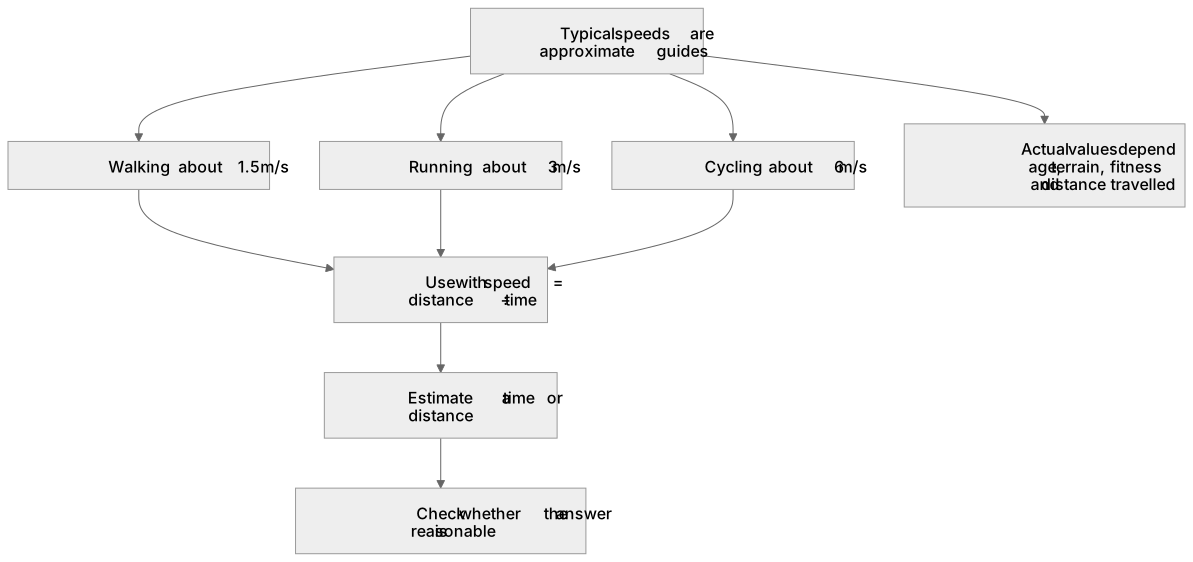
This statement introduces the typical speed values that support the earlier idea that walking, running and cycling speeds vary. In GCSE Combined Science you should recall approximate values and use them to judge whether a calculated answer is reasonable. A person walking typically moves at about 1.5 m/s, running at about 3 m/s, and cycling at about 6 m/s, though these are guides rather than exact constants. For example, a 1500 m walk at 1.5 m/s takes about 1000 s, while the same distance run at 3 m/s takes about 500 s. Use typical values to estimate times, check units and identify unrealistic answers, such as a walking speed of 30 m/s. Always state that actual values depend on age, terrain, fitness and distance travelled.
What earns the marks
- Recall approximate typical speeds: walking about 1.5 m/s, running about 3 m/s, and cycling about 6 m/s.
- Use a typical value with speed = distance ÷ time to estimate a time or distance, for example time = distance ÷ speed.
- Check whether a calculated speed is reasonable by comparing it with the typical range for that activity.
- Convert between m/s and km/h where needed, remembering that 1 m/s = 3.6 km/h.
- Explain that typical values are approximate because age, terrain, fitness and distance travelled change actual speed.
- Select the most appropriate typical value when comparing modes of transport, such as walking versus cycling over the same distance.
Common mistakes and how to put them right
Treating typical values as exact constants.
Put it right by saying they are approximate guides that vary between people and conditions.
Using the wrong unit.
Put it right by giving walking, running and cycling speeds in m/s and converting if a question asks for km/h.
Dividing time by distance instead of distance by time.
Put it right by rearranging speed = distance ÷ time to time = distance ÷ speed.
Accepting an unreasonable answer.
Put it right by comparing the result with typical values, for example rejecting a running speed of 50 m/s.
Exam tips
- Learn the approximate values walking ≈ 1.5 m/s, running ≈ 3 m/s and cycling ≈ 6 m/s, and quote them when estimating.
- Show the rearrangement you use, such as time = distance ÷ speed, before substituting numbers.
- Use typical values to sanity-check answers and comment briefly on whether the result is realistic.
- Keep units consistent throughout a calculation and convert km/h to m/s by dividing by 3.6 when necessary.
Try the lesson
The start of the Speed: Typical values may be taken as: lesson, made from checked teaching notes for this specification point.
Have a go first
A student walks to school at a steady speed. Which typical value is used for the speed of a person walking?
Listen
This statement introduces the typical speed values that support the earlier idea that walking, running and cycling speeds vary. In GCSE Combined Science you should recall approximate values and use them to judge whether a calculated answer is reasonable. A person walking typically moves at about 1.5 m/s, running at about 3 m/s, and cycling at about 6 m/s, though these are guides rather than exact constants. For example, a 1500 m walk at 1.5 m/s takes about 1000 s, while the same distance run at 3 m/s takes about 500 s. Use typical values to estimate times, check units and identify unrealistic answers, such as a walking speed of 30 m/s. Always state that actual values depend on age, terrain, fitness and distance travelled. A strong answer earns marks for these points. Recall approximate typical speeds: walking about 1.5 m/s, running about 3 m/s, and cycling about 6 m/s. Use a typical value with speed = distance ÷ time to estimate a time or distance, for example time = distance ÷ speed. Check whether a calculated speed is reasonable by comparing it with the typical range for that activity. Convert between m/s and km/h where needed, remembering that 1 m/s = 3.6 km/h. A common slip: Treating typical values as exact constants. Instead, saying they are approximate guides that vary between people and conditions. Exam tip: Learn the approximate values walking ≈ 1.5 m/s, running ≈ 3 m/s and cycling ≈ 6 m/s, and quote them when estimating.
See it
Key words
Say what each word means before you turn the card.
Approximate typical speeds
Try answering aloud or in your head before turning the card.
Estimation and reasonableness
Try answering aloud or in your head before turning the card.
Unit conversion
Try answering aloud or in your head before turning the card.
Speed, distance and time relationships
Try answering aloud or in your head before turning the card.
See every definition
- Approximate typical speeds
- Guides rather than exact constants, such as walking about 1.5 m/s, running about 3 m/s and cycling about 6 m/s.
- Estimation and reasonableness
- Using typical values to estimate times or distances and to judge whether a calculated answer is reasonable.
- Unit conversion
- Converting between m/s and km/h where needed, remembering that 1 m/s = 3.6 km/h.
- Speed, distance and time relationships
- Using speed = distance ÷ time, rearranged as time = distance ÷ speed, to estimate a time or distance.
Label the diagram
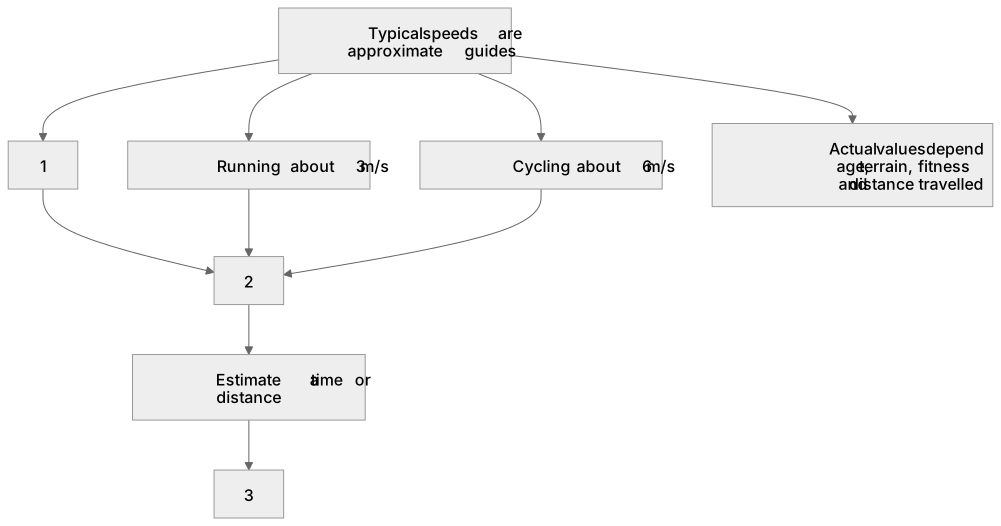
Some boxes have lost their names. Pick the right name for each number.
1Box 1
2Box 2
3Box 3
There is more to this lesson
The full lesson goes on to check your understanding and help you earn the marks. Create a free account to carry on, with your progress saved.
A week of Premium from your first lesson · Then the free plan continues · No card, no charge
Test your understanding of Speed: Typical values may be taken as:
Active recall beats re-reading. Take an instant quiz now to test what you’ve learned and lock it into long-term memory.
A week of Premium from your first lesson · Then the free plan continues · No card, no charge