AQA · GCSE · Combined Science
Course version: 8464 · Version from Sept 2018
The difference between the plum pudding model of the atom and the nuclear…
Full specification wording
The development of the model of the atom (common content with chemistry): the difference between the plum pudding model of the atom and the nuclear model of the atom.
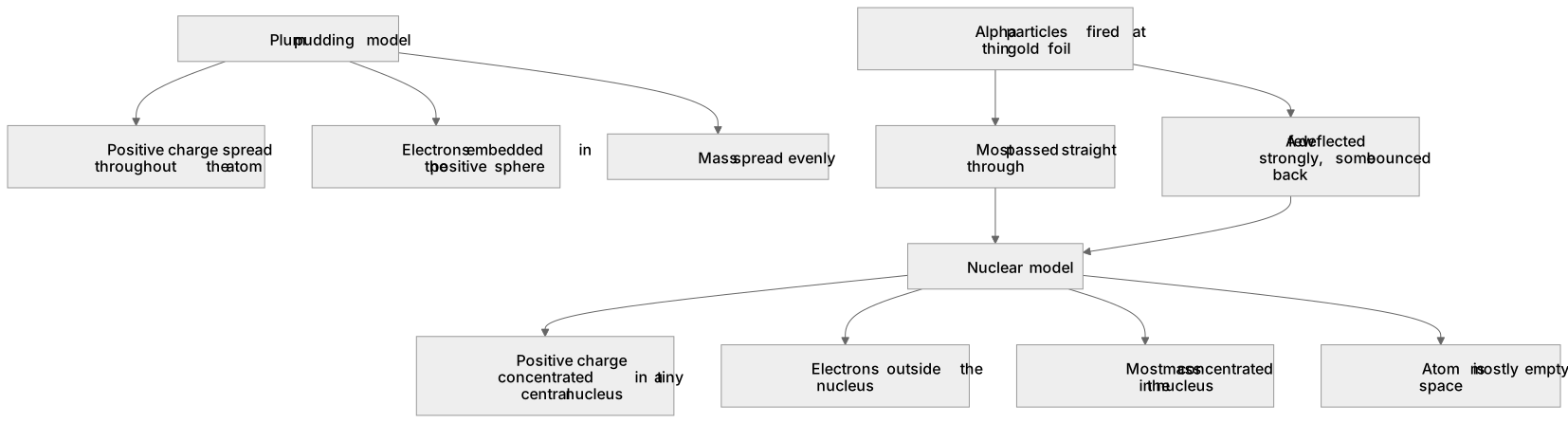
The plum pudding model pictured the atom as a ball of positive charge with negative electrons embedded in it, like fruit in a pudding.
Checked against the AQA 8464 specification (opens in a new tab) on .
- Point 10 of 10
- 4 key terms
Study notes
From the checked teaching notes for this specification point.
The idea
The plum pudding model pictured the atom as a ball of positive charge with negative electrons embedded in it, like fruit in a pudding. The nuclear model replaced this after alpha particles fired at thin gold foil were mostly undeflected, but a few bounced back. That showed the atom is mostly empty space with a tiny, dense, positively charged nucleus, and electrons orbiting it. So the key differences are: charge distribution (spread out versus concentrated in a nucleus), mass distribution (throughout versus concentrated in the nucleus), and structure (embedded electrons versus orbiting electrons). The nuclear model also leaves most of the atom as empty space, which the plum pudding model does not.
What earns the marks
- Plum pudding: positive charge spread throughout the atom, with electrons embedded in it.
- Nuclear: positive charge concentrated in a tiny central nucleus, with electrons outside it.
- Plum pudding: mass spread evenly; nuclear: most mass concentrated in the nucleus.
- Nuclear model implies the atom is mostly empty space, unlike plum pudding.
- Rutherford's alpha-particle scattering evidence: most alpha particles passed straight through, few deflected strongly.
- Strong backward deflection indicates a dense, positive centre, not a spread-out charge.
Common mistakes and how to put them right
Saying the plum pudding model has a nucleus.
Put it right by stating the positive charge is spread throughout, with no nucleus.
Saying electrons orbit in the plum pudding model.
Put it right by stating electrons are embedded in the positive sphere.
Confusing the nuclear model with the Bohr model.
Put it right by noting the nuclear model has a nucleus and orbiting electrons, while Bohr added fixed energy shells.
Exam tips
- Use a labelled diagram for each model to make the charge and mass distribution clear.
- Link each feature of the nuclear model to the alpha-particle scattering observation that supports it.
- Use comparative language such as 'whereas' and 'in contrast' to make differences explicit.
Try the lesson
The start of the The development of the model of the atom (common content with chemistry): the difference between the plum pudding model of the atom and the nuclear model of the atom. lesson, made from checked teaching notes for this specification point.
Have a go first
Which statement describes the plum pudding model of the atom?
Listen
The plum pudding model pictured the atom as a ball of positive charge with negative electrons embedded in it, like fruit in a pudding. The nuclear model replaced this after alpha particles fired at thin gold foil were mostly undeflected, but a few bounced back. That showed the atom is mostly empty space with a tiny, dense, positively charged nucleus, and electrons orbiting it. So the key differences are: charge distribution (spread out versus concentrated in a nucleus), mass distribution (throughout versus concentrated in the nucleus), and structure (embedded electrons versus orbiting electrons). The nuclear model also leaves most of the atom as empty space, which the plum pudding model does not. A strong answer earns marks for these points. Plum pudding: positive charge spread throughout the atom, with electrons embedded in it. Nuclear: positive charge concentrated in a tiny central nucleus, with electrons outside it. Plum pudding: mass spread evenly; nuclear: most mass concentrated in the nucleus. Nuclear model implies the atom is mostly empty space, unlike plum pudding. A common slip: Saying the plum pudding model has a nucleus. Instead, stating the positive charge is spread throughout, with no nucleus. Exam tip: Use a labelled diagram for each model to make the charge and mass distribution clear.
See it
Key words
Say what each word means before you turn the card.
Plum pudding model
Try answering aloud or in your head before turning the card.
Nuclear model
Try answering aloud or in your head before turning the card.
Charge and mass distribution
Try answering aloud or in your head before turning the card.
Empty space
Try answering aloud or in your head before turning the card.
See every definition
- Plum pudding model
- A model picturing the atom as a ball of positive charge with negative electrons embedded in it, like fruit in a pudding.
- Nuclear model
- A model in which positive charge and most mass are concentrated in a tiny central nucleus, with electrons outside it.
- Charge and mass distribution
- How charge and mass are arranged in the atom: spread throughout in the plum pudding model, concentrated in the nucleus in the nuclear model.
- Empty space
- The nuclear model implies the atom is mostly empty space, unlike the plum pudding model.
Label the diagram
Some boxes have lost their names. Pick the right name for each number.
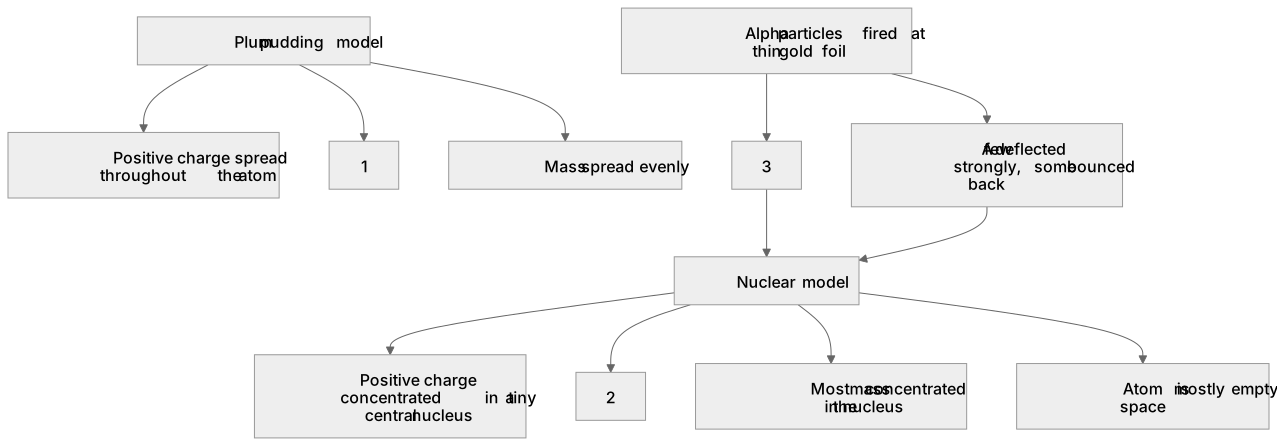
1Box 1
2Box 2
3Box 3
There is more to this lesson
The full lesson goes on to check your understanding and help you earn the marks. Create a free account to carry on, with your progress saved.
A week of Premium from your first lesson · Then the free plan continues · No card, no charge
Test your understanding of The development of the model of the atom (common content with chemistry): the difference between the plum pudding model of the atom and the nuclear model of the atom.
Active recall beats re-reading. Take an instant quiz now to test what you’ve learned and lock it into long-term memory.
A week of Premium from your first lesson · Then the free plan continues · No card, no charge