AQA · GCSE · Combined Science
Course version: 8464 · Version from Sept 2018
The experimental work of James Chadwick provided the evidence to show the…
Full specification wording
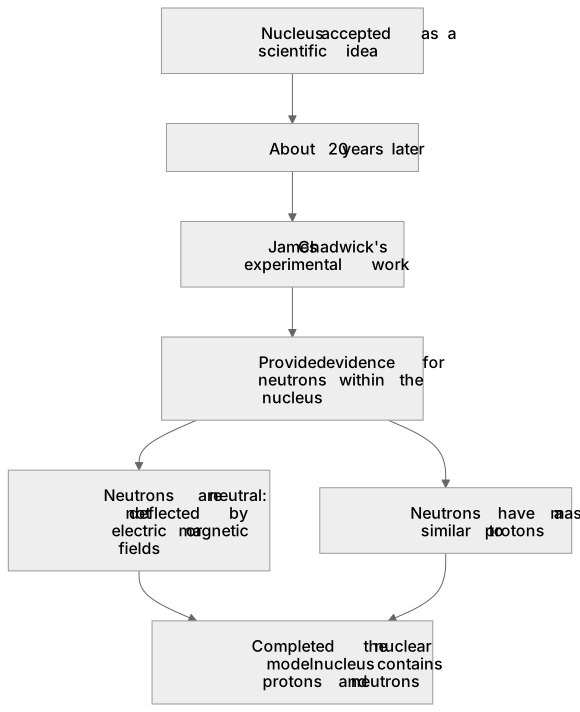
The development of the model of the atom (common content with chemistry): The experimental work of James Chadwick provided the evidence to show the existence of neutrons within the nucleus. This was about 20 years after the nucleus became an accepted scientific idea.
This statement explains how the neutron was discovered.
Checked against the AQA 8464 specification (opens in a new tab) on .
- Point 7 of 10
Study notes
From the checked teaching notes for this specification point.
The idea
This statement explains how the neutron was discovered. After the nucleus was accepted, scientists knew about protons but could not account for all the mass of atoms. James Chadwick carried out experiments in which he bombarded beryllium with alpha particles and detected a new type of radiation. This radiation was not deflected by electric or magnetic fields, so it was neutral, and it could knock protons out of paraffin wax. Chadwick interpreted this as evidence for a neutral particle in the nucleus, which he called the neutron. This happened about 20 years after the nucleus became an accepted scientific idea. The neutron has nearly the same mass as a proton but no charge. This discovery completed the modern picture of the nucleus as containing protons and neutrons.
What earns the marks
- James Chadwick's experimental work provided the evidence for neutrons within the nucleus.
- The evidence came from experiments about 20 years after the nucleus became an accepted scientific idea.
- Neutrons are neutral particles, so they are not deflected by electric or magnetic fields.
- Neutrons have a mass similar to protons, which helps account for the mass of the nucleus.
- The discovery of the neutron completed the nuclear model by showing the nucleus contains both protons and neutrons.
- Chadwick's evidence was needed because protons alone could not explain the mass of many nuclei.
Common mistakes and how to put them right
Thinking Chadwick discovered the electron.
Put it right by stating that Chadwick discovered the neutron, while the electron was discovered earlier by J. J. Thomson.
Saying neutrons are positive or negative.
Put it right by stating that neutrons are neutral, with no charge.
Placing neutrons outside the nucleus.
Put it right by stating that neutrons are found inside the nucleus with protons.
Exam tips
- Include the approximate timing: state that the neutron was discovered about 20 years after the nucleus became an accepted idea.
- Link the evidence to the property: say that the radiation was not deflected by electric or magnetic fields, so the particle must be neutral.
- Use the mass clue: explain that neutrons have a mass similar to protons, which helps explain nuclear mass.
Try the lesson
The start of the The development of the model of the atom (common content with chemistry): The experimental work of James Chadwick provided the evidence to show the existence of neutrons within the nucleus. This was about 20 years after the nucleus became an accepted scientific idea. lesson, made from checked teaching notes for this specification point.
Have a go first
In the history of atomic structure, what specific contribution was made by the experimental work of James Chadwick?
Listen
This statement explains how the neutron was discovered. After the nucleus was accepted, scientists knew about protons but could not account for all the mass of atoms. James Chadwick carried out experiments in which he bombarded beryllium with alpha particles and detected a new type of radiation. This radiation was not deflected by electric or magnetic fields, so it was neutral, and it could knock protons out of paraffin wax. Chadwick interpreted this as evidence for a neutral particle in the nucleus, which he called the neutron. This happened about 20 years after the nucleus became an accepted scientific idea. The neutron has nearly the same mass as a proton but no charge. This discovery completed the modern picture of the nucleus as containing protons and neutrons. A strong answer earns marks for these points. James Chadwick's experimental work provided the evidence for neutrons within the nucleus. The evidence came from experiments about 20 years after the nucleus became an accepted scientific idea. Neutrons are neutral particles, so they are not deflected by electric or magnetic fields. Neutrons have a mass similar to protons, which helps account for the mass of the nucleus. A common slip: Thinking Chadwick discovered the electron. Instead, stating that Chadwick discovered the neutron, while the electron was discovered earlier by J. J. Thomson. Exam tip: Include the approximate timing: state that the neutron was discovered about 20 years after the nucleus became an accepted idea.
See it
Label the diagram
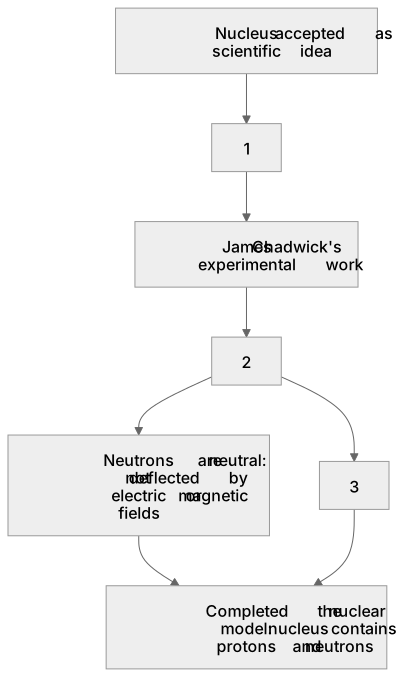
Some boxes have lost their names. Pick the right name for each number.
1Box 1
2Box 2
3Box 3
There is more to this lesson
The full lesson goes on to check your understanding and help you earn the marks. Create a free account to carry on, with your progress saved.
A week of Premium from your first lesson · Then the free plan continues · No card, no charge
Test your understanding of The development of the model of the atom (common content with chemistry): The experimental work of James Chadwick provided the evidence to show the existence of neutrons within the nucleus. This was about 20 years after the nucleus became an accepted scientific idea.
Active recall beats re-reading. Take an instant quiz now to test what you’ve learned and lock it into long-term memory.
A week of Premium from your first lesson · Then the free plan continues · No card, no charge