AQA · GCSE · Combined Science
Course version: 8464 · Version from Sept 2018
Students should be able to describe:
Full specification wording
The development of the model of the atom (common content with chemistry): Students should be able to describe:
This statement introduces the requirement to describe how ideas about the atom have changed over time.
Checked against the AQA 8464 specification (opens in a new tab) on .
- Point 8 of 10
Study notes
From the checked teaching notes for this specification point.
The idea
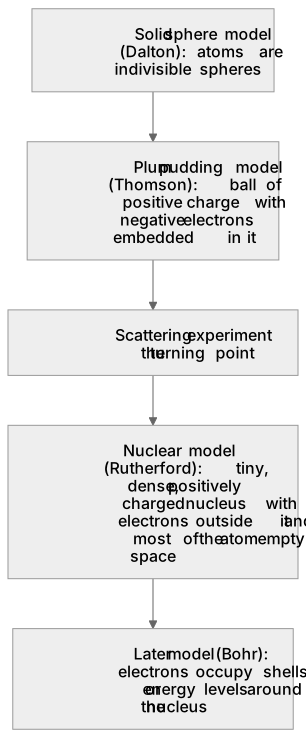
This statement introduces the requirement to describe how ideas about the atom have changed over time. You need to be able to give a clear, ordered account of the main models: the solid sphere model of Dalton, the plum pudding model of Thomson, the nuclear model of Rutherford, and the later refinement by Bohr in which electrons occupy shells or energy levels. Describing means setting out the key features of each model and how they differ, for example moving from a positive sphere with electrons embedded in it to a tiny positive nucleus surrounded by mostly empty space. A good answer names the model, states its main feature and explains what changed and why, using the scattering experiment as the turning point.
What earns the marks
- Names the early solid sphere model associated with Dalton, in which atoms are indivisible spheres.
- Describes the plum pudding model as a ball of positive charge with negative electrons embedded in it.
- Describes the nuclear model as a tiny, dense, positively charged nucleus with electrons outside it and most of the atom empty space.
- Describes the later model in which electrons occupy shells or energy levels around the nucleus.
- Links each change in the model to new experimental evidence rather than presenting the models as arbitrary.
- Uses correct terms such as nucleus, electron, positive charge and empty space accurately.
Common mistakes and how to put them right
Saying the nucleus contains electrons.
Put it right by stating the nucleus contains protons and neutrons, while electrons are outside the nucleus.
Describing the plum pudding model as a nucleus with electrons orbiting it.
Put it right by saying the positive charge is spread throughout the sphere with electrons embedded in it.
Presenting the models as a simple list with no explanation of change.
Put it right by stating what evidence caused each model to be replaced.
Exam tips
- Use a timeline structure: earliest model first, then each replacement in turn.
- For each model, give one sentence on its main feature and one sentence on the evidence that changed it.
- Learn the names Dalton, Thomson, Rutherford and Bohr alongside the model each is linked with.
Try the lesson
The start of the The development of the model of the atom (common content with chemistry): Students should be able to describe: lesson, made from checked teaching notes for this specification point.
Have a go first
In the plum pudding model, the atom was pictured as a ball of positive charge with which particles scattered through it?
Listen
This statement introduces the requirement to describe how ideas about the atom have changed over time. You need to be able to give a clear, ordered account of the main models: the solid sphere model of Dalton, the plum pudding model of Thomson, the nuclear model of Rutherford, and the later refinement by Bohr in which electrons occupy shells or energy levels. Describing means setting out the key features of each model and how they differ, for example moving from a positive sphere with electrons embedded in it to a tiny positive nucleus surrounded by mostly empty space. A good answer names the model, states its main feature and explains what changed and why, using the scattering experiment as the turning point. A strong answer earns marks for these points. Names the early solid sphere model associated with Dalton, in which atoms are indivisible spheres. Describes the plum pudding model as a ball of positive charge with negative electrons embedded in it. Describes the nuclear model as a tiny, dense, positively charged nucleus with electrons outside it and most of the atom empty space. Describes the later model in which electrons occupy shells or energy levels around the nucleus. A common slip: Saying the nucleus contains electrons. Instead, stating the nucleus contains protons and neutrons, while electrons are outside the nucleus. Exam tip: Use a timeline structure: earliest model first, then each replacement in turn.
See it
Put it in order
Put these steps in the order they happen.
- 1. Plum pudding model (Thomson): ball of positive charge with negative electrons embedded in it
- 2. Scattering experiment as the turning point
- 3. Solid sphere model (Dalton): atoms are indivisible spheres
- 4. Later model (Bohr): electrons occupy shells or energy levels around the nucleus
- 5. Nuclear model (Rutherford): tiny, dense, positively charged nucleus with electrons outside it and most of the atom empty space
Label the diagram
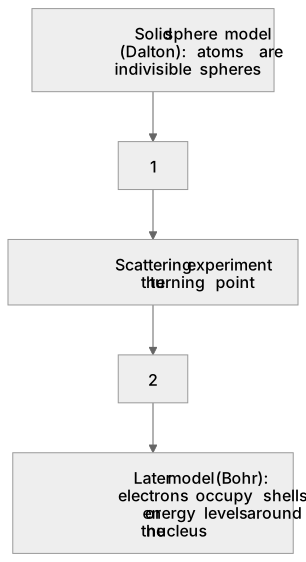
Some boxes have lost their names. Pick the right name for each number.
1Box 1
2Box 2
There is more to this lesson
The full lesson goes on to check your understanding and help you earn the marks. Create a free account to carry on, with your progress saved.
A week of Premium from your first lesson · Then the free plan continues · No card, no charge
Test your understanding of The development of the model of the atom (common content with chemistry): Students should be able to describe:
Active recall beats re-reading. Take an instant quiz now to test what you’ve learned and lock it into long-term memory.
A week of Premium from your first lesson · Then the free plan continues · No card, no charge