AQA · GCSE · Combined Science
Course version: 8464 · Version from Sept 2018
Radio waves – television and radio
Full specification wording
Uses and applications of electromagnetic waves: radio waves – television and radio
Radio waves are electromagnetic waves with the longest wavelengths and lowest frequencies in the spectrum.
Checked against the AQA 8464 specification (opens in a new tab) on .
- Point 2 of 8
- 4 key terms
Study notes
From the checked teaching notes for this specification point.
The idea
Radio waves are electromagnetic waves with the longest wavelengths and lowest frequencies in the spectrum. They travel at the speed of light in a vacuum. They are used for television and radio broadcasting. In television and radio, an alternating current in a transmitting aerial generates radio waves. These waves travel to a receiver, where they induce an alternating current of the same frequency, which is then decoded into sound and pictures. Longer radio wavelengths can diffract (bend) around obstacles like hills, while shorter ones require a direct line of sight.
What earns the marks
- Radio waves are transverse electromagnetic waves with the longest wavelength and lowest frequency in the electromagnetic spectrum.
- (HT only) They can travel long distances through the atmosphere without being absorbed, making them suitable for broadcasting.
- (HT only) Radio waves are produced by oscillations in electrical circuits, such as an alternating current in a transmitting aerial.
- (HT only) When absorbed by a receiver aerial, they create an alternating current with the same frequency as the radio wave itself.
- (HT only) Longer radio wavelengths can diffract around obstacles such as hills, allowing reception without direct line of sight.
Common mistakes and how to put them right
Thinking radio waves are sound waves.
Put it right by stating that radio waves are electromagnetic and do not need a medium, whereas sound waves are mechanical.
Believing radio waves cannot travel through a vacuum.
Put it right by noting that all electromagnetic waves travel through a vacuum at 3 × 10⁸ m/s.
(HT only) Stating that radio waves carry sound directly.
Put it right by explaining they induce an alternating current in the receiver which is then converted to sound.
Exam tips
- State clearly that radio waves are used for television and radio.
- (HT only) Link the use of radio waves to a specific property, such as long wavelength or ability to travel through the atmosphere without absorption.
- (HT only) Describe how radio waves are produced by and induce alternating currents in aerials.
Try the lesson
The start of the Uses and applications of electromagnetic waves: radio waves – television and radio lesson, made from checked teaching notes for this specification point.
Have a go first
Which type of electromagnetic wave is used to carry television and radio signals?
Listen
Radio waves are electromagnetic waves with the longest wavelengths and lowest frequencies in the spectrum. They travel at the speed of light in a vacuum. They are used for television and radio broadcasting. In television and radio, an alternating current in a transmitting aerial generates radio waves. These waves travel to a receiver, where they induce an alternating current of the same frequency, which is then decoded into sound and pictures. Longer radio wavelengths can diffract (bend) around obstacles like hills, while shorter ones require a direct line of sight. A strong answer earns marks for these points. Radio waves are transverse electromagnetic waves with the longest wavelength and lowest frequency in the electromagnetic spectrum. HT only) They can travel long distances through the atmosphere without being absorbed, making them suitable for broadcasting. HT only) Radio waves are produced by oscillations in electrical circuits, such as an alternating current in a transmitting aerial. HT only) When absorbed by a receiver aerial, they create an alternating current with the same frequency as the radio wave itself. A common slip: Thinking radio waves are sound waves. Instead, stating that radio waves are electromagnetic and do not need a medium, whereas sound waves are mechanical. Exam tip: State clearly that radio waves are used for television and radio.
See it
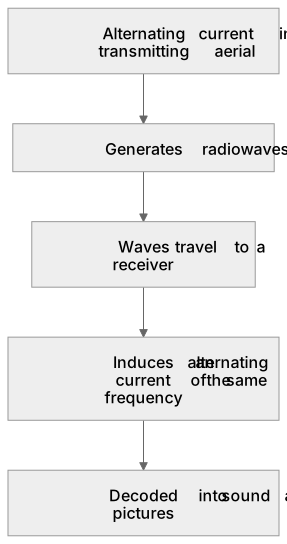
Put it in order
Put these steps in the order they happen.
- 1. Generates radio waves
- 2. Waves travel to a receiver
- 3. Alternating current in transmitting aerial
- 4. Decoded into sound and pictures
- 5. Induces an alternating current of the same frequency
Key words
Say what each word means before you turn the card.
Radio waves
Try answering aloud or in your head before turning the card.
Diffract
Try answering aloud or in your head before turning the card.
Transmitting aerial
Try answering aloud or in your head before turning the card.
Receiver aerial
Try answering aloud or in your head before turning the card.
See every definition
- Radio waves
- Transverse electromagnetic waves with the longest wavelength and lowest frequency in the electromagnetic spectrum, used for television and radio communications.
- Diffract
- Bend around obstacles such as hills, which longer radio wavelengths can do, allowing reception without direct line of sight.
- Transmitting aerial
- Where an alternating current generates radio waves, which then travel to a receiver.
- Receiver aerial
- When radio waves are absorbed by it, they create an alternating current with the same frequency as the radio wave itself.
Label the diagram
Some boxes have lost their names. Pick the right name for each number.
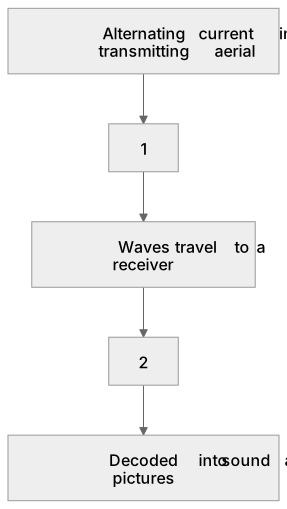
1Box 1
2Box 2
There is more to this lesson
The full lesson goes on to check your understanding and help you earn the marks. Create a free account to carry on, with your progress saved.
A week of Premium from your first lesson · Then the free plan continues · No card, no charge
Test your understanding of Uses and applications of electromagnetic waves: radio waves – television and radio
Active recall beats re-reading. Take an instant quiz now to test what you’ve learned and lock it into long-term memory.
A week of Premium from your first lesson · Then the free plan continues · No card, no charge